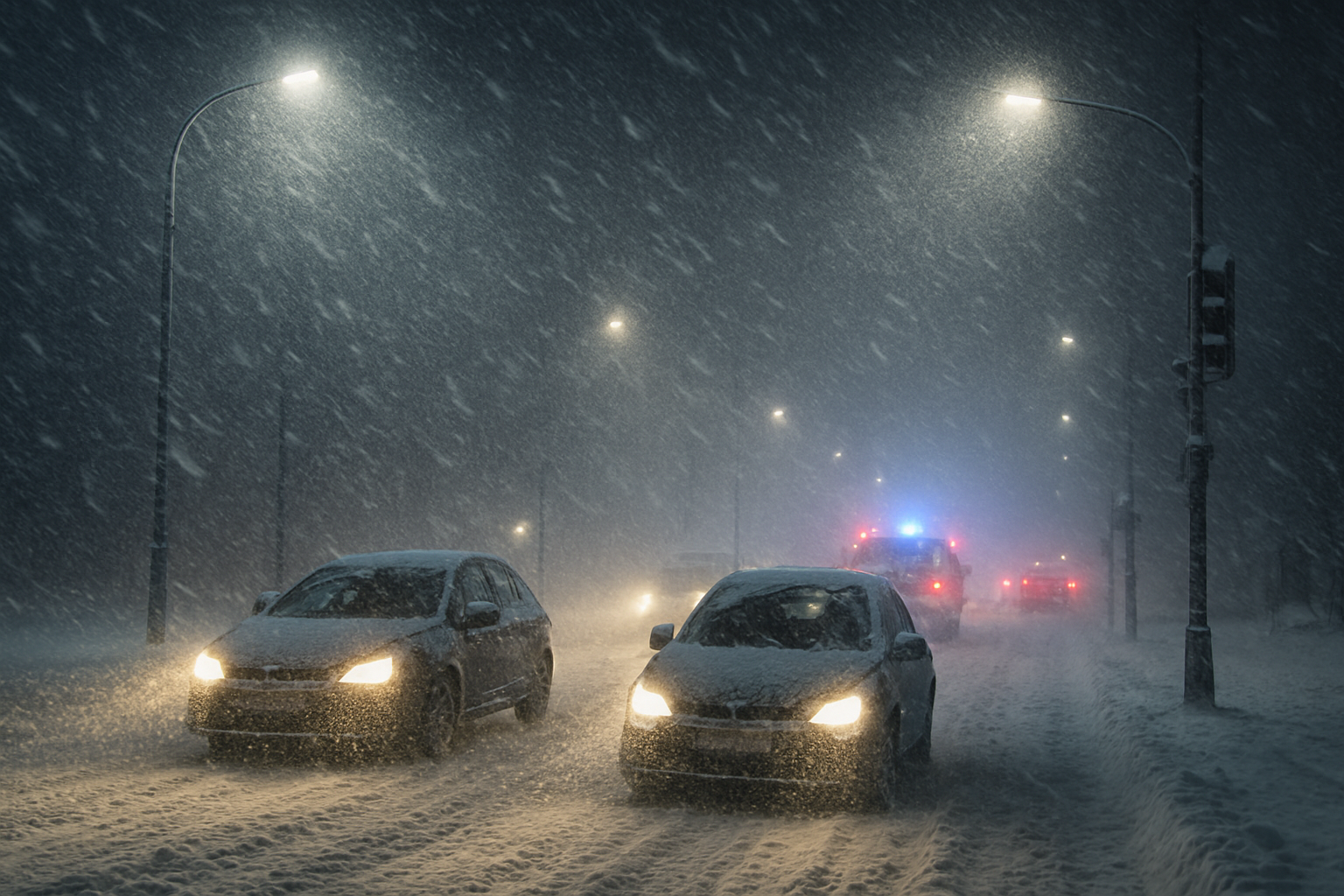
Storm Pedro has emerged as the latest in an unprecedented series of severe weather systems battering Europe, with French authorities placing 15 departments under orange flood alerts while winter conditions continue to disrupt transportation networks from the Netherlands to Romania, marking February 2026 as one of the most challenging months in recent European climate history.
The storm system, impacting western France's coastal regions, represents the continuation of what meteorologists are describing as an extraordinary succession of Atlantic weather systems that have overwhelmed European emergency services throughout February. French weather service Météo-France issued urgent warnings for 15 departments along the western façade, with authorities preparing for "important and major overflows within 24 hours" according to their latest bulletin.
Transportation Networks Under Siege
Aviation disruptions have reached critical levels across the continent, with Amsterdam's Schiphol Airport canceling 132 flights due to severe winter weather conditions. The Dutch meteorological service KNMI has issued code yellow warnings for icy roads, bike paths, and sidewalks across large portions of the Netherlands, as snowfall in the center and east of the country creates hazardous travel conditions.
The transportation crisis extends far beyond the Netherlands, with Latvia experiencing what meteorologists describe as challenging winter conditions throughout the country. Latvian State Roads (LVC) reported that snow and ice across Latvia on Thursday morning created poor driving conditions, warning motorists of dangerous road surfaces and reduced visibility.
In Iceland, the situation has become particularly severe, with the Icelandic Road and Coastal Administration (Vegagerðin) assessing extremely difficult conditions across multiple routes. Northern Iceland faces very difficult conditions on Þverárfjall (route 73) and Siglufjarðarvegur (76), while the northeast sees challenging conditions on Kelduhverfi (85) and Hófaskarð (85). Most critically, several routes in eastern Iceland have become completely impassable, with Öxi (939) and Breiðdalsheiði (95) closed to all traffic.
Regional Impact Assessment
The crisis affecting Portugal has reached unprecedented levels, with six coastal districts - Porto, Viana do Castelo, Leiria, Aveiro, Coimbra, and Braga - under yellow maritime alerts due to dangerous wave conditions. Forecasters predict waves reaching up to five meters in height, posing significant risks to coastal infrastructure and maritime operations.
Romania, meanwhile, is emerging from what climatologists are calling the most severe winter episode of the year. After experiencing the heaviest snowfall and blizzard conditions in recent memory, the country now faces dramatic temperature fluctuations that could create additional hazards. Western regions that will see temperatures reach 14 degrees Celsius today are expected to plummet by 10 degrees within 48 hours, with freezing conditions expected by Saturday night.
"Winter is not over yet, and March is a capricious month," warned Roxana Bojariu, head of the Climatology Department at Romania's National Meteorological Administration.
— Roxana Bojariu, ANM Climatology Department Head
Historical Context of Crisis
The current weather emergency represents a continuation of the devastating storm succession that has plagued Europe throughout February 2026. Previous storms including Kristin, Leonardo, Marta, and Nils claimed over 30 lives across Portugal, Spain, and France, requiring the deployment of 26,500 emergency personnel in Portugal's largest peacetime rescue operation.
This crisis occurs against the backdrop of January 2026 being confirmed as the hottest month in recorded history - the 18th consecutive month to exceed 1.5°C above pre-industrial levels. This unprecedented warming trend demonstrates the complex climate volatility that enables both record global temperatures and severe regional winter extremes simultaneously.
Emergency services across the continent continue to operate at capacity limits, with traditional regional aid mechanisms severely strained by the simultaneous nature of multiple national disasters. The European Union's Civil Protection Mechanism has been activated multiple times, with Sweden and Denmark providing a €246 million assistance package - the largest coordinated European weather response in recent history.
Infrastructure Vulnerabilities Exposed
The ongoing crisis has highlighted critical vulnerabilities in European infrastructure systems designed for historical rather than current climate conditions. Transportation networks, power grids, and communication systems are operating beyond their design parameters, raising urgent questions about the need for comprehensive climate adaptation strategies.
Aviation infrastructure has proven particularly vulnerable, with major airports across Northern and Central Europe facing repeated closures and delays. The economic implications extend far beyond immediate travel disruptions, affecting supply chains, tourism, and business operations during what should be a crucial winter period.
Emergency response coordination has been complicated by the scale and simultaneous nature of the disasters. Traditional mutual aid mechanisms, designed for helping neighboring countries with localized emergencies, have been overwhelmed when multiple nations require assistance simultaneously.
Economic and Social Impact
The cumulative economic impact of February 2026's weather succession is estimated in the billions of euros across agricultural, tourism, and infrastructure sectors. Recovery timelines extend from months to years for the most severely affected regions, with some areas requiring complete reconstruction of critical infrastructure.
The human cost extends beyond immediate casualties to include families losing generational homes, small businesses facing extinction, and vulnerable populations requiring extended emergency support. Mental health services report increased demand as communities grapple with repeated extreme weather events.
Agricultural sectors across the continent face unprecedented challenges, with crop losses and infrastructure damage affecting food security and rural livelihoods. The tourism industry, already struggling with repeated cancellations and safety concerns, faces long-term reputation damage in affected regions.
Looking Forward: Adaptation and Resilience
Climate scientists warn that the current conditions may represent a preview of routine weather patterns expected in the 2030s without significant climate adaptation investments. The choice between reactive crisis management and transformative infrastructure adaptation has become increasingly urgent as extreme weather frequency and intensity continue to increase.
European leaders face mounting pressure to develop comprehensive "build back better" approaches that create climate-resilient infrastructure designed for future rather than historical climate conditions. Enhanced international cooperation, improved early warning systems, and expanded emergency response capabilities are being identified as critical components of continental adaptation strategies.
The crisis has also demonstrated the climate-democracy intersection, as extreme weather events increasingly disrupt governance systems, electoral processes, and daily democratic functions. Portugal's successful conduct of presidential elections despite severe weather conditions has been cited as a template for maintaining democratic continuity under environmental stress.
Immediate Outlook and Preparedness
Weather monitoring agencies continue to track additional Atlantic weather systems developing, suggesting that the crisis may persist for several more weeks. The frequency and intensity of these systems represent what meteorologists are calling a "new normal" that will require fundamental changes to emergency preparedness and response strategies.
Transportation authorities across the continent continue to prioritize safety over service continuity, advising citizens to avoid unnecessary travel, monitor weather warnings closely, and maintain emergency supplies. Emergency services remain on high alert, with resources pre-positioned in areas forecast to experience severe conditions.
The ongoing crisis serves as a watershed moment for European climate preparedness, forcing a fundamental reconsideration of how the continent approaches infrastructure design, emergency response, and international cooperation in an era of permanent climate volatility.