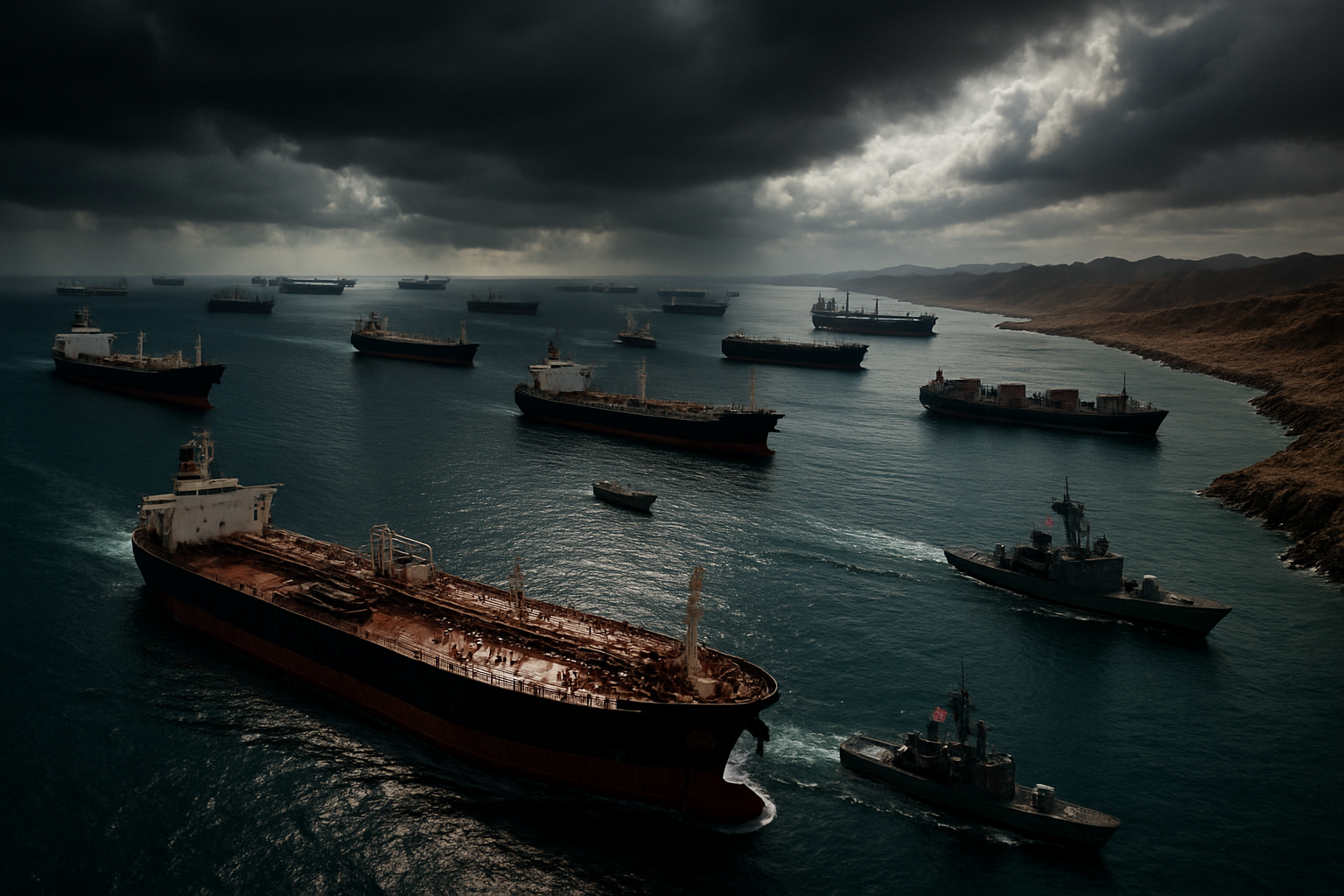
Iran's Revolutionary Guards maintain their closure of the Strait of Hormuz amid ongoing nuclear negotiations with the United States, with both sides reporting progress but acknowledging significant gaps remain in reaching a comprehensive agreement.
The strategic waterway, which handles approximately 40% of global seaborne oil transit, remains effectively blocked as Iran's military forces have deployed thousands of naval mines throughout the 21-mile corridor. Iranian state media broadcast warnings that any vessels approaching the strait would be viewed as cooperating with the "enemy," while US President Donald Trump has called for crisis meetings as oil prices continue to surge.
Iranian Parliamentary Speaker Mohammad Bagher Ghalibaf acknowledged that negotiations with the United States have shown progress but emphasized that the two sides remain "far from final discussions" and face "many discrepancies" on fundamental issues.
Nuclear Negotiations Show Mixed Signals
Despite the military tensions, Iran's chief nuclear negotiator has indicated willingness to engage in talks, with reports suggesting possible discussions in Islamabad, Pakistan, before the end of the week. Pakistan has positioned itself as a key mediator, with Prime Minister Shehbaz Sharif and military leadership maintaining round-the-clock contact with both Iranian and US officials.
The fundamental sticking point remains the scope of any potential agreement. Iran continues to maintain that ballistic missiles and regional proxy activities are "red lines" that cannot be included in nuclear-focused discussions. The United States, led by Secretary of State Marco Rubio, insists on a comprehensive agreement that addresses not only nuclear issues but also Iran's missile program, support for armed groups, and human rights concerns.
Iran currently maintains uranium enrichment at 60% purity, significantly above the 3.67% limit established in the 2015 Joint Comprehensive Plan of Action (JCPOA). Intelligence estimates suggest Iran possesses over 400 kilograms of weapons-grade material, sufficient for multiple nuclear weapons if the decision is made to weaponize.
Global Economic Impact Intensifies
The closure of the Strait of Hormuz has triggered the most severe global energy crisis since the 1970s oil shocks. Oil prices have surged past $100 per barrel for the first time since 2022, with Brent crude reaching peaks of $119.50 and West Texas Intermediate jumping a record 18.98% in a single day.
The International Energy Agency has deployed its largest strategic petroleum reserve release in 50 years, coordinating the release of 400 million barrels from 32 member countries. Japan, which depends on the Middle East for 95% of its oil imports with 70% transiting through Hormuz, is releasing 80 million barrels for the first time since the 2011 Fukushima disaster.

Major shipping companies including Maersk and MSC have suspended all Persian Gulf operations, leaving more than 150 oil and LNG tankers stranded with cargo worth billions of dollars. Qatar has halted LNG production at its Ras Laffan and Mesaid facilities, which account for approximately 20% of global LNG exports.
Natural gas prices have exploded, rising 24% in Europe and 78% in the United States, reaching €47.32/MWh - the highest level since February 2025. Qatar's Energy Minister Saad Al Kaabi has warned that Gulf states may be forced to declare force majeure "within weeks" if oil approaches $150 per barrel, which could "bring down economies worldwide."
Aviation Crisis and Supply Chain Disruption
The conflict has created unprecedented disruption to global aviation, with over 18,000 flights cancelled worldwide - the most extensive disruption since COVID-19. Eight countries have simultaneously closed their airspace, creating an "aviation black hole" that severely impacts Europe-Asia corridors.
Dubai International Airport, the world's busiest with 86 million passengers annually, remains completely shut down due to missile damage. Major carriers including Emirates, Air France-KLM, and Wizz Air have suspended operations indefinitely, affecting hundreds of thousands of passengers globally.
The crisis has exposed dangerous vulnerabilities in global supply chains that extend far beyond energy. The Persian Gulf serves as a critical trade hub affecting consumer goods and industrial materials worldwide. Manufacturing sectors dependent on Gulf logistics networks, including automotive, electronics, and textiles, face severe disruptions.
Regional Coalition Under Strain
An unprecedented coalition of Saudi Arabia, the UAE, Qatar, and Egypt had initially backed diplomatic efforts to prevent military confrontation. However, this consensus is now severely threatened as Iran's "Operation True Promise 4" has targeted coalition territories directly.
The UAE reported one civilian killed in Abu Dhabi, Kuwait suffered 32 injuries from airport strikes, and Qatar reported 8 wounded despite successfully intercepting 65 missiles and 12 drones using Patriot defense systems. Egyptian President Abdel Fattah el-Sisi condemned attacks on "sisterly Arab countries" and warned of "comprehensive chaos" spreading regionally.
"We are seeing the breakdown of decades-old security arrangements in the Gulf, with traditional partners caught between their alliance with the United States and mounting pressure from Iranian retaliation."
— Regional Security Expert
Trump Administration's Dual Approach
The Trump administration has maintained a dual-track approach, combining maximum military pressure with selective diplomatic engagement. President Trump has deployed unprecedented naval forces to the region, including the dual-carrier deployment of USS Gerald R. Ford and USS Abraham Lincoln, representing approximately one-third of the active US Navy fleet.
However, Trump has also indicated openness to negotiations, stating that Iran "can't blackmail us" with Strait of Hormuz closures while acknowledging that both sides need to find common ground. The administration has authorized Pakistan to facilitate potential talks in Islamabad, marking the most direct US-Iran diplomatic engagement since the 1979 Revolution.
The military operation, designated "Epic Fury," has already cost $11.3 billion in its first week alone, making it one of the most expensive recent military campaigns. Congressional opposition has grown, with Senator Richard Blumenthal expressing concern about potential ground troop deployments and the conflict's historically low 25% public support.
Nuclear Governance Crisis Context
The current crisis unfolds against the backdrop of a broader nuclear governance crisis. The New START treaty between the United States and Russia expired in February 2026, marking the first time in over 50 years that the world's two largest nuclear powers operate without arms control constraints.
China's nuclear expansion and Iran's advancement toward weapons-grade uranium enrichment have created what UN Secretary-General António Guterres describes as nuclear risks at their "highest level in decades." He has called the current situation "the greatest test of multilateral cooperation in crisis management in the modern era."
Energy Architecture Transformation
The crisis has exposed fundamental vulnerabilities in global energy architecture, with the 21-mile Strait of Hormuz representing a dangerous single-point failure for modern logistics. Energy experts argue that the crisis highlights the need for comprehensive restructuring to reduce dependence on volatile geopolitical regions and strategic chokepoints.
Samuel Ciszuk, an energy security analyst, described the situation as "the most severe energy security crisis in decades, completely exposing single-chokepoint vulnerabilities." The crisis has accelerated urgency for supply diversification and renewable energy transitions, though such transformations require years or decades to implement.
Path Forward Uncertain
As the crisis enters its second month, the path forward remains highly uncertain. Pakistan's mediation efforts represent the most promising diplomatic avenue, with Foreign Minister Ishaq Dar announcing that both the US and Iran have expressed confidence in Pakistan's ability to facilitate meaningful talks.
However, fundamental disagreements persist on the scope of any potential agreement. Iran's insistence on nuclear-only discussions conflicts with US demands for comprehensive arrangements addressing regional security concerns. The situation represents a template-setting moment for 21st-century conflict resolution, with implications extending far beyond the immediate Middle East crisis.
The stakes could not be higher: success in containing the crisis could provide a framework for nuclear crisis resolution and strengthen diplomatic precedents globally. Failure may accelerate military solutions, reshape Middle Eastern geopolitics for decades, encourage nuclear proliferation elsewhere, and undermine diplomatic credibility for future international disputes.
As oil markets continue their volatile trajectory and global supply chains face unprecedented strain, the world watches to see whether innovative diplomatic solutions can bridge longstanding disagreements or whether the crisis will mark a decisive shift toward military confrontation in addressing 21st-century geopolitical challenges.