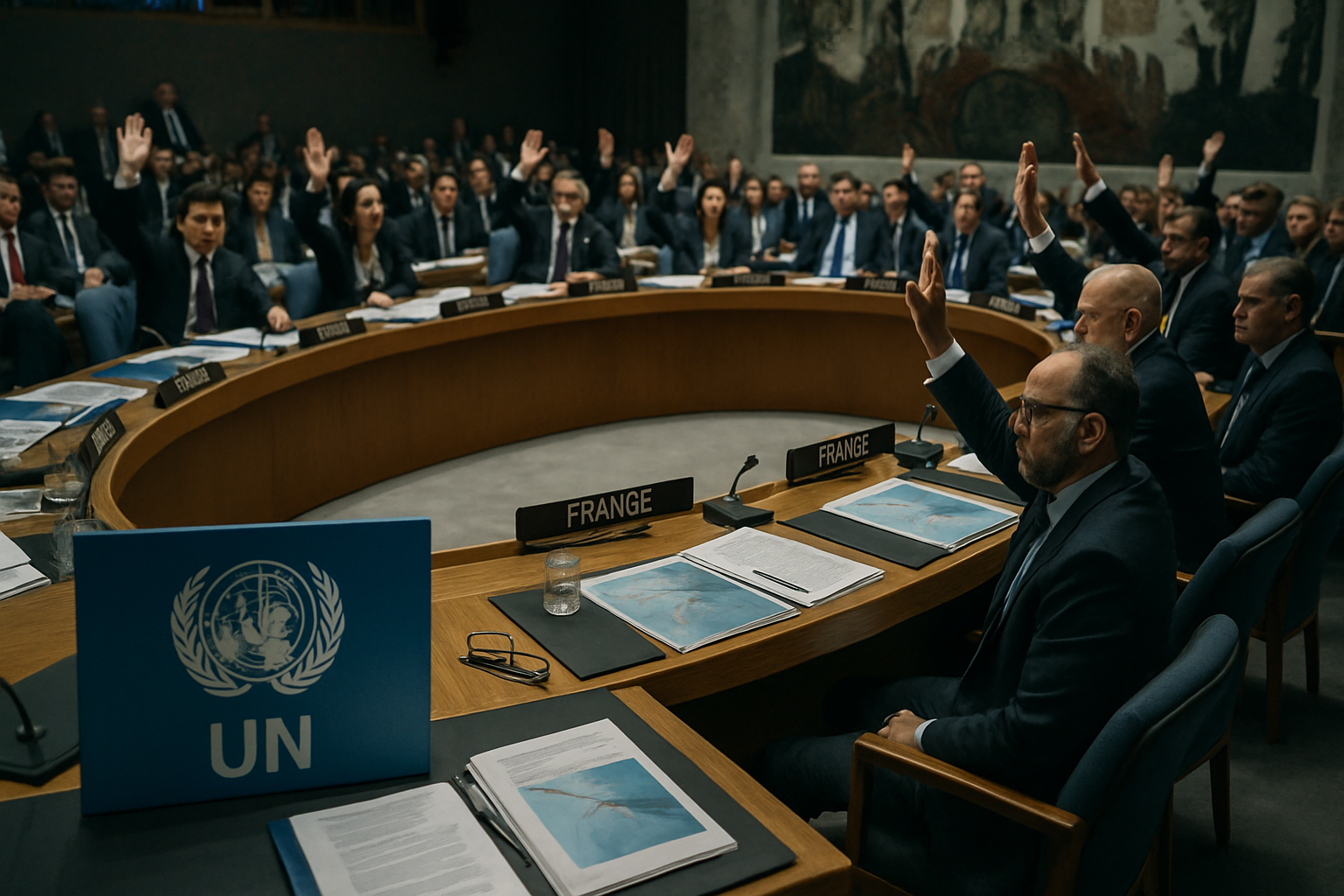
The United Nations Security Council is set to vote on a Bahraini resolution to protect commercial shipping in and around the Strait of Hormuz, as international diplomatic pressure mounts to keep the strategic waterway open amid escalating tensions in the Middle East.
Two diplomats confirmed that the meeting of the Council's 15 members and the crucial vote were scheduled for Saturday morning, April 4, rather than Friday as originally planned. The delay comes as veto-wielding China has made clear its opposition to authorizing any use of force in the resolution.
The Strait of Hormuz has become a critical flashpoint in the ongoing Middle East crisis, with Iran's Revolutionary Guard having declared the 21-mile waterway "unsafe for shipping," effectively threatening 40% of global seaborne oil transit. Oil prices have surged dramatically since the United States and Israel struck Iran at the end of February, unleashing a conflict that has disrupted this vital global trade artery for more than a month.
Bahrain Seeks International Protection for Shipping
Bahrain, currently chairing the Security Council, finalized a draft resolution seen by Reuters that would authorize "all defensive means necessary" to protect commercial shipping through the strategic chokepoint. The resolution represents a significant international effort to address what has become the most severe energy crisis since the 1970s oil shocks.
Earlier on Thursday, Bahrain's Foreign Minister Abdullatif bin Rashid Al Zayani told the council that a vote would be held on Friday, "God willing," highlighting the urgency surrounding the maritime crisis that has stranded over 150 oil and LNG tankers worth billions in cargo value.
The Bahraini proposal has backing from the United States and other Western allies who view the protection of international shipping lanes as essential to global economic stability. However, the resolution faces potential opposition from China and possibly Russia, both of which have expressed concerns about authorizing military force in the region.
China Opposes Force Authorization
Chinese officials have made their position clear regarding any authorization of force to protect shipping in the strait. Beijing's opposition stems from broader concerns about Western military intervention in the Middle East and the precedent such authorization might set for future conflicts.
The Chinese stance reflects the complex geopolitical calculations at play in the Security Council, where permanent members' veto powers can effectively block international action even when facing severe global economic disruption.
According to diplomatic sources, China has expressed preference for diplomatic solutions and has been working with Pakistan to put forward alternative proposals for restoring peace and stability in the Gulf region through negotiated settlements rather than military protection.
Global Economic Impact Intensifies
The crisis has triggered the most significant global energy disruption in decades. Oil prices have reached historic highs, with Brent crude peaking at $119.50 per barrel and WTI jumping a record 18.98% to $108.15. The International Energy Agency has responded with its largest strategic petroleum reserve release in 50 years, deploying 400 million barrels from 32 countries.
Natural gas prices have exploded 24% in Europe and 78% in the United States, while Qatar has halted LNG production at critical facilities that supply approximately 20% of global exports. Major shipping companies Maersk and MSC have suspended operations in the Persian Gulf, leaving billions in cargo stranded.
"The situation is going longer than initially thought, with financial markets becoming the ultimate constraint on prolonged conflict."
— Damien Boey, Energy Market Analyst
The aviation industry has faced parallel disruption, with over 18,000 flights cancelled worldwide—the most extensive disruption since COVID-19. Eight Middle Eastern countries have maintained simultaneous airspace closures, effectively creating an "aviation black hole" that has severed critical Europe-Asia air corridors.
Philippine Vessels Granted Exemption
In a rare diplomatic development, the Department of Foreign Affairs announced that Philippine-flagged vessels and energy shipments to the Philippines will not be charged toll fees to cross the Strait of Hormuz, according to Iranian authorities. This exemption highlights the complex negotiations occurring behind the scenes as countries seek to minimize economic damage from the crisis.
UK-Led International Coordination
British Foreign Secretary Yvette Cooper announced that more than 40 countries participated in a virtual summit to discuss coordinating diplomatic pressure and practical measures to reopen the strait. The UK-led talks wrapped up with a demand for the "immediate and unconditional" reopening of the vital shipping route.
The international coordination effort represents one of the most significant multilateral responses to a shipping crisis in modern history, demonstrating the global economic stakes involved in keeping the Strait of Hormuz operational.
Diplomatic Breakdown Context
The current crisis stems from the complete breakdown of US-Iran nuclear negotiations despite what had been described as a "broad agreement on guiding principles"—the most progress since the 2018 collapse of the Joint Comprehensive Plan of Action (JCPOA).
Iran maintained that ballistic missiles and regional proxy groups were "red lines" that could not be included in nuclear-only talks, while the United States demanded comprehensive negotiations covering missiles, armed groups, and human rights issues. This fundamental scope disagreement proved insurmountable, leading to the current military confrontation.
The diplomatic collapse occurred against the backdrop of broader nuclear governance challenges, including the expiration of the New START treaty between the US and Russia in February—marking the first time in over 50 years without nuclear constraints between the superpowers.
Regional Coalition Under Strain
The crisis has severely tested an unprecedented regional coalition of Saudi Arabia, UAE, Qatar, and Egypt that had been supporting diplomatic solutions. Iranian retaliation operations have directly targeted member territories, with casualties reported in the UAE, Kuwait, and Qatar from missile and drone attacks.
Egyptian President Abdel Fattah al-Sisi condemned Iranian attacks on "sisterly Arab countries," warning of "comprehensive chaos" spreading throughout the region. The coalition fracturing represents a significant blow to Middle Eastern stability and decades-old security arrangements.
"We must work with neighboring countries with the aim of ensuring and securing security and peace in the region."
— Iranian President Masoud Pezeshkian
Energy Architecture Transformation
The crisis has exposed dangerous vulnerabilities in global energy architecture, with experts warning that over-dependence on strategic chokepoints requires fundamental restructuring to reduce geopolitical volatility. The 21-mile Strait of Hormuz has proven to be a critical single-point failure in modern logistics with no realistic alternatives.
Alternative shipping routes through the Arabian Peninsula offer inadequate capacity and involve significant time and cost penalties. This reality has accelerated urgent discussions about supply diversification and renewable energy transitions, though such transformations require years or decades to implement.
Samuel Ciszuk, a leading energy security analyst, described the situation as "the most severe energy security crisis in decades, with single-chokepoint vulnerabilities fully exposed."
Template-Setting Moment for International Relations
UN Secretary-General António Guterres has characterized the current crisis as "the greatest test of multilateral cooperation and crisis management in the modern era." The rapid transition from diplomatic breakthrough to military confrontation demonstrates the fragility of crisis management mechanisms in an increasingly multipolar world.
The outcome of Saturday's Security Council vote will serve as a template-setting moment for 21st-century international relations, determining whether diplomatic or military solutions take precedence in future territorial and nuclear disputes globally.
Success in containing the escalation could provide a framework for nuclear crisis resolution and strengthen diplomatic precedents. However, failure risks accelerating military solutions, reshaping Middle Eastern geopolitics for decades, encouraging nuclear proliferation globally, and undermining diplomatic credibility worldwide.
Looking Ahead
The Security Council vote represents what may be the last coordinated diplomatic effort to prevent the most dangerous international crisis since the Cold War from expanding into broader regional warfare. With global energy security, nuclear governance credibility, and international law enforcement mechanisms all being tested simultaneously, the stakes could not be higher.
Recovery timelines remain uncertain, as unlike weather-related disruptions, resolution depends on military operations outcomes and diplomatic normalization. The international community faces critical decisions balancing immediate supply needs against long-term energy security architecture that could reshape global energy markets and international relations for generations to come.