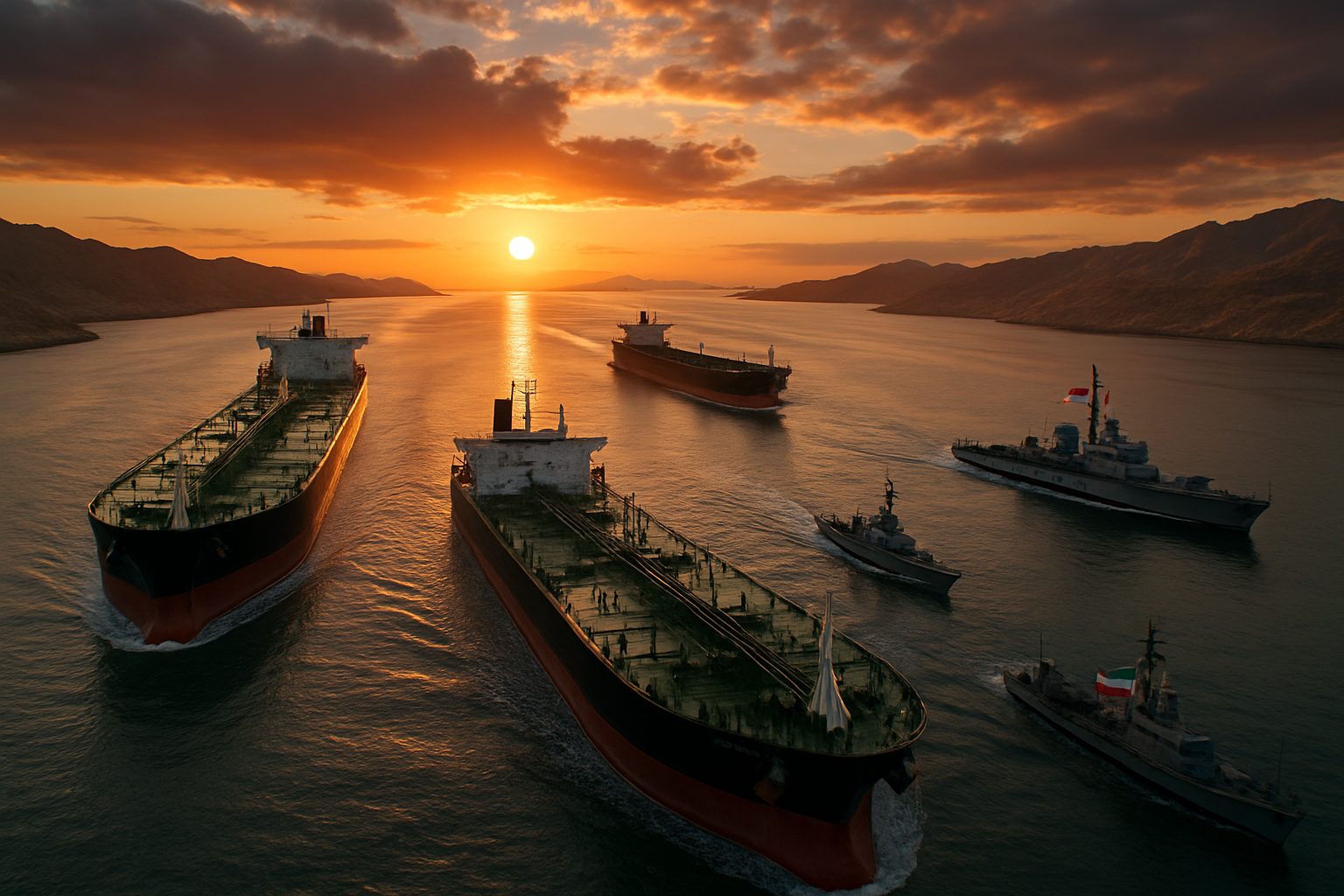
More than 40 countries have launched an international coalition to secure free passage through the Strait of Hormuz as Iran's Revolutionary Guard maintains effective control over the critical waterway, triggering the most severe global energy crisis since the 1970s oil shocks.
The coalition, announced Thursday during a virtual meeting hosted by British Foreign Secretary Yvette Cooper, comes amid mounting pressure from U.S. President Donald Trump on European allies to help reopen the vital strait where thousands of ships remain trapped. Oil prices have surged past $100 per barrel for the first time since 2022, with Brent crude peaking at $119.50 and West Texas Intermediate hitting $108.15.
"We have seen Iran hijack an international shipping route to hold the global economy hostage," Cooper said in her introductory remarks, warning of crippling disruptions on gas, jet fuels, fertilizers and the overall cost of living.
Crisis Escalation and International Response
Iran's Revolutionary Guard declared the 21-mile Strait of Hormuz "unsafe for shipping" in late February, effectively blocking 40% of the world's seaborne oil transit. The closure came after the largest U.S.-Israeli military operation since 2003, codenamed "Operation Epic Fury," targeted Iranian military infrastructure.
Over 220 vessels have crossed the strait since March 1, according to AFP analysis of Kpler maritime data. Most crossings—nearly six out of ten—involved Iranian-origin or Iranian-bound ships. The Islamic Republic has implemented what analysts describe as a "vetting system" requiring coordination with Iranian authorities for safe passage.
"We have not closed the strait. It is open," Iranian Foreign Minister Abbas Araghchi stated, emphasizing that passage requires "coordination with Iranian authorities with full respect for sovereignty and security."
Global Economic Impact
The crisis has triggered the International Energy Agency's largest strategic petroleum reserve release in its 50-year history—400 million barrels from 32 countries, more than double the 182.7 million barrels released during the 2022 Ukraine crisis. Japan is releasing 80 million barrels, marking its first deployment since the 2011 Fukushima disaster.
Natural gas prices have exploded by 24% in Europe and 78% in the United States, reaching €47.32/MWh—the highest levels since February 2025. Qatar, which accounts for approximately 20% of global LNG exports, has halted production at its Ras Laffan and Mesaid facilities following Iranian drone attacks.
Major shipping companies Maersk and MSC have suspended all Persian Gulf operations, leaving over 150 oil and LNG tankers stranded with billions of dollars in cargo. Iran has deployed an estimated 2,000-6,000 naval mines throughout the waterway, forcing the U.S. Navy to destroy 28 Iranian mine-laying vessels.
Aviation Crisis Parallels COVID-19 Disruption
The maritime crisis has been accompanied by an unprecedented aviation emergency, with over 18,000 flights cancelled worldwide—the most extensive disruption since the COVID-19 pandemic. Eight countries have simultaneously closed their airspace: Iran, Iraq, Israel, UAE, Qatar, Syria, Kuwait, and Bahrain.
Dubai International Airport, the world's busiest with 86 million passengers annually, remains completely shut down due to missile damage. Major carriers including Emirates, Air France-KLM, Wizz Air, and Bulgaria Air have suspended operations indefinitely. Jet fuel costs have soared from $85-90 to $150-200 per barrel, representing a 122% increase.
Consumer Impact Worldwide
The energy crisis has created severe consumer impacts globally. In Bangladesh, fuel rationing has been implemented for 170 million people. Pakistan has introduced wartime austerity measures including four-day work weeks, with fuel prices reaching Rs321.17 per liter—the highest in South Asia. Bosnia-Herzegovina reports having only two days of gas reserves remaining.
European nations are experiencing significant price increases, with Ireland's heating oil approaching €2 per liter amid what officials call "brazen rip-offs." Sweden faces electricity increases of 10-20 öre and gasoline rises of 1-2 kronor per liter, with the Malmö region most exposed due to continental market integration.
Financial Market Devastation
Global financial markets have crashed, with Pakistan's KSE-100 suffering its largest single-day decline in history at -8.97%. South Korea's KOSPI plummeted 12% before circuit breakers activated, sending the Korean won to a 17-year low. PayPal postponed its $1.1 billion IPO indefinitely due to market volatility.
Central banks including the European Central Bank and Bank of Japan are coordinating emergency liquidity measures to prevent contagion, though traditional monetary policy has limited effectiveness against such structural geopolitical disruptions.
Diplomatic Breakdown and Nuclear Concerns
The crisis stems from the complete collapse of U.S.-Iran nuclear negotiations despite achieving what officials called "broad agreement on guiding principles"—the most progress since the JCPOA breakdown in 2018. Iran maintained ballistic missiles and proxy groups as "red lines" while the U.S. demanded comprehensive reforms including missiles, armed groups, and human rights.
The diplomatic breakdown is occurring against a backdrop of nuclear governance crisis. The New START treaty expired on February 5, marking the first time in over 50 years without U.S.-Russia nuclear constraints. Iran continues uranium enrichment at 60% purity with over 400kg of weapons-grade material—sufficient for multiple weapons.
Regional Coalition Under Strain
The crisis has severely strained the unprecedented Saudi-UAE-Qatar-Egypt consensus that had emerged supporting diplomatic solutions. Iranian retaliation under "Operation True Promise 4" has targeted coalition member territories directly. The UAE reported one civilian killed in Abu Dhabi, Kuwait suffered 32 injuries from airport strikes, and Qatar intercepted 65 missiles and 12 drones despite eight people wounded by fragments.
Egyptian President Abdel Fattah el-Sisi condemned attacks on "sisterly Arab countries" while warning of "comprehensive chaos" if escalation continues. The targeting of Gulf coalition members represents a significant blow to Middle East stability frameworks.
European Territory Attacked for First Time Since WWII
In an unprecedented escalation, Iranian drones struck RAF Akrotiri in Cyprus—marking the first attack on European territory since World War II. The European Union activated its ESTIA evacuation plan for the first time in the bloc's history, while an unprecedented naval coalition including HMS Dragon and Spanish, Italian, French, Dutch, and Greek vessels has deployed to protect European interests.
UN Security Council Deadlock
The UN Security Council postponed a scheduled Friday vote on authorizing defensive force to protect shipping in the Strait of Hormuz. The 15-member body was set to vote on a draft resolution brought by Bahrain, but faced opposition from Russia, China, and France—all veto-wielding members.
Iran warned the Security Council against any "provocative action," with Foreign Minister Araghchi stating that such moves would "only complicate the situation." Russian Foreign Minister Sergey Lavrov declared the draft resolution "cannot be approved" as it "does not contribute to a peaceful resolution of the conflict."
Ukraine Offers Assistance
Ukrainian President Volodymyr Zelensky has offered his country's assistance in reopening the Strait of Hormuz, stating that "only joint action by nations can yield results" when addressing the blockade. During visits to Middle Eastern countries, Zelensky told representatives that Ukraine could help with the waterway crisis.
First Western European Transit
A significant development occurred Friday when a French-owned container ship, CMA CGM Kribi, became the first Western European-linked vessel to successfully transit the strait since the crisis began. The Malta-flagged vessel openly broadcast its route while staying close to the Iranian coastline between Keshm and Larak islands, suggesting coordination with Iranian authorities.
The transit represents a potential model for how European shipping might resume operations through Iranian coordination mechanisms, though major shipping companies continue to avoid the waterway entirely.
Energy Architecture Transformation Needed
The crisis has exposed dangerous over-dependence on strategic chokepoints, with the 21-mile Strait of Hormuz representing a single-point failure in modern logistics. Qatar Energy Minister Saad Al Kaabi warned that Gulf states may be forced to declare force majeure "within weeks," potentially driving oil to $150 per barrel and threatening to "bring down the economies of the world."
Energy analysts describe this as "the most severe energy security crisis in decades," with Samuel Ciszuk noting how "single-chokepoint vulnerabilities have been exposed." The crisis highlights the need for fundamental restructuring of energy architecture to reduce dependence on volatile geopolitical regions.
Recovery Timeline Uncertain
Unlike weather-related disruptions, recovery from this crisis depends entirely on military operations resolution and diplomatic normalization. Aviation industries cannot maintain long-term scheduling with multiple airspaces closed, while energy markets remain volatile with critical transit routes blocked.
UN Secretary-General António Guterres has called the situation "the greatest test of multilateral cooperation in the modern era," emphasizing how nuclear risks are at their "highest in decades." The crisis represents a template-setting moment for 21st-century conflict resolution, determining whether diplomatic or military solutions will prevail in an increasingly multipolar world.
International Maritime Organization Talks
There are potential diplomatic channels emerging, with International Maritime Organization officials confirming possible talks with Iran within a week to negotiate strait reopening. Maritime safety experts emphasize the fundamental rights of sailors in war zones, with unions confirming that seafarers have the right to refuse passage through designated conflict areas.
The crisis has stranded over 20,000 seafarers on 3,200 vessels throughout the Persian Gulf, creating the most severe maritime humanitarian emergency in decades. The International Maritime Organization has called for urgent creation of "safe corridors" for merchant vessel evacuation.
As the international coalition mobilizes diplomatic and economic tools to address the crisis, the world faces its most dangerous moment since the end of the Cold War. Success in containing the escalation could provide a framework for future nuclear crisis resolution, while failure risks accelerating military solutions and reshaping Middle Eastern geopolitics for decades to come.