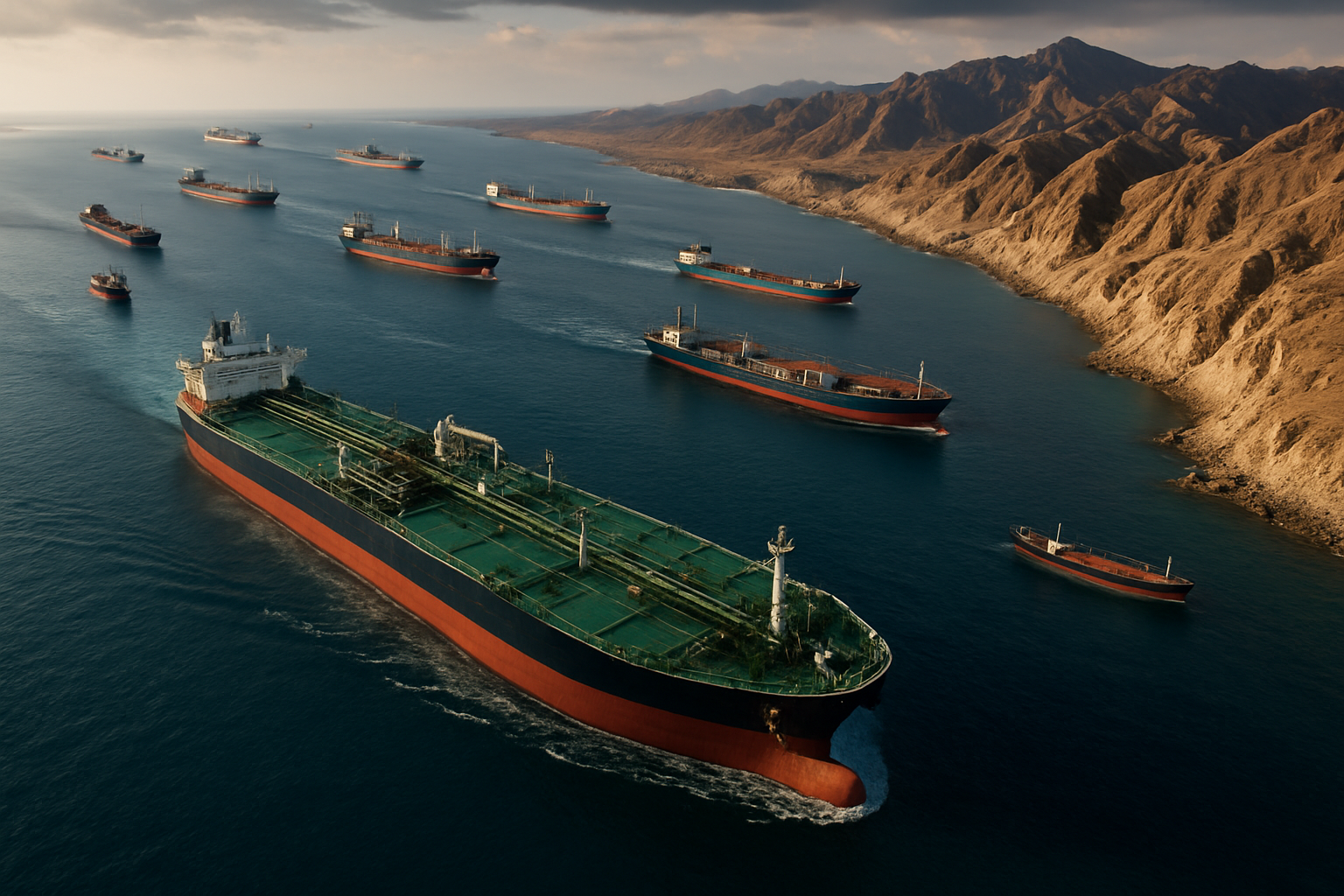
Iran has agreed to reopen the strategic Strait of Hormuz shipping lane as part of a breakthrough two-week ceasefire deal with the United States, reached just 88 minutes before President Trump's "whole civilization will die tonight" deadline, immediately ending the most severe global energy crisis since the 1970s oil shocks.
The historic agreement, brokered by Pakistan Prime Minister Shehbaz Sharif and Field Marshal Asim Munir, was announced at 10:43 PM ET via Trump's Truth Social platform after Iran's 10-point proposal was deemed a "workable basis for negotiations" by the Trump administration.
Oil prices crashed nearly 20% in overnight trading, plummeting from crisis peaks of $119.50 Brent crude to below $100 as Iranian Foreign Minister Abbas Araghchi confirmed Tehran's agreement to reopen the Strait of Hormuz for "safe passage" during the two-week ceasefire period "in coordination with Iranian armed forces."
Dramatic Reversal From Brink of War
The ceasefire represents a complete reversal for Trump, who just hours earlier had issued his most explosive threats yet, warning he would "destroy every bridge and power plant in Iran Tuesday night" if the strategic waterway remained closed. The president's shift from apocalyptic warnings to accepting a diplomatic solution marks one of the most dramatic policy reversals in modern presidential history.
Iran's Supreme National Security Council hailed the agreement as a "historic victory," claiming they had "forced Trump to accept our 10-point plan." The Iranian position represents a major shift from their earlier categorical rejection of temporary measures to accepting negotiations on broader regional arrangements while maintaining Revolutionary Guard control over Strait of Hormuz coordination mechanisms.
"We'll be loading up with supplies of all kinds, and just 'hangin' around' in order to make sure that everything goes well. There will be lots of positive action! Big money will be made. Iran can start the reconstruction process."
— Donald Trump, US President
Pakistan's Crucial Mediation Role
Pakistan emerged as the crucial diplomatic broker through its innovative "message relay system" that facilitated indirect talks when direct communication was impossible. Prime Minister Shehbaz Sharif maintained round-the-clock contact with US Vice President JD Vance and Iranian officials, while Field Marshal Asim Munir provided crucial military-to-military communication channels.
The "Islamabad Accord" framework provides a template for future crisis management through multilateral cooperation, demonstrating that middle powers can successfully bridge major adversary divides during international crises when traditional mechanisms fail. China's Foreign Minister Wang Yi expressed "full support" for the Pakistan initiative, while Germany noted "positive signs" for direct talks.
Global Crisis Resolution
The agreement immediately resolved the unprecedented global crisis that had paralyzed world markets for over a month. The International Energy Agency began reducing its record 400 million barrel strategic reserve release—the largest in the agency's 50-year history—as supply concerns eased with the prospect of reopened shipping lanes.
Aviation markets prepared for recovery as the crisis had forced the cancellation of over 18,000 flights worldwide—the most extensive disruption since COVID-19. Dubai International Airport, the world's busiest with 86 million annual passengers, began preparations to reopen after being shut down by missile damage.
Energy Markets in Relief Rally
Financial markets erupted in celebration globally, with Asian stocks posting explosive rallies and oil futures collapsing as the 21-mile Strait of Hormuz—which handles 40% of global oil transit—prepared to reopen. Airlines began planning resumption of Middle East routes, while major shipping companies Maersk and MSC started mobilizing stranded vessels worth billions in cargo.
The energy crisis had pushed natural gas prices up 24% in Europe and 78% in the US, reaching €47.32/MWh—the highest levels since February 2025. Qatar, which provides approximately 20% of global LNG exports, began preparing to resume production at its Ras Laffan and Mesaid facilities that had been halted due to Iranian attacks.

Consumer Relief Worldwide
The agreement brought immediate relief to consumers worldwide who had faced severe fuel shortages and price spikes. Bangladesh began reviewing fuel rationing measures affecting 170 million people, while Pakistan considered reversing wartime austerity measures that had driven fuel costs to Rs321.17 per liter—the highest in South Asia.
European households anticipated significant cost reductions, particularly in Sweden where electricity and gasoline prices had increased dramatically, with the Malmö region being most exposed due to continental energy integration. Ireland's heating oil prices, which had approached €2 per liter amid what officials called "brazen rip-offs," were expected to normalize rapidly.
Nuclear Diplomacy Context
The crisis had emerged from the complete breakdown of US-Iran nuclear talks despite achieving a "broad agreement on guiding principles"—the most progress since the JCPOA collapse in 2018. The fundamental scope disagreement between Iran's nuclear-only position and US comprehensive demands including missiles and proxies remained, but the ceasefire creates a diplomatic window to address these concerns through scheduled talks in Islamabad.
Iran maintains 60% uranium enrichment with over 400kg of weapons-grade material, while the February 2026 expiration of the New START treaty created the first 50+ year gap in US-Russia nuclear constraints, adding to broader nuclear governance concerns that UN Secretary-General António Guterres described as "the highest in decades."
Regional Coalition Preserved
The agreement preserved the unprecedented regional coalition of Saudi Arabia, UAE, Qatar, and Egypt that had maintained diplomatic consensus despite Iranian "Operation True Promise 4" attacks targeting their territories. The UAE had suffered one civilian death in Abu Dhabi, Kuwait reported 32 injuries from airport strikes, and Qatar had eight wounded while intercepting 65 missiles and 12 drones with Patriot systems.
Egyptian President Abdel Fattah el-Sisi had repeatedly condemned attacks on "sisterly countries" while warning of "comprehensive chaos" if escalation continued. The coalition's preservation through the crisis provides a foundation for broader Middle East stability as diplomatic talks proceed.
"This is a historic moment that demonstrates that diplomatic solutions are possible even in the darkest hours when the stakes are maximum, affecting energy security, nuclear governance, and international law enforcement simultaneously."
— António Guterres, UN Secretary-General
Operation Epic Fury Concluded
The ceasefire brings to a close Operation Epic Fury, which had become the largest US Middle East military operation since 2003 with costs reaching $11.3 billion in the first week alone. The dual-carrier deployment of the Gerald Ford and Abraham Lincoln represented approximately one-third of the US Navy fleet, while complex rescue missions had included over 170 aircraft extracting downed airmen from Iranian territory.
The operation had resulted in 3 US service members killed and 150 wounded, with 8 in critical condition—the first American combat deaths in the region since 2003. The USS Charlotte submarine's sinking of the Iranian frigate IRIS Dena marked the first enemy vessel destroyed by a US submarine since World War II.
Congressional Response
The agreement provided relief to Congressional leaders who had faced mounting pressure over the conflict's unprecedented unpopularity, with only 25% American support—described by analysts as "almost unprecedented" for early-stage military operations. Senator Richard Blumenthal had expressed being "more concerned than ever" about potential ground troop deployments, while Pentagon operations had been prepared to continue through September—well beyond the initial 4-6 week timeline.
Template-Setting Diplomatic Success
UN Secretary-General Guterres hailed the breakthrough as representing "the greatest test of multilateral cooperation in the modern era," with the success demonstrating that innovative diplomatic solutions remain possible when traditional mechanisms fail. The Pakistan-mediated framework provides a template for 21st-century crisis resolution in an increasingly multipolar world.
The International Air Transport Association noted that while the immediate aviation crisis was resolved, it could take months for fuel supply chains to fully recover after disruptions to refining capacity in the Middle East. However, the framework success demonstrates diplomatic credibility preservation over military escalation precedents that will affect international stability for decades.
Energy Architecture Implications
While the immediate crisis has been resolved, the month-long closure exposed dangerous vulnerabilities in global energy architecture that require fundamental transformation. The 21-mile Strait of Hormuz represents a catastrophic single-point failure for modern logistics, with no realistic alternatives to handle the diverted volume during closures.
Energy experts emphasize that strategic petroleum reserves provide only temporary buffers for sustained disruptions, highlighting the urgent need for supply diversification and renewable energy transitions that may require years or decades to implement but whose urgency has been dramatically accelerated by recent events.
Looking Ahead: Islamabad Framework
The two-week ceasefire provides a crucial diplomatic window for the most direct US-Iran engagement in decades, scheduled for Friday, April 10, in Islamabad. The US delegation may include Vice President JD Vance, special envoy Steve Witkoff, and Jared Kushner, while Iran's 10-point proposal addresses Strait of Hormuz protocols, sanctions relief, regional conflicts, and security guarantees.
The success or failure of these talks will determine whether the temporary pause can be converted into a lasting framework for regional stability and global energy security, potentially reshaping approaches to territorial sovereignty, nuclear governance, and conflict resolution for the 21st century.
April 8, 2026, represents a watershed moment in international relations—the most significant diplomatic breakthrough preventing broader regional war with global consequences. The innovative Pakistan-mediated framework demonstrates that multilateral cooperation can be effective in our volatile, interconnected world, providing hope that diplomatic solutions can prevail over military confrontation even when civilization itself appears to hang in the balance.