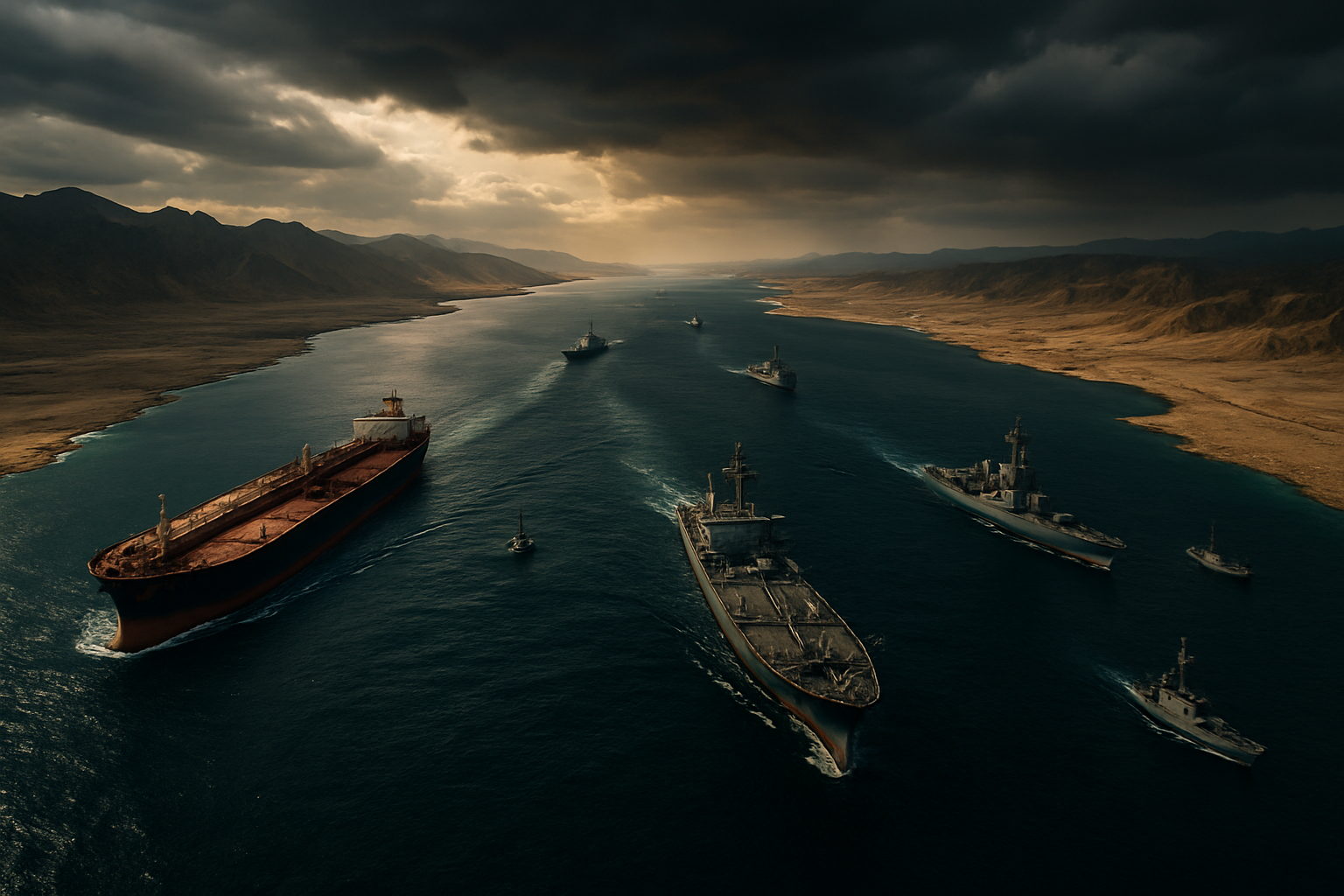
The strategic Strait of Hormuz remains largely closed to commercial shipping despite the fragile ceasefire between the United States and Iran, creating ongoing concerns about global oil supply and maritime trade as the world's most critical energy chokepoint remains under Iranian control.
Despite breakthrough diplomatic efforts that ended the most dangerous international crisis since the Cold War, the vital 21-mile waterway that handles 40% of global seaborne oil transit continues to operate under severely restricted conditions. Iran has implemented an unprecedented vetting system requiring coordination with Revolutionary Guard authorities for ship passage, fundamentally altering decades of free navigation through international waters.
Cryptocurrency Payment System Creates New Maritime Commerce
Iran has introduced a revolutionary payment system for oil tankers transiting the strait, demanding $1 per barrel in cryptocurrency to avoid sanctions tracking. The Greek-owned NJ Earth and Liberia-flagged Daytona Beach became the first non-Iranian vessels to successfully cross since the ceasefire, marking a dramatic shift in global maritime commerce.
Hamid Hosseini, chairman of Iran's oil exports union, confirmed the cryptocurrency payment requirement represents a systematic effort to circumvent international sanctions. Empty tankers are permitted passage without fees, but loaded vessels must comply with the digital payment system.
"The strait has not been closed. It is open, but requires coordination with Iranian authorities with full respect for sovereignty and security."
— Abbas Araghchi, Iranian Foreign Minister
This payment system has created complex challenges for international shipping companies and oil traders, forcing them to navigate unprecedented digital currency transactions for access to the world's most crucial energy transit route.
Limited Traffic Despite Ceasefire
According to Swedish media reports analyzing Marine Traffic data, only a handful of cargo ships and oil tankers have passed through the strait since the ceasefire announcement. The resumption of traffic remains far from the normal flow of vessels that previously made the waterway one of the world's busiest shipping channels.
Italian tanker Auroura was forced to make a 180-degree turn back into the Persian Gulf, highlighting the continued uncertainty facing commercial vessels. Iran has distributed maps showing "safe routes" under Iranian supervision, with some ships directed through alternative Larak Island waters.
Currently, 42 Japan-linked vessels remain stranded in the Persian Gulf, including crude oil tankers, chemical carriers, vehicle transporters, and LNG ships, representing billions of dollars in cargo value.
Environmental and Economic Risks
The continued restrictions pose significant environmental risks, with Iranian strikes on vessels carrying millions of barrels of oil threatening potential maritime disasters. The Kuwait Al Salmi tanker near Dubai, carrying approximately 2 million barrels, was among vessels struck during the crisis.
The United Kingdom Maritime Trade Operations (UKMTO) documented 24 incidents between February and March across the Arabian Gulf, with 16 confirmed attacks on commercial vessels.
International Legal Challenges
Iran's demand for toll collection rights violates fundamental principles of the UN Convention on the Law of the Sea, according to international legal experts. The ancient principle of freedom of peaceful navigation has been a cornerstone of international maritime commerce for centuries.
NATO allies have expressed concerns that Iran's actions represent a dangerous precedent that could encourage other nations to claim similar tolls over international waterways. President Trump has warned of serious consequences if Iran continues to restrict free navigation.
Coalition Response
Over 40 countries have formed an unprecedented international coalition led by British Foreign Secretary Yvette Cooper to secure Strait of Hormuz free passage. The coalition warns that Iran has "hijacked an international shipping route to hold the global economy hostage."
Trump has demanded European allies assist in reopening the strait, with thousands of ships trapped and global energy markets remaining volatile. The coalition is pursuing diplomatic and economic tools to restore normal shipping operations.
Global Energy Market Impact
The crisis has fundamentally altered global energy markets, with oil prices reaching historic peaks of $119.50 per barrel for Brent crude before the ceasefire. The International Energy Agency deployed its largest strategic petroleum reserve release in 50-year history - 400 million barrels from 32 countries - to stabilize markets.
Japan released 80 million barrels for the first time since the 2011 Fukushima disaster, highlighting the crisis's severity given Japan's 95% dependence on Middle East oil, with 70% transiting through Hormuz.
"The situation is going longer than initially thought, with financial markets being the ultimate constraint on prolonged conflict."
— Damien Boey, Energy Market Analyst
Qatar's LNG production at Ras Laffan and Mesaid facilities, representing approximately 20% of global exports, was halted during the crisis. Energy Minister Saad Al Kaabi had warned that Gulf states might declare force majeure "within weeks" if oil approached $150 per barrel.
Aviation and Supply Chain Effects
The crisis created the most extensive aviation disruption since COVID-19, with over 18,000 flights cancelled worldwide. Eight Middle Eastern countries simultaneously closed their airspace, creating an "aviation black hole" for Europe-Asia corridors.
Dubai International Airport, the world's busiest with 86 million passengers annually, suffered missile damage and remains closed. Major carriers including Emirates, Air France-KLM, and Wizz Air suspended Middle East operations indefinitely.
Diplomatic Breakthrough and Fragile Peace
The ceasefire was achieved through innovative Pakistan mediation, with Prime Minister Shehbaz Sharif and Field Marshal Asim Munir successfully bridging US-Iran communications when direct talks were impossible. The breakthrough came just 88 minutes before Trump's deadline.
This mediation success represents a template for 21st-century crisis resolution, demonstrating how middle powers can effectively bridge major adversaries when traditional diplomatic mechanisms fail.
Ukraine President Zelensky has offered assistance in reopening the strait, stating that "only joint action by nations can yield results." The UN Security Council remains deadlocked on authorizing defensive force to protect shipping, with Russia and China opposing proposed resolutions.
Looking Forward
The crisis exposed catastrophic vulnerabilities in global energy architecture, highlighting dangerous over-dependence on strategic chokepoints. The 21-mile Strait of Hormuz represents a single-point failure for modern logistics with no realistic alternatives.
Recovery remains uncertain and depends on sustained diplomatic progress rather than military resolution. Unlike weather disruptions with predictable patterns, geopolitical conflicts require fundamental restructuring of energy systems and supply chain resilience.
Regional Coalition Strain
The crisis severely tested regional relationships, with Iran's systematic retaliation targeting coalition territories. The UAE suffered one civilian death in Abu Dhabi, Kuwait reported 32 injuries from airport strikes, and Qatar intercepted 65 missiles and 12 drones, resulting in eight injuries.
Egyptian President Sisi condemned attacks on "sisterly countries" while warning of "comprehensive chaos" if escalation continued. The Saudi-UAE-Qatar-Egypt coalition preserved unity despite direct targeting, representing a significant diplomatic achievement.
Cyprus became the first European territory attacked since World War II when Iranian drones struck RAF Akrotiri, prompting an unprecedented naval coalition response including HMS Dragon and vessels from Spain, Italy, France, the Netherlands, and Greece.
Nuclear Context
The shipping crisis emerged from the complete collapse of US-Iran nuclear talks despite achieving a "broad agreement on guiding principles" - the most progress since the 2018 JCPOA breakdown. Iran maintains 60% uranium enrichment with 400kg+ of weapons-grade material sufficient for multiple weapons.
The expiration of New START in February 2026 created the first 50+ year gap without US-Russia nuclear constraints, adding to global governance concerns. UN Secretary-General Guterres described nuclear risks as at their "highest in decades."
Economic and Consumer Impact
The crisis created severe consumer impacts worldwide, with Bangladesh implementing fuel rationing for 170 million people and Pakistan adopting wartime austerity measures including four-day work weeks. Sweden experienced electricity and gasoline price increases, while Ireland faced heating oil approaching €2 per liter.
Financial markets crashed globally, with Pakistan's KSE-100 recording its largest single-day decline in history at -8.97% and South Korea's KOSPI falling 12% with circuit breakers activated. The Korean won hit a 17-year low as foreign capital fled.
PayPal postponed its $1.1 billion IPO indefinitely due to market volatility, while central banks coordinated emergency liquidity provisions to prevent broader financial contagion.
Template-Setting Significance
March-April 2026 represents a watershed moment in international relations, affecting regional war prevention, global energy security, nuclear governance credibility, and international law enforcement simultaneously. The crisis tested multilateral cooperation mechanisms more severely than any event since the Cold War's end.
Success in containing the crisis provides a framework for nuclear crisis resolution and strengthens diplomatic precedents. However, the underlying vulnerabilities remain, requiring fundamental transformation of energy security planning to reduce dependence on strategic chokepoints.
The innovative cryptocurrency payment system and Iranian vetting procedures represent unprecedented challenges to international maritime law, potentially setting precedents for future conflicts over strategic waterways worldwide.