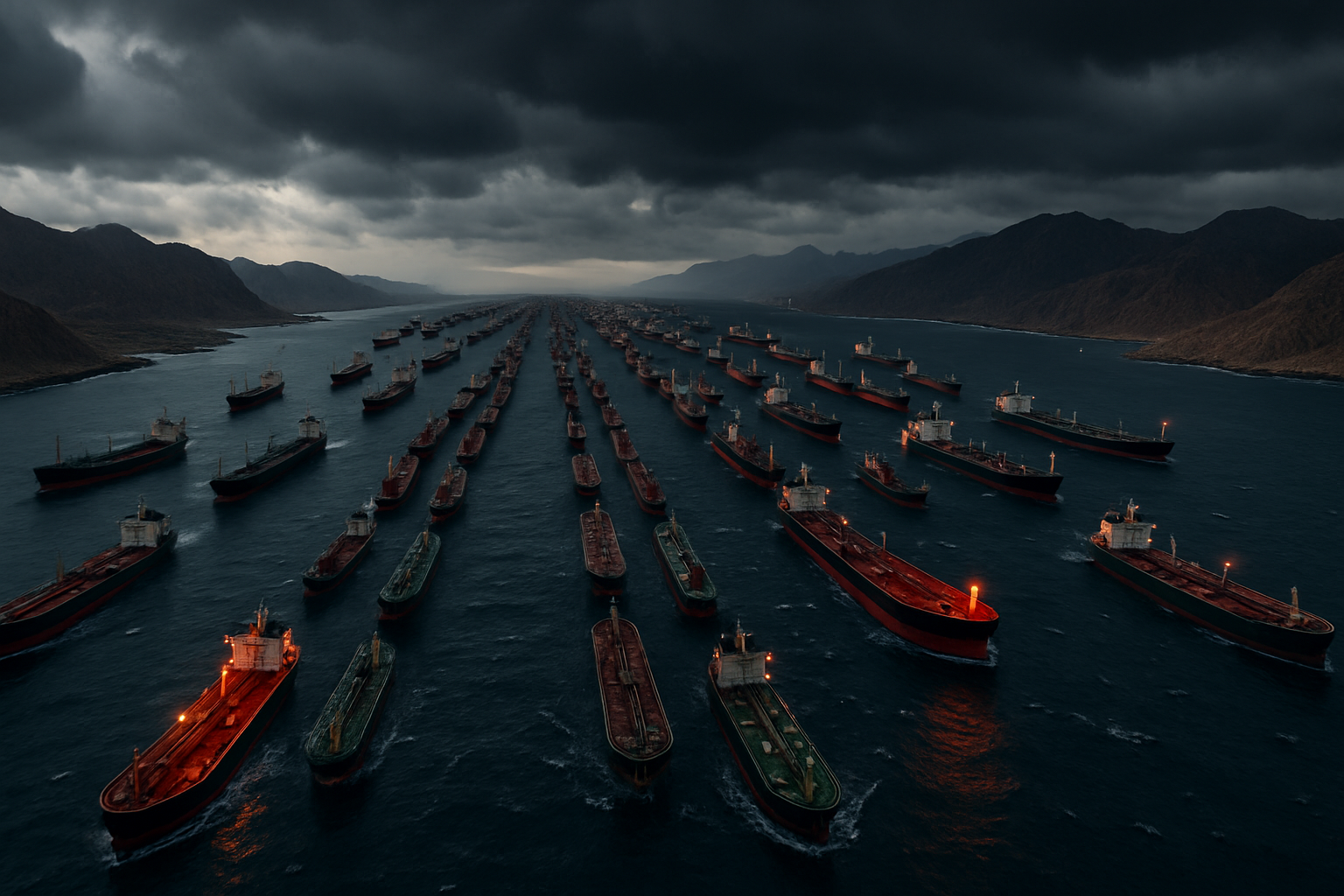
Shipping traffic through the strategically vital Strait of Hormuz remains at critically low levels as commercial vessels continue to avoid the waterway despite a temporary ceasefire between the United States and Iran, according to multiple maritime security sources and industry reports.
The 21-mile waterway, which handles approximately 40% of the world's seaborne oil transit, has been effectively disrupted since March 2026 when Iran's Revolutionary Guard declared it "unsafe for shipping" and deployed an estimated 2,000-6,000 naval mines throughout the chokepoint.
Current Maritime Situation
According to maritime security firm Diaplous, shipping flows remain at extremely low levels despite Iran's recent willingness to facilitate "safe passage" for certain vessels. The presence of naval mines and ongoing military tensions continue to deter most commercial traffic from entering the Persian Gulf through the strait.
Intelligence sources confirm that while the U.S. Navy has destroyed 28 Iranian mine-laying vessels, the waterway remains dangerous for navigation. Iran maintains the ability to quickly close the strait again, having demonstrated sophisticated mining capabilities using small, fast vessels that can deploy explosives rapidly across the narrow shipping lanes.
Several shipping companies, including industry giants Maersk and MSC, have suspended operations in the Persian Gulf entirely, leaving over 150 oil and LNG tankers stranded with billions of dollars in cargo value. Alternative routing through the Red Sea and around Africa adds significant time and cost to shipments, further straining global supply chains.
Economic and Energy Impacts
The crisis has triggered the most severe global energy disruption since the 1970s oil shocks. Oil prices surged past $100 per barrel for the first time since 2022, with Brent crude peaking at $119.50 and WTI reaching $108.15 in a record 18.98% single-day jump.
"We are witnessing the most severe energy security crisis in decades, with single-chokepoint vulnerabilities fully exposed"
— Samuel Ciszuk, Energy Security Analyst
Natural gas prices have exploded across global markets, rising 24% in Europe and 78% in the United States, reaching €47.32/MWh—the highest levels since February 2025. Qatar's LNG production at Ras Laffan and Mesaid facilities, representing approximately 20% of global exports, remains halted due to Iranian attacks on the infrastructure.
The International Energy Agency (IEA) deployed the largest strategic petroleum reserve release in its 50-year history, totaling 400 million barrels from 32 member countries—more than double the 182.7 million barrels released during the 2022 Ukraine crisis. Japan is contributing 80 million barrels, marking the first such deployment since the 2011 Fukushima disaster.
Iran's Naval Mine Clearance Challenges
According to U.S. officials cited by maritime intelligence sources, Iran faces significant technical difficulties in rapidly clearing the naval mines it has deployed throughout the strait. The Iranian military lacks sufficient mine-sweeping capabilities to quickly locate and neutralize all explosives, creating a prolonged security threat even if political tensions ease.
The mine-clearing challenge compounds the shipping industry's reluctance to resume normal operations. Even with Iranian assurances of "safe corridors," vessel operators remain concerned about hidden explosives and the potential for renewed hostilities.
International Response and Diplomatic Efforts
Ukraine has emerged as an unexpected player in international efforts to secure the strait, with Britain's armed services minister praising Ukrainian drone technology as potentially useful for mine-clearing operations. Ukraine has already deployed over 200 experts to the Middle East, where they have successfully countered Iranian Shahed drones.
Britain has organized consultations among more than 30 nations on how to reopen the strait safely. The discussions represent the largest international maritime security coordination since World War II, highlighting the global economic stakes involved.
President Trump has stated expectations that the strait will "reopen to shipping soon," though he has provided few details about specific timelines or conditions. Iranian officials maintain that the waterway was never formally closed but requires coordination with Iranian authorities "with full respect for sovereignty and security."
Global Supply Chain Disruption
The shipping crisis has created cascading effects throughout global supply chains. The Persian Gulf serves as a critical trade hub beyond energy exports, affecting consumer goods, industrial materials, and manufacturing inputs for automotive, electronics, and textile industries worldwide.
China has suspended refined fuel exports due to the supply disruptions, while Singapore faces 30% increases in logistics costs. Manufacturing centers dependent on Gulf-sourced materials are experiencing severe production delays.
The aviation industry continues to suffer, with over 18,000 flights cancelled since the crisis began—the most extensive disruption since COVID-19. Eight Middle Eastern countries maintain simultaneous airspace closures, creating an "aviation black hole" for Europe-Asia flight corridors. Dubai International Airport, the world's busiest with 86 million passengers annually, remains shut due to missile damage.
Consumer Impact and Government Responses
Consumers worldwide are experiencing severe fuel price increases and rationing measures. Bangladesh has implemented fuel rationing for 170 million people, while Pakistan has instituted wartime austerity measures including four-day government work weeks and fuel prices reaching Rs321.17 per liter.
European governments have activated unprecedented emergency measures. Hungary implemented immediate price caps on gasoline and diesel to combat "war-driven explosions" in fuel costs. France deployed 500 fuel station inspectors to prevent price manipulation, while Romania developed five scenarios to prevent diesel from exceeding 10 lei per liter.
Ireland faces heating oil prices approaching €2 per liter, prompting complaints about "brazen rip-offs" by fuel suppliers. Sweden has seen electricity prices increase 10-20 öre and gasoline rise 1-2 kronor, with the Malmö region most exposed due to continental energy integration.
Nuclear Context and Diplomatic Breakdown
The shipping crisis stems from the complete collapse of U.S.-Iran nuclear negotiations despite a Geneva breakthrough that achieved "broad agreement on guiding principles"—the most progress since the 2018 JCPOA collapse. Iran excluded ballistic missiles and regional proxies as "red lines," while the U.S. demanded comprehensive agreements covering missiles, armed groups, and human rights.
The diplomatic failure led to Operation Epic Fury, the largest U.S.-Israeli coordinated operation since 2003, prompting Iranian retaliation through "Operation True Promise 4" with the declared policy that "no red lines remain."
Adding to global security concerns, the New START Treaty expired on February 5, 2026, marking the first time in over 50 years without nuclear constraints between the United States and Russia. Iran continues uranium enrichment at 60% purity with over 400 kilograms of weapons-grade material—sufficient for multiple nuclear weapons.
Financial Market Impacts
Global financial markets have experienced severe disruption. Pakistan's KSE-100 index suffered its largest single-day decline in history at -8.97%, while South Korea's KOSPI index fell 12% before circuit breakers halted trading, with the Korean won hitting a 17-year low.
PayPal postponed its $1.1 billion IPO indefinitely due to market volatility. Central banks including the European Central Bank and Bank of Japan are coordinating emergency liquidity provisions, though traditional monetary policy has limited effectiveness against structural geopolitical disruptions.
Long-term Energy Security Implications
The crisis has exposed dangerous over-dependence on strategic chokepoints in the global energy system. The Strait of Hormuz represents a single-point failure for modern logistics, with no realistic alternative routes for the massive volume of oil and gas transit.
"This situation is going on longer than initially thought, with financial markets becoming the ultimate constraint on prolonged conflict"
— Damien Boey, Financial Markets Analyst
Qatar's Energy Minister Saad Al Kaabi has warned that Gulf states may declare force majeure "within weeks" if oil approaches $150 per barrel, threatening to "bring down the economies of the world." This represents the most severe threat to global economic stability since the 1970s oil shocks.
Energy experts argue the crisis necessitates fundamental transformation of global energy architecture to reduce dependence on volatile geopolitical regions. While strategic petroleum reserves provide temporary buffers, sustained disruptions require years or decades of supply diversification and renewable energy transitions—efforts that this crisis has dramatically accelerated in urgency.
Template-Setting International Crisis
UN Secretary-General António Guterres has described the situation as "the greatest test of multilateral cooperation in the modern era." The crisis affects regional war prevention, global energy security, nuclear governance credibility, and international law enforcement simultaneously.
The rapid transition from diplomatic breakthrough to military confrontation demonstrates the fragility of crisis management mechanisms in the multipolar era. Success in containing the escalation could provide a framework for nuclear crisis resolution, while failure may accelerate military solutions for decades, encouraging nuclear proliferation globally and undermining diplomatic credibility worldwide.
As the crisis enters its second month, the recovery timeline remains uncertain and depends on military and diplomatic resolution rather than predictable economic factors. The shipping industry's continued avoidance of the Strait of Hormuz, despite ceasefire agreements, underscores the lasting damage to confidence in this critical maritime chokepoint.
The April 2026 shipping crisis represents a watershed moment in establishing new paradigms for energy security planning, requiring fundamental transformation to reduce dependence on strategic chokepoints and affecting international stability mechanisms globally for decades beyond the current events.