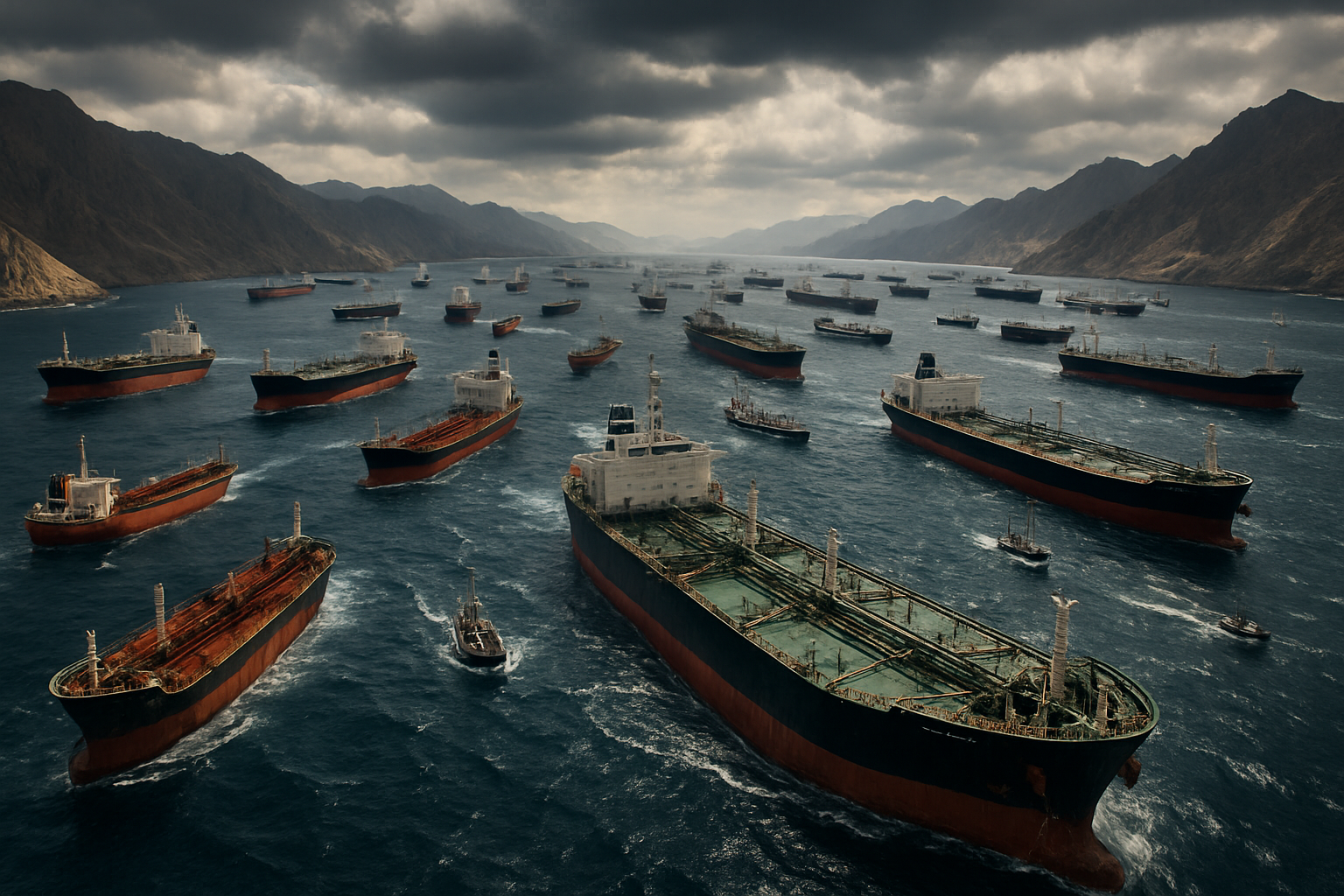
The Strait of Hormuz, a critical artery handling 40% of the world's seaborne oil transit, has been effectively closed following a series of missile attacks on commercial vessels and Iran's declaration that the waterway is "unsafe," triggering the most severe global shipping crisis in decades.
The crisis escalated dramatically on Wednesday as the Malta-flagged container ship Safeen Prestige reported a missile strike while en route to Saudi Arabia, with the vessel's 24-member crew successfully evacuated by Omani naval forces without casualties. The incident occurred approximately two nautical miles north of Oman during what sources describe as the fifth consecutive day of maritime disruption.
Major international shipping companies Maersk and MSC have suspended all operations through the strategic 21-mile-wide chokepoint, leaving more than 150 oil and liquefied natural gas tankers anchored in Persian Gulf waters, representing billions of dollars in stranded cargo. According to ship-tracking data from MarineTraffic, hundreds of additional vessels remain unable to reach ports throughout the region.
Energy Markets in Turmoil
The shipping disruption has sent shockwaves through global energy markets, with Brent crude oil prices surging 10% to over $80 per barrel - the highest levels seen since the previous major Middle Eastern crisis. Natural gas prices have exploded even more dramatically, rising 24% in Europe and an unprecedented 78% in the United States as supply chains face severe strain.
Qatar, responsible for approximately 20% of global LNG exports, has been forced to halt production at its critical Ras Laffan and Mesaid facilities following infrastructure damage from regional military operations. Industry analysts expect a force majeure declaration that could further constrict global energy supplies for months.
"This represents the most serious threat to global energy security in decades," said one senior energy analyst. "Alternative shipping routes around the Arabian Peninsula simply cannot handle the volume and add significant time and cost penalties that will be passed on to consumers worldwide."
Military Operations Intensify Crisis
The shipping crisis stems from the escalation of "Operation Epic Fury," described as the largest coordinated US-Israeli military operation since the 2003 Iraq invasion. The campaign has involved a dual-carrier deployment of the USS Gerald R. Ford and USS Abraham Lincoln, representing approximately one-third of the active US Navy fleet positioned 800 kilometers from Iran's coast.
Iran's Revolutionary Guard has responded with "Operation True Promise 4," declaring that "no red lines remain" in targeting what it considers legitimate military and economic targets. The systematic retaliation has affected multiple Gulf nations where international shipping companies maintain major operations.
Slovakia reported that two missiles struck the Safeen Prestige container ship, while Russia's TASS news agency confirmed that a cargo ship crew of 24 was evacuated following missile strikes near the strait. The attacks represent an unprecedented direct targeting of civilian commercial vessels in one of the world's most critical shipping lanes.
Aviation Crisis Compounds Global Impact
The maritime crisis has been compounded by the simultaneous closure of airspace by eight Middle Eastern countries - Iran, Iraq, Israel, UAE, Qatar, Syria, Kuwait, and Bahrain. Over 18,000 flights have been cancelled worldwide, representing the most extensive aviation disruption since the COVID-19 pandemic.
Dubai International Airport, the world's busiest with over 86 million passengers annually, remains completely shut down following missile damage to critical infrastructure. Emirates and Etihad Airways face operational crisis as their hub is eliminated from global aviation networks, forcing complex rerouting that affects hundreds of thousands of passengers worldwide.
Portugal reported that at least six ships continue anchored in the ports of Dubai, Abu Dhabi, and Doha, with thousands of passengers unable to return home as the crisis extends into its fifth day.
Diplomatic Efforts Collapse
The current crisis follows the complete breakdown of nuclear negotiations between the United States and Iran, despite what had been described as a "broad agreement on guiding principles" achieved during Geneva talks - the most significant diplomatic progress since the 2018 collapse of the Joint Comprehensive Plan of Action (JCPOA).
The fundamental disagreement centered on scope: Iran excluded ballistic missiles and regional proxy groups as "red lines" and demanded nuclear-only talks, while the US insisted on a comprehensive agreement addressing missiles, armed groups, and human rights issues. This decade-old structural obstacle ultimately proved insurmountable.
Iran continues enriching uranium to 60% purity, approaching the 90% threshold considered weapons-grade, with intelligence assessments indicating sufficient material for multiple nuclear weapons if weaponized.
Regional Coalition Under Strain
An unprecedented coalition of Saudi Arabia, UAE, Qatar, and Egypt that had backed diplomatic solutions now faces severe strain as Iranian retaliation has directly targeted member territories. Egypt's President Sisi condemned attacks on "sisterly Arab countries," warning of "comprehensive chaos" if the crisis continues to escalate.
The UAE reported one civilian killed in Abu Dhabi from missile debris, while Kuwait confirmed 32 foreign nationals injured in drone strikes on airport facilities. Qatar successfully intercepted 65 missiles and 12 drones using Patriot defense systems, though fragments still wounded eight people.
Global Economic Consequences
Financial markets have reacted with panic to the crisis, with Pakistan's KSE-100 index suffering its largest single-day decline in history, plummeting 8.97%. US Dow futures dropped 400-570 points, while European markets faced severe losses as investors fled to safe-haven assets.
The Organization of the Petroleum Exporting Countries (OPEC) announced an emergency production increase of 206,000 barrels per day, but analysts confirm this is insufficient to offset the shipping disruption through the Strait of Hormuz. The waterway's geography makes it essentially irreplaceable for regional oil exports.
Consumer impact is already being felt globally. Sweden predicts electricity price increases of 10-20 öre and gasoline price rises of 1-2 kronor per liter. Australia has issued fuel price warnings, while Mexico faces concerns about potential "gasolinazo" fuel price increases.
Supply Chain Vulnerability Exposed
The crisis has exposed dangerous vulnerabilities in global supply chains' over-dependence on single strategic chokepoints. The Persian Gulf serves as a critical hub for global trade extending far beyond energy, affecting everything from consumer goods to industrial materials worldwide.
The 150+ stranded tankers represent not just crude oil and LNG, but also petrochemicals, refined products, and manufacturing feedstocks essential to supply chains dependent on Middle Eastern logistics networks. Recovery timelines remain uncertain, as resolution depends on military and diplomatic developments rather than predictable natural disasters or technical failures.
International Response and Evacuations
The international community has activated the largest coordinated evacuation protocols since the Arab Spring of 2011. Sweden and Serbia have initiated immediate evacuations from Iran citing "extremely uncertain" security conditions, while multiple other nations have issued the highest-level travel warnings for the region.
Cyprus activated its ESTIA national evacuation plan for the first time, while the United Nations Security Council convened emergency sessions with Secretary-General António Guterres warning of "the most serious threat to international peace and security" and a dangerous "chain of events" that may spiral beyond control.
Nuclear Governance Crisis Context
The crisis occurs amid a broader nuclear governance breakdown, with the New START treaty between the US and Russia having expired on February 5 - marking the first time in over 50 years without constraints on the world's two largest nuclear arsenals. Combined with China's nuclear expansion and Iran's advancing program, UN officials warn that nuclear risks are at their "highest level in decades."
This template-setting moment for 21st-century crisis management demonstrates the fragility of modern diplomatic mechanisms in a multipolar world order. Success in containing the escalation could provide a framework for future nuclear crisis resolution, while failure may accelerate military solutions over diplomatic engagement globally.
Looking Ahead
The coming days will prove decisive in determining whether this crisis can be contained as a regional confrontation or will expand into a broader Middle Eastern conflict with worldwide implications. Unlike weather-related or technical shipping disruptions, recovery depends entirely on political and military developments that could extend for months or years.
The aviation industry faces fundamental challenges in long-term scheduling with multiple countries' airspace remaining closed indefinitely. Energy markets remain volatile with critical oil transit routes blocked, while traditional monetary policy tools prove limited against structural infrastructure and geopolitical disruptions.
As the crisis enters its fifth day, the international community confronts what many analysts describe as the most dangerous moment since the end of the Cold War - a test that will determine approaches to conflict resolution, energy security architecture, and diplomatic credibility for decades to come. The stakes extend far beyond the immediate region, affecting global energy markets, supply chains, and the fundamental principles of post-World War II international order.