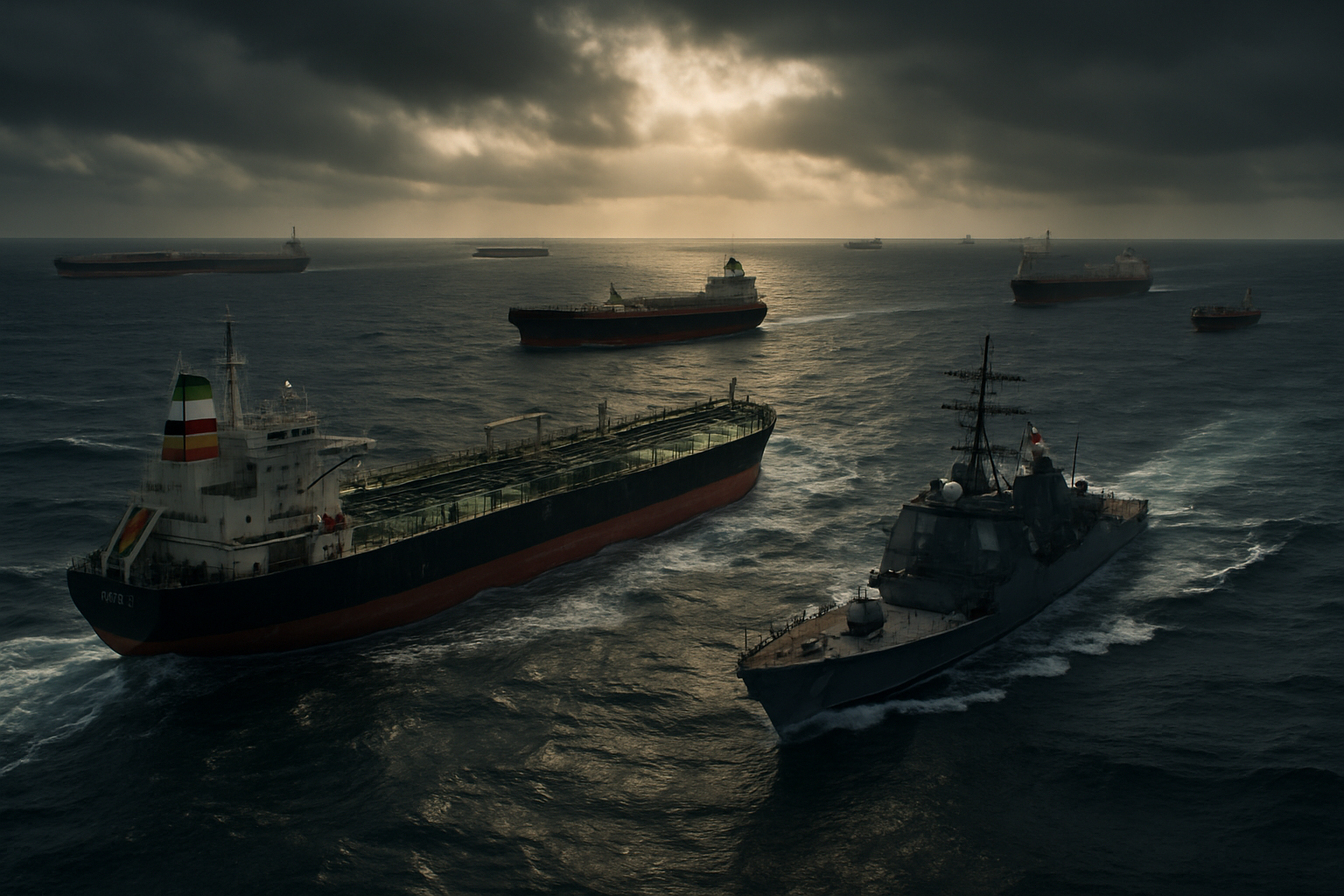
Iran's Revolutionary Guard has effectively blockaded the Strait of Hormuz, creating the most severe global energy crisis since the 1970s oil shocks as President Donald Trump calls for an international military coalition to force the waterway open.
The crisis reached unprecedented levels Saturday as oil prices surged past $100 per barrel for the first time since 2014, with Brent crude hitting $119.50 and West Texas Intermediate reaching $108.15 — an 18.98% single-day jump marking the largest increase on record. Iran's mining of the 21-mile strategic waterway has stranded over 150 oil and LNG tankers worth billions in cargo throughout the Persian Gulf.
Trump's International Military Appeal
In a Truth Social post Saturday, President Trump announced that "many countries" would send warships to keep the Strait of Hormuz open, specifically naming China, France, Japan, South Korea, and Britain as potential contributors. However, the White House did not immediately confirm which nations had committed to the mission.
"Many Countries, especially those who are affected by Iran's attempted closure of the Hormuz Strait, will be sending War Ships, in conjunction with the United States of America, to keep the Strait open and safe"
— Donald Trump, U.S. President
Trump's statement took an aggressive turn, warning: "In the meantime, the United States will be bombing the hell out of the shoreline, and continually shooting Iranian Boats and Ships out of the water." The unprecedented language reflects the severity of a crisis affecting 40% of global seaborne oil transit.
Global Aviation and Energy Paralysis
The crisis has triggered the most extensive aviation disruption since COVID-19, with over 18,000 flights cancelled worldwide. Eight Middle Eastern countries — Iran, Iraq, Israel, UAE, Qatar, Syria, Kuwait, and Bahrain — have simultaneously closed their airspace, completely severing Asia-Europe flight corridors.
Dubai International Airport, the world's busiest with 86 million annual passengers, remains completely shut down due to missile damage. Major carriers including Emirates, Air France-KLM, and Wizz Air have suspended operations indefinitely, affecting hundreds of thousands of travelers globally.
Energy Market Catastrophe
Natural gas prices have exploded by 24% in Europe and 78% in the United States, reaching €47.32 per MWh — the highest level since February 2025. Qatar has halted LNG production at its Ras Laffan and Mesaid facilities, representing approximately 20% of global LNG exports, with Energy Minister Saad Al Kaabi warning that Gulf states may declare force majeure "within weeks."

The International Energy Agency (IEA) has announced the largest strategic petroleum reserve release in its 50-year history — 400 million barrels from 32 member countries, more than double the 182.7 million barrel release during the 2022 Ukraine crisis. Japan is releasing 80 million barrels starting March 16, marking the first deployment since the 2011 Fukushima disaster.
Iran's Exception for Indian Vessels
In a rare diplomatic development, Tehran's Ambassador to India Mohammad Fathali confirmed Saturday that Iran has allowed some Indian vessels to pass through the Strait of Hormuz. This marks a notable exception to the broader blockade that has disrupted global energy supplies, demonstrating Iran's selective approach to the crisis.
Two Indian-flagged tankers carrying liquefied petroleum gas (LPG) successfully crossed the strait, according to India's shipping ministry, representing the first commercial transits since the blockade began. The development suggests potential diplomatic channels remain open despite the broader military confrontation.
Regional Reactions and Alternative Routes
Saudi Arabia has begun rerouting its oil exports through the Red Sea to avoid the blocked Strait of Hormuz, though alternative routes lack adequate capacity and add significant time and cost penalties. The kingdom's pivot highlights the limited alternatives to the strategic waterway.
Qatar's leadership warned of "catastrophic consequences" for global energy markets if the Strait remains closed, while a member of Iran's Expediency Council confirmed Saturday that the waterway would remain closed to U.S. ships indefinitely.
Diplomatic Breakdown and Military Escalation
The current crisis stems from the complete collapse of U.S.-Iran nuclear negotiations despite achieving a "broad agreement on guiding principles" in Geneva — the most significant diplomatic progress since the 2018 JCPOA collapse. Iran excluded ballistic missiles and regional proxies as "red lines" in nuclear-only talks, while the U.S. demanded comprehensive agreements including missiles, armed groups, and human rights.
This diplomatic failure led to Operation Epic Fury, the largest U.S.-Israeli military operation since 2003, prompting Iranian retaliation under "Operation True Promise 4." Iran continues enriching uranium at 60% purity with over 400kg of weapons-grade material sufficient for multiple weapons.
European Territory Under Attack
The conflict expanded beyond the Middle East when Iranian drones struck RAF Akrotiri in Cyprus — the first attack on European territory since World War II. The unprecedented assault prompted an international naval coalition response, with HMS Dragon, Spanish frigates, and vessels from Italy, France, Netherlands, and Greece deploying to protect Cyprus.
The European Union activated its ESTIA evacuation plan for the first time in the bloc's history, coordinating the largest international evacuation since the Arab Spring in 2011. Australia has 115,000 nationals trapped in the region, while Germany is evacuating 30,000 stranded tourists.
Financial Market Turmoil
Global financial markets have crashed in response to the crisis. Pakistan's KSE-100 index recorded its largest single-day decline in history at -8.97%, while South Korea's KOSPI fell 12%, triggering circuit breakers as the Korean won hit a 17-year low. PayPal postponed its $1.1 billion IPO indefinitely due to market volatility.
Central banks including the European Central Bank and Bank of Japan are coordinating emergency liquidity measures, though traditional monetary policy has limited effectiveness against structural geopolitical disruptions.
Regional Coalition Under Strain
An unprecedented coalition of Saudi Arabia, UAE, Qatar, and Egypt that had supported diplomatic processes is now severely strained as Iranian retaliation directly targets member territories. The UAE suffered one civilian death in Abu Dhabi, Kuwait reported 32 injured in airport strikes, and Qatar recorded eight wounded while intercepting 65 missiles and 12 drones with Patriot systems.
Egyptian President Abdel Fattah el-Sisi condemned the attacks on "sisterly countries," warning of "comprehensive chaos" spreading across the region. The coalition faces an impossible choice between maintaining U.S. alliance commitments and avoiding Iranian retaliation.
Supply Chain Vulnerabilities Exposed
The crisis has exposed fundamental vulnerabilities in global supply chains beyond energy. The Persian Gulf serves as a critical trade hub affecting consumer goods and industrial materials worldwide. Major shipping companies Maersk and MSC have suspended all Persian Gulf operations, while China has suspended refined fuel exports, canceling committed shipments.
Manufacturing sectors dependent on Gulf logistics networks — including automotive, electronics, and textiles — face severe disruptions. Singapore has reported logistics cost increases of 30% for some goods, demonstrating the waterway's critical role in global commerce.
Iranian Leadership Transition
The crisis unfolds amid Iran's first hereditary succession in Islamic Republic history. Mojtaba Khamenei, son of the late Supreme Leader Ali Khamenei who died March 1, has emerged as the favored successor. CIA assessments suggest Revolutionary Guards control is consolidating, indicating a historic shift from clerical to military governance during active warfare.
This unprecedented succession during wartime has created additional uncertainty about Iran's decision-making processes and potential for diplomatic resolution.
Congressional Opposition Mounts
Bipartisan opposition in the U.S. Congress is intensifying, with Senator Richard Blumenthal expressing he is "more concerned than ever" about potential ground troop deployment. The conflict's unpopularity is "almost unprecedented" for an early-stage military operation, with only 25% of Americans supporting the intervention.
Operation Epic Fury has cost $11.3 billion in its first week alone — $891.4 million daily — with Pentagon operations planned through September, far beyond the initial 4-6 week White House timeline. Financial markets are emerging as the "ultimate constraint" on further escalation.
Nuclear Governance Crisis
The crisis occurs amid broader nuclear governance breakdown. The New START treaty expired February 5, creating the first 50-year period without U.S.-Russia nuclear constraints. Iran continues uranium enrichment at 60% purity with sufficient material for multiple weapons, while China expands its nuclear arsenal.
UN Secretary-General António Guterres has called this "the greatest test of multilateral cooperation in crisis management in the modern era," with nuclear risks at their "highest in decades."
Template-Setting Implications
March 2026 represents a watershed moment in international relations, determining whether diplomatic or military solutions will set the precedent for 21st-century conflict resolution. The rapid transition from diplomatic breakthrough to military escalation demonstrates the fragility of crisis management in the multipolar era.
Success in containing the crisis could provide a framework for future nuclear dispute resolution and strengthen non-proliferation norms globally. Failure may accelerate military solutions in international conflicts, encourage nuclear proliferation elsewhere, and fundamentally undermine diplomatic credibility for decades to come.
Recovery Timeline Uncertain
Unlike weather-related disruptions, recovery from this crisis depends entirely on military operations resolution and diplomatic normalization. Aviation industries cannot maintain schedules with closed airspace, while energy markets remain volatile with critical transit routes blocked.
Energy experts warn that strategic petroleum reserves provide only temporary relief for sustained disruptions. Fundamental restructuring of energy architecture is needed to reduce dependence on strategic chokepoints, though such transitions require years or decades to implement.
"This is the most severe energy security crisis in decades, exposing our over-dependence on strategic chokepoints"
— Samuel Ciszuk, Energy Security Analyst
The Strait of Hormuz crisis of March 2026 has emerged as the most dangerous international crisis since the Cold War's end, affecting regional war prevention, global energy security, nuclear governance credibility, and international law enforcement simultaneously. Its resolution will establish precedents for international stability mechanisms that will influence global affairs for decades beyond the current events.