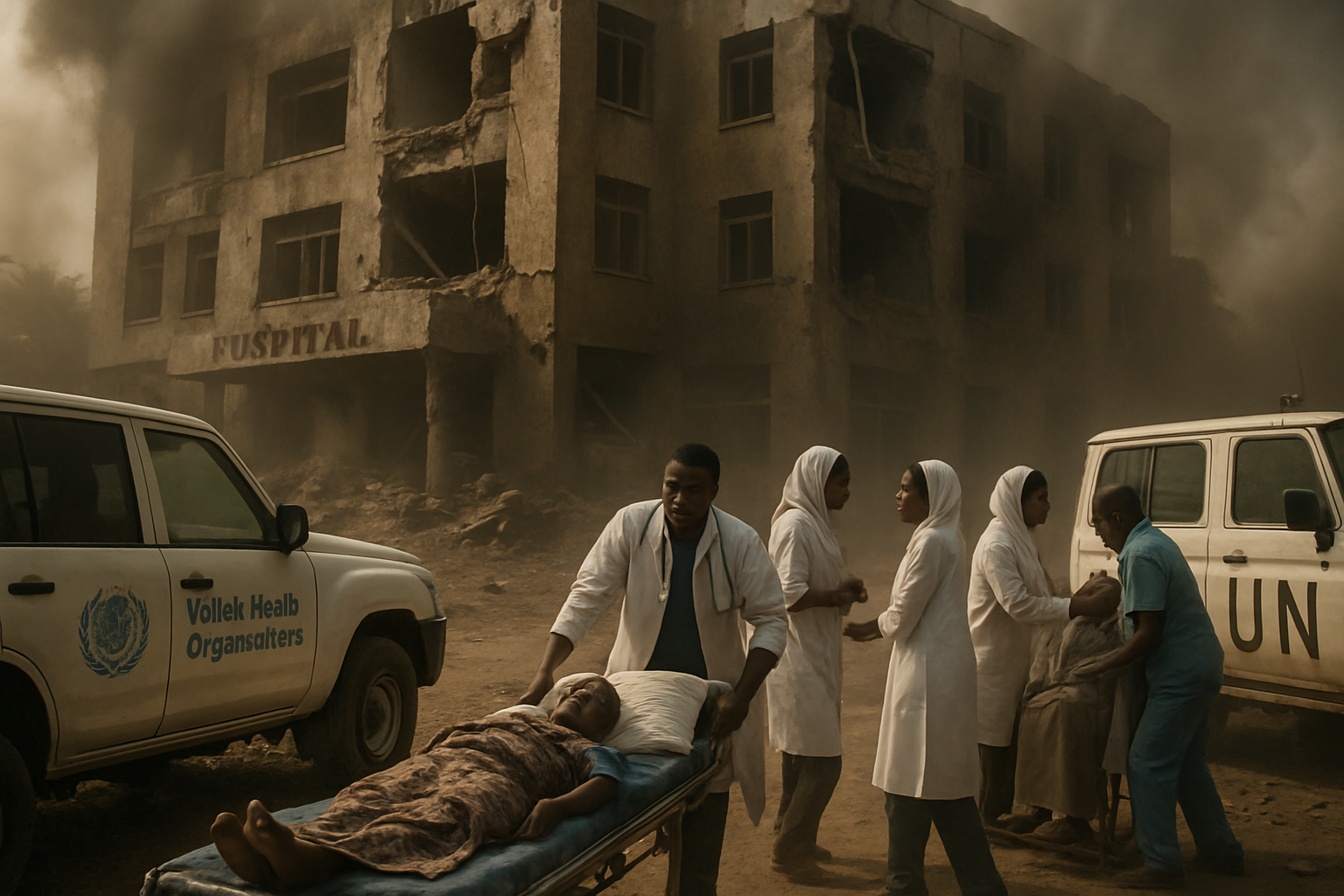
Sudan's army has categorically denied responsibility for a devastating attack on El-Daein Teaching Hospital in East Darfur that killed 64 people and wounded nearly 90 others on Friday night, even as the World Health Organization (WHO) confirmed the tragic death toll in what appears to be the latest systematic targeting of healthcare infrastructure during the country's brutal 20-month civil war.
The attack on the El-Daein Teaching Hospital in East Darfur state has rendered the medical facility "non-functional" according to WHO officials, adding to the mounting evidence of deliberate healthcare infrastructure destruction across Sudan. Among the confirmed dead were 13 children, 2 nurses, 1 doctor, and several patients, representing a grave violation of international humanitarian law and the Geneva Conventions that protect medical facilities during armed conflict.
Conflicting Accounts Amid Humanitarian Catastrophe
The Sudanese Armed Forces (SAF) has vehemently denied any involvement in the hospital attack, despite mounting documentation from international organizations tracking systematic violations of civilian protection during the ongoing conflict between SAF and the Rapid Support Forces (RSF). Emergency Lawyers, a Sudanese rights group that has been meticulously documenting war crimes throughout the conflict, continues to track these systematic violations of international humanitarian law.
The UN humanitarian office expressed being "appalled" by the strike on the hospital, which killed "dozens, including children." This incident follows a disturbing pattern established since the civil war erupted in April 2023, when a power struggle between SAF General Abdel Fattah al-Burhan and RSF leader General Mohamed Hamdan Dagalo (known as Hemedti) plunged the country into chaos.
"This attack renders Al-Daein Teaching Hospital non-functional, following a pattern of deliberate healthcare infrastructure destruction across Sudan."
— WHO Statement
Systematic Targeting of Healthcare Infrastructure
The attack on El-Daein Teaching Hospital is far from an isolated incident. According to memory records from previous investigations, this represents a continuation of systematic healthcare targeting that has characterized Sudan's civil war. In February 2026, RSF paramilitary forces attacked a military hospital in southern Sudan, killing 22 people including the hospital director and three medical staff members.
The WHO has been forced to provide emergency medical oxygen to only 23 hospitals nationwide, while hundreds of health centers have been forced to close due to the ongoing violence. This collapse of the healthcare system is occurring within the context of Sudan's broader humanitarian catastrophe, which now affects 17.8 million people requiring urgent assistance.
The systematic targeting of medical facilities violates fundamental provisions of the Fourth Geneva Convention, which explicitly protects hospitals, medical personnel, and patients during armed conflict. Such deliberate targeting constitutes war crimes under international law and represents what experts describe as a calculated strategy to destroy institutional capacity and civilian morale through mass atrocities.
Historical Context: From Genocide to Civil War
The current crisis has deep historical roots. The RSF emerged from the notorious Janjaweed militias responsible for the original Darfur genocide two decades ago, creating a disturbing historical continuity in systematic atrocities against civilian populations. UN-backed human rights experts made a historic determination in February 2026 that the RSF's "campaign of destruction" in El Fasher shows "hallmarks of genocide" against non-Arab communities.
The October 2024 RSF assault on El Fasher documented over 6,000 killed during a three-day offensive that UN experts described as a "wave of violence shocking in scale and brutality." This attack targeted the last major Darfur stronghold under SAF control, and its capture would give the RSF complete control over the Darfur region, representing one-third of Sudan's territory.
Unprecedented Humanitarian Emergency
The scope of Sudan's humanitarian crisis has reached catastrophic proportions. Famine conditions have been declared in multiple North Darfur areas, including Um Baru, which shows a catastrophic 53% acute malnutrition rate in children under 5 - nearly double the 30% threshold that defines famine conditions. This expands the famine crisis beyond previously identified areas in western Sudan's Darfur region.
The crisis stems from the April 2023 power struggle between military leaders over RSF integration into the national army and the timeline for civilian rule. The conflict has displaced millions internally and forced hundreds of thousands to flee to neighboring countries, creating a regional refugee emergency that is straining resources across the Horn of Africa.
Healthcare facilities face systematic attacks, forced closures, and resource shortages that are crippling the medical system precisely when it is needed most. The targeting of healthcare workers and facilities represents a particularly egregious violation of international humanitarian law, as medical personnel are supposed to be protected under all circumstances during armed conflict.
International Response Challenges
The international response has been severely hampered by access restrictions, funding shortfalls, and competing global emergencies including the conflicts in Ukraine and Gaza. The African Union has suspended Sudan's membership, creating diplomatic isolation that has complicated efforts to broker a peaceful resolution to the crisis.
Despite these challenges, the UN Security Council has imposed sanctions on RSF commanders, including Abdul Rahim Dagalo, representing attempts at accountability. However, the violence continues to escalate, with evidence suggesting a deliberate strategy of destroying institutional capacity and civilian morale through mass atrocities.
Regional implications include massive refugee flows into Chad and South Sudan, disrupted trade routes throughout the Horn of Africa, and food security threats that extend far beyond Sudan's borders. The crisis now represents one of the world's most urgent humanitarian emergencies, testing the international community's commitment to the Responsibility to Protect principle.
Critical Test of International Law
The attack on El-Daein Teaching Hospital represents a critical test of international humanitarian law enforcement in the 21st century. The systematic violation of Geneva Conventions through targeting of civilian infrastructure, particularly healthcare facilities, constitutes clear war crimes that demand accountability through national, regional, and international courts.
Documentation by organizations like Emergency Lawyers provides crucial evidence for future accountability mechanisms, but the immediate priority must be stopping the violence and providing humanitarian assistance to the millions facing starvation and medical emergencies without adequate care.
The crisis represents a fundamental challenge to the international community's ability to protect civilians and uphold humanitarian law during systematic violations. Sudan's transformation from the northeast African breadbasket to a humanitarian catastrophe zone requires sustained, coordinated international response mechanisms that address both immediate humanitarian needs and longer-term accountability for war crimes.
Urgent Need for International Action
As the death toll mounts and healthcare infrastructure continues to be systematically destroyed, the international community faces an urgent moral and legal imperative to act. The targeting of hospitals, schools, and other civilian infrastructure during armed conflict is not merely a violation of international law - it represents an attack on the fundamental principles of human dignity and the protection of non-combatants.
The conflicting accounts surrounding the El-Daein Hospital attack underscore the broader challenge of establishing accountability during active conflict. However, the pattern of systematic targeting documented by international organizations leaves little doubt about the deliberate nature of attacks on civilian infrastructure.
With 64 lives lost in a single attack on a medical facility that was supposed to be protected under international law, Sudan's crisis has reached a point where immediate international intervention is not just warranted but morally imperative. The alternative is allowing the systematic destruction of civilian institutions to continue unchecked, with devastating consequences for millions of innocent Sudanese civilians caught in the crossfire of a brutal civil war.