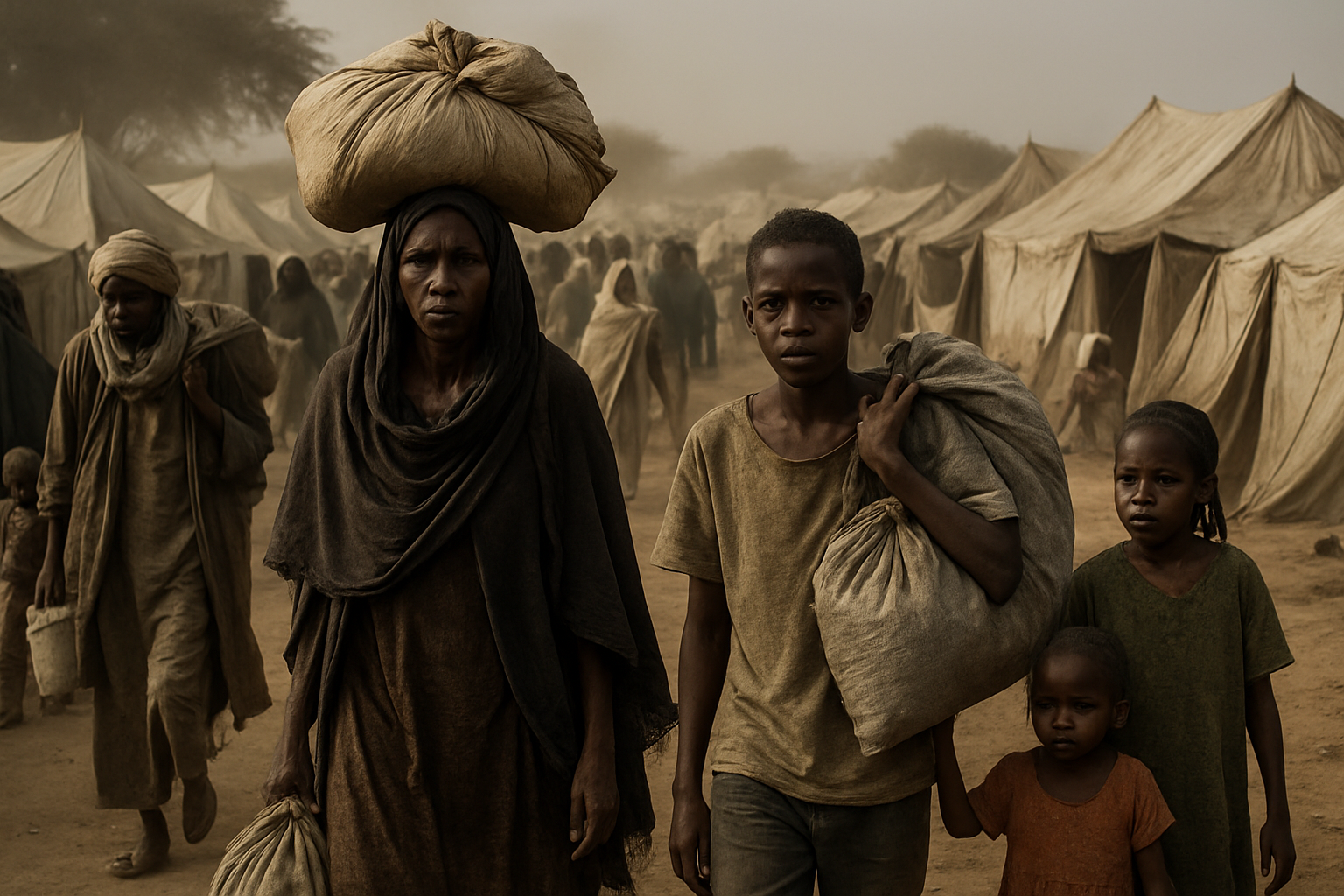
As Sudan marks three years since the outbreak of civil war between the Sudanese Armed Forces (SAF) and the Rapid Support Forces (RSF), the nation confronts what the United Nations describes as the world's largest humanitarian crisis, with over 17.8 million people requiring urgent assistance and millions more displaced from their homes.
The conflict, which began in April 2023 as a power struggle between military leaders over the integration of the RSF into civilian rule, has devastated a country that was once considered northeast Africa's breadbasket. Today, Sudan faces systematic violations of international humanitarian law, with both warring factions accused of deliberately targeting civilian infrastructure and blocking humanitarian aid.
A Crisis Beyond Comprehension
The scale of Sudan's humanitarian emergency defies easy description. According to UN sources, 11+ million people have been internally displaced, while famine conditions have been declared in multiple areas of North Darfur, including Um Baru, where 53% of children under five suffer from acute malnutrition—nearly double the 30% threshold that defines famine.
The healthcare system has collapsed entirely. The World Health Organization (WHO) now provides emergency medical oxygen to only 23 hospitals nationwide, while hundreds of health centers have been forced to close due to security concerns and lack of resources. In recent months, systematic attacks on medical facilities have claimed dozens of healthcare workers' lives, including a March 2026 assault on Al-Deain Teaching Hospital that killed 64 people, including 13 children, 2 nurses, and 1 doctor.
"This represents the forgotten and yet largest refugee crisis in the world. Particularly the people in Darfur and Kordofan are suffering under the ongoing fighting between army and RSF militia."
— German media report, documenting the crisis
From Political Crisis to Humanitarian Catastrophe
The current conflict emerged from a dispute between SAF General Abdel Fattah al-Burhan and RSF leader Mohamed Hamdan Dagalo (known as "Hemedti") over the timeline for integrating the RSF into a unified command structure and establishing civilian rule. What began as a political disagreement quickly escalated into a brutal war that has transformed Sudan from a potential democratic transition into a failed state.
The RSF, which emerged from the notorious Janjaweed militias responsible for atrocities during the original Darfur genocide two decades ago, has been particularly accused of systematic ethnic targeting. In February 2026, UN experts made a historic genocide determination regarding RSF actions in El Fasher, describing their campaign as showing "hallmarks of genocide" against non-Arab communities. The October 2024 assault on El Fasher alone documented over 6,000 killed in just three days.
Systematic Targeting of Civilians
Both sides in the conflict have been accused of war crimes, but the pattern of civilian targeting has been particularly systematic. Recent documented incidents include drone strikes on schools and mosques, attacks on healthcare facilities, and the deliberate blocking of humanitarian corridors.
The conflict has seen unprecedented use of drone warfare against civilian targets. Médecins Sans Frontières (MSF) reported treating 167 patients in just two weeks from drone strike injuries, highlighting the systematic nature of attacks on civilian areas, markets, and residential neighborhoods.
International efforts to address the crisis have been hampered by access restrictions, funding shortfalls, and competing global emergencies. The African Union suspended Sudan's membership, creating diplomatic isolation at a time when the country most needs international support.
Regional and Global Implications
The Sudan crisis has far-reaching implications beyond the country's borders. Massive refugee flows have strained resources in neighboring Chad and South Sudan, while disrupted trade routes have affected food security across the Horn of Africa. The conflict has also become a template for how the international community responds—or fails to respond—to mass atrocities in the 21st century.
The crisis represents a critical test of the "Responsibility to Protect" principle, which holds that the international community has a duty to intervene when national governments fail to protect their populations from genocide, war crimes, and crimes against humanity. Sudan's transformation from a country with democratic potential to a humanitarian catastrophe zone demonstrates the fragility of political transitions and the speed with which stability can collapse.
International Response Falls Short
Despite the magnitude of the crisis, international response has been inadequate. UN appeals for humanitarian assistance remain severely underfunded, while diplomatic efforts to broker peace have repeatedly failed. The UN Security Council has imposed sanctions on RSF commanders, including Abdul Rahim Dagalo, but violence continues to escalate.
Recent diplomatic initiatives, including those mediated by regional powers, have made little progress in addressing the underlying drivers of conflict. The international community's attention has been diverted by other global crises, including conflicts in Gaza, Ukraine, and elsewhere, allowing Sudan's humanitarian emergency to deepen without adequate response.
The Human Cost
Behind the statistics lies immense human suffering. Families have been torn apart, with children separated from parents in the chaos of displacement. Women and girls face heightened risks of sexual violence, while elderly and disabled populations struggle to access basic services.
Educational systems have collapsed entirely in conflict-affected areas. Healthcare workers describe operating without basic supplies, performing surgeries without anesthesia, and watching patients die from treatable conditions. The psychological trauma of sustained conflict affects entire communities, with long-term implications for Sudan's future even if peace were to be restored.
A Test for Global Governance
Sudan's crisis has become what UN Secretary-General António Guterres calls "the greatest test of multilateral cooperation in the modern era." The international community's response to Sudan will set precedents for how future humanitarian crises are addressed and whether the principles of international humanitarian law retain their meaning in practice.
The systematic nature of violations in Sudan—including attacks on hospitals, schools, and places of worship—represents a comprehensive challenge to civilian protection frameworks developed after World War II. The failure to effectively respond risks normalizing such violations and encouraging similar approaches in conflicts worldwide.
Looking Ahead
As Sudan enters its fourth year of conflict, prospects for resolution remain dim. Both warring factions appear committed to military solutions, while civilian populations continue to bear the cost. The international community faces a choice between sustained engagement to address the crisis or allowing Sudan to become a forgotten emergency that festers for years to come.
The documentation of war crimes and systematic violations continues, providing evidence for future accountability mechanisms. However, the immediate priority remains stopping the violence and providing humanitarian assistance to millions facing starvation and death.
For the 17.8 million Sudanese requiring urgent assistance, and the millions more whose lives have been shattered by conflict, the international community's response will determine whether Sudan emerges from this dark chapter or descends further into chaos. The stakes could not be higher—not just for Sudan, but for the credibility of international humanitarian law and the global community's commitment to protecting civilian populations in the 21st century.