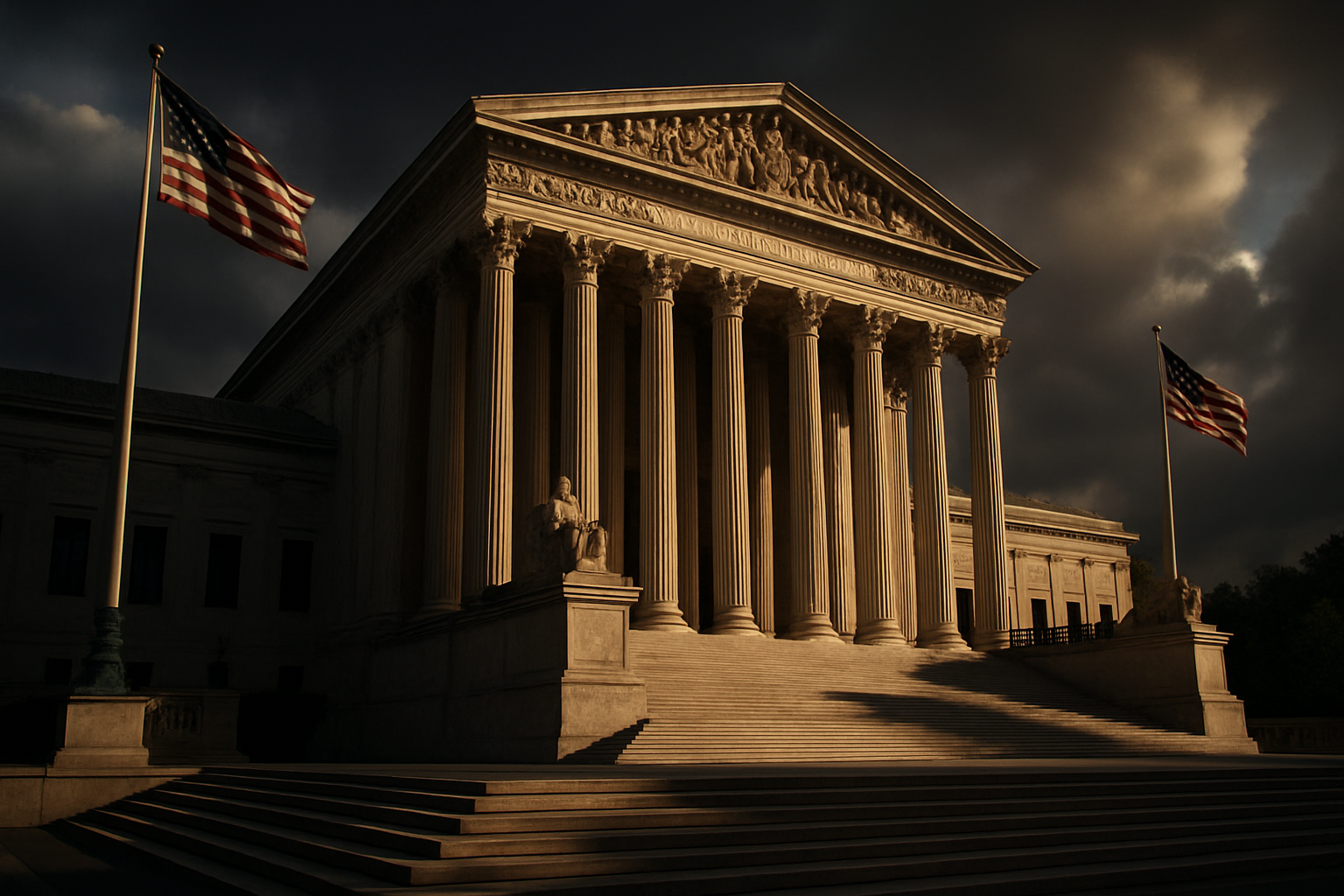
The United States Supreme Court delivered a crushing blow to President Donald Trump's trade agenda Friday, striking down his sweeping global tariffs in a historic 6-3 ruling that immediately triggered an unprecedented defiant response from the White House and raised serious questions about a looming constitutional crisis.
Chief Justice John Roberts authored the majority opinion applying the "major questions doctrine," ruling that the 1977 International Emergency Economic Powers Act (IEEPA) "does not authorize the president to impose tariffs" without explicit congressional authorization for actions of "vast economic and political significance."
Within hours of the decision, an unbowed Trump launched a furious attack on the court he helped shape, calling the justices "absolutely ashamed," a "disgrace to our nation," and "disloyal to the Constitution." More significantly, he announced a new 10% global tariff under alternative legal authorities, claiming the Court's decision paradoxically made his presidential trade powers "more powerful and crystal clear."
Constitutional Precedent with Far-Reaching Implications
The ruling represents the first major defeat of Trump's economic agenda in his second term and establishes a critical constitutional precedent limiting presidential emergency powers for economic objectives. The Court's application of the major questions doctrine creates a higher bar for executive branch economic policy implementation without explicit congressional authorization.
Legal experts describe the decision as a watershed moment in the ongoing tension between presidential power and constitutional limitations, demonstrating that institutional checks can function even during periods of expanded executive authority and political polarization.
"This is the first time we've seen the Court directly confront Trump's most aggressive use of executive power in his second term. The major questions doctrine application here will have implications far beyond trade policy."
— Constitutional Law Expert
Immediate Market and Political Reactions
Wall Street initially celebrated the ruling with significant gains—the Nasdaq surged 0.90% to 22,886.07 points and the S&P 500 rose 0.69% to 6,090 points as markets welcomed reduced trade uncertainty. Oil prices jumped over $1 per barrel amid the news.
However, gains moderated following Trump's immediate announcement of replacement tariffs, highlighting ongoing economic uncertainty. The ruling potentially affects billions in tariff refunds for U.S. importers who have paid approximately $200 billion since Trump's return to office.
The decision came just days after the Republican-controlled House passed legislation 219-211 to end Trump's Canada tariffs, with six GOP members defecting—marking the first significant bipartisan rebuke of Trump's trade policies in his second term.
Trump's Unprecedented Judicial Attack
Trump's response to the Supreme Court ruling broke new ground in presidential criticism of the judiciary. His characterization of the justices as "fools" and his claim they are "disloyal to the Constitution" represents what legal scholars call an "unprecedented public criticism" of Supreme Court justices.
Previous presidents have criticized court rulings, but Trump's "contemptuous tone" and personal attacks on individual justices mark a significant departure from institutional norms, raising separation of powers concerns among constitutional experts.
Treasury Secretary Scott Bessent defended the administration's position, arguing that while the Court "took away leverage," it paradoxically "made it more draconian because [they] agreed the president has the right to full embargo." He claimed the new 10% global tariff would be "more predictable" than the previous system.
International Diplomatic Ramifications
The Supreme Court decision has sent shockwaves through the international community, with mixed reactions reflecting the complexity of global trade relationships with the United States.
China, which had been targeted with 34% tariffs under Trump's maximum pressure campaign, welcomed the ruling as vindication and an opportunity to strengthen its bilateral negotiation position ahead of Trump's scheduled March 31-April 2 visit to Beijing.
European Union officials expressed cautious optimism but remained concerned about Trump's replacement tariff measures. Mexico's Economy Secretary called for "prudence" while planning a Washington trip to defend Mexican interests. Canada's Trade Minister welcomed the tariff reduction but warned of "considerable uncertainty" ahead.
The ruling comes at a critical time for international relations, occurring after the expiration of the New START treaty on February 5—marking the first time in over 50 years that the U.S. and Russia operate without nuclear arms control constraints.
Economic Effectiveness Questions
The Court's decision highlights fundamental questions about the effectiveness of tariff policies in addressing structural trade imbalances. Despite Trump's extensive use of tariffs, the U.S. trade deficit reached $901.5 billion annually in December 2025, essentially unchanged from pre-tariff levels.
This data demonstrates the structural nature of trade imbalances that extend beyond what tariff adjustments alone can address, lending weight to the Court's skepticism about using emergency powers for broad economic policy objectives.
However, January 2026 employment data showed unexpected strength, with 130,000 jobs added versus a forecast of 55,000, and unemployment declining to 4.3%. This economic backdrop complicates the political narrative around trade policy effectiveness.
Legal Challenges Ahead
Trump's new 10% global tariff faces immediate legal challenges. Trade experts question the alternative statutory authorities supporting such broad import restrictions, noting that World Trade Organization rules limit unilateral actions of this scope.
The new tariff includes exemptions for minerals, fertilizers, metals, energy equipment, agricultural products, pharmaceuticals, and medical raw materials, and does not apply to the USMCA. However, legal scholars argue these exemptions do not address the fundamental constitutional issues raised by the Court's decision.
International legal challenge grounds remain strong, with potential violations of WTO commitments and bilateral trade agreements creating multiple avenues for opposition.
Broader Constitutional Crisis Concerns
By directly defying the Supreme Court's ruling through immediate implementation of alternative tariffs, Trump appears to be precipitating what some constitutional experts describe as a potential constitutional crisis. This confrontation tests the fundamental principle of judicial review and the separation of powers.
The situation recalls historical tensions between executive and judicial branches, but the immediacy and directness of Trump's defiance—coupled with his personal attacks on the justices—represents an unprecedented challenge to constitutional governance.
Congressional Democrats have begun discussing potential legislative responses, while some Republicans privately express concern about the long-term implications of directly challenging Supreme Court authority.
Global Implications and Future Outlook
The Supreme Court ruling and Trump's defiant response have created a template that extends far beyond American borders. International observers are closely monitoring how democratic institutions respond to direct challenges from elected leaders, with implications for democratic governance worldwide.
The crisis occurs against a backdrop of rising authoritarianism globally and increasing challenges to judicial independence in various democracies. The American response may influence how other nations approach similar constitutional confrontations.
The coming weeks will be decisive in determining whether this represents a temporary institutional setback or a more fundamental shift in the balance of power between America's constitutional branches. The international community watches as the world's oldest constitutional democracy grapples with unprecedented challenges to its foundational principles.
As Trump prepares for his crucial China summit in March, the constitutional constraints imposed by the Supreme Court may paradoxically create space for more conventional diplomatic engagement, though his immediate defiance suggests a continued preference for confrontational approaches over institutional accommodation.