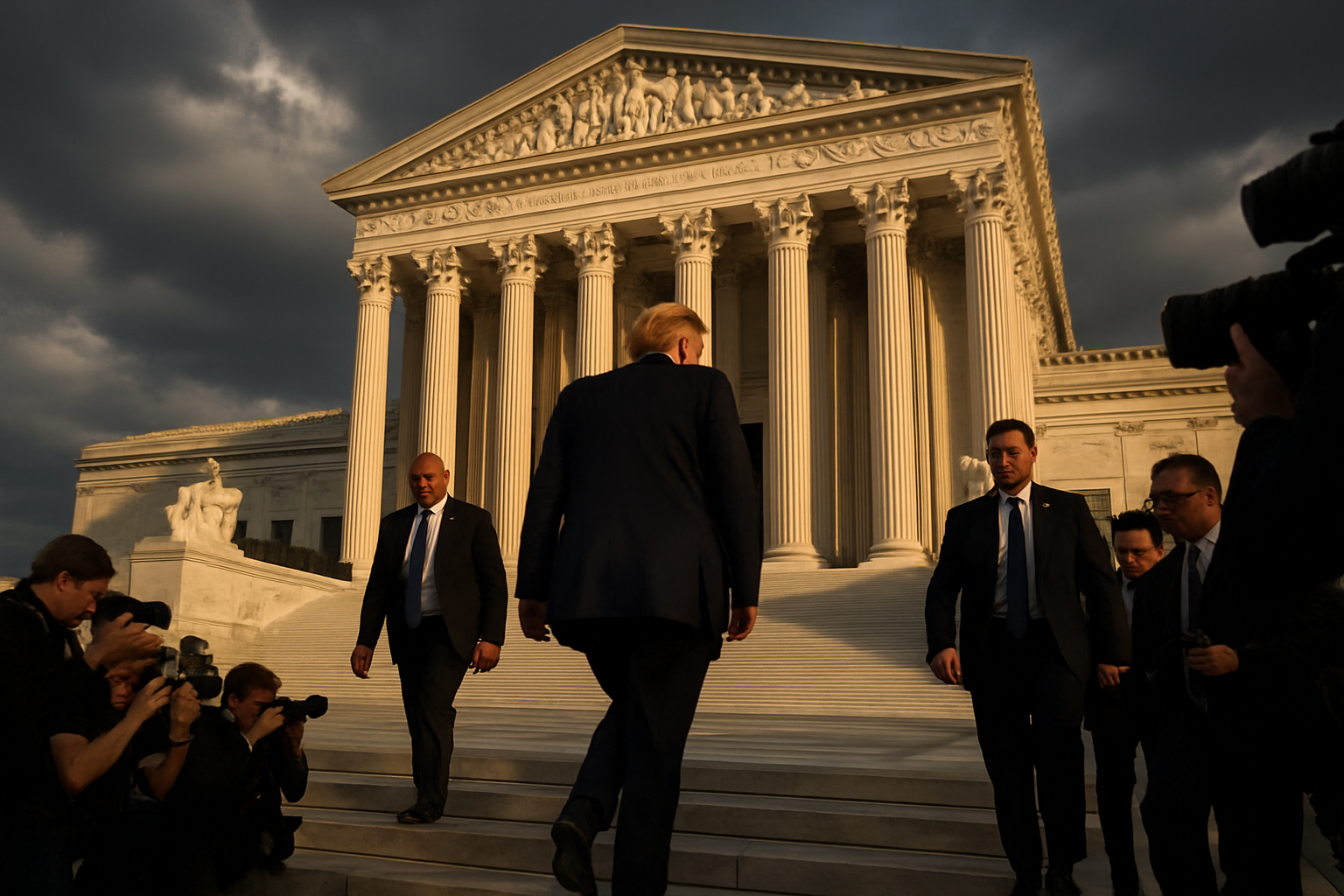
In an unprecedented scene that shattered 165 years of traditional separation between the executive and judicial branches, President Donald Trump personally attended Supreme Court oral arguments Wednesday as justices expressed deep skepticism about his executive order attempting to end birthright citizenship in the United States.
Trump became the first sitting president in U.S. history to attend Supreme Court oral arguments reviewing his own policies, arriving by presidential motorcade and sitting in the front row of the public gallery during the "Trump v. Barbara" case proceedings. Wearing a dark suit and red tie, the president departed midway through the hearing after the Justice Department completed its presentation in what legal experts characterized as calculated political theater.
Judicial Skepticism Across Ideological Lines
Over two hours of intense questioning, justices across the ideological spectrum—including conservatives despite the Court's 6-3 Republican majority—grilled Solicitor General D. John Sauer about the constitutional authority and practical implications of Trump's January 2025 executive order. Chief Justice John Roberts led the questioning about reinterpreting the 14th Amendment's Citizenship Clause through administrative action.
"The arguments appear very strange," Chief Justice Roberts commented about the administration's constitutional theories.
— John Roberts, Chief Justice
The executive order directs federal agencies not to recognize citizenship for children born in the United States if neither parent is an American citizen or legal permanent resident, potentially affecting an estimated 400,000 children born annually. This represents the most direct challenge to the 14th Amendment's citizenship clause in modern history since its ratification in 1868.
Constitutional Crisis Context
The hearing occurred against the backdrop of an ongoing constitutional crisis between the Trump administration and federal courts that has intensified since his return to office. This includes the February 2026 Supreme Court 6-3 tariff ruling defeat when Trump called justices a "disgrace to the nation" and "disloyal to the Constitution"—the most serious executive-judicial confrontation since Watergate.
Federal judges across multiple jurisdictions have uniformly blocked the birthright citizenship executive order as unconstitutional, continuing a broader pattern of judicial resistance to Trump policies including ICE warrant requirements, third-country deportation blocks, and historical exhibit restoration orders.
International Attention and Diplomatic Concerns
The case has drawn extensive international attention, with multiple countries issuing diplomatic notes expressing concern about dual nationals and international law compliance. European officials have questioned the human rights implications of the policy, viewing it as a critical test of American constitutional governance and rule of law commitment.
Solicitor General Sauer argued that birthright citizenship "has spawned a sprawling industry of birth tourism," claiming "uncounted thousands of foreigners from potentially hostile nations" exploit the system. China emerged as a particular focal point in the administration's arguments about birth tourism, though justices appeared unpersuaded by the national security rationale.
Legal Precedent at Stake
Over 40 amicus briefs have been filed by legal organizations, civil rights groups, and historians arguing that birthright citizenship has been a cornerstone of American immigration law since the 14th Amendment's ratification in 1868. Legal experts describe this as the most significant citizenship restriction attempt since the Chinese Exclusion Acts of the 1880s.
The case establishes crucial precedents about presidential immigration authority boundaries and constitutional interpretation methods that could affect American democracy for generations. Constitutional scholars argue the resolution will determine whether federal courts can effectively check executive power through judicial review amid unprecedented constitutional confrontation.
Massive Demonstrations and Security
Large crowds of both supporters and protesters gathered outside the Supreme Court with "Defend the Constitution" versus "Secure Our Borders" signs, creating a charged atmosphere requiring heightened security coordination between Capitol Police, Supreme Court Police, and Secret Service. Despite the tensions, demonstrations remained peaceful throughout the proceedings.
The Northern Mariana Islands would be particularly affected by the policy, as children born there to undocumented or temporary visa holders would lose automatic U.S. citizenship under Trump's directive.
Political and Congressional Context
The hearing comes as Trump faces declining approval ratings, with University of Virginia political analyst Larry Sabato reporting the president is "underwater on all top ten issues except border security." The House recently passed 219-211 legislation on Canada tariffs with six GOP defections—the first bipartisan rebuke of Trump's trade authority in his second term.
Congressional Democrats have threatened to block Department of Homeland Security funding over immigration enforcement methods, while Republicans defend what they characterize as necessary border security measures. The political context adds urgency to the Court's deliberations, scheduled to conclude by the end of the current term in June 2026.
Historical Violation of Separation of Powers
Trump's attendance represents an unprecedented breach of traditional separation of powers norms dating back 165 years. While presidents have visited the Court ceremonially, no sitting president has ever attended oral arguments reviewing their own policies, creating what constitutional scholars describe as a calculated demonstration of confidence while applying indirect pressure on the judicial branch.
The violation of executive-judicial boundaries represents a continuation of Trump's broader confrontation with institutional norms, following his unprecedented attack on Supreme Court justices after the February 2026 tariff ruling. Legal historians note this as the most significant challenge to judicial independence since the constitutional crisis of the 1930s.
June 2026 Ruling Expected
The Supreme Court is expected to rule by the end of the current term in June 2026, with the decision anticipated to reshape presidential immigration authority and establish constitutional interpretation precedents. Justices appeared ideologically divided during the arguments, with some conservative justices expressing reservations about the administration's claims about the breadth of executive authority.
The ruling will likely influence international approaches to citizenship law and constitutional governance, as democratic institutions worldwide monitor American institutional resilience during this period of constitutional stress. Success or failure in maintaining constitutional limits on executive power could establish templates for democratic governance challenges in the 21st century.
Beyond the immediate immigration policy implications, the case represents a fundamental test of governmental power balance, presidential authority limits, and the capacity of democratic institutions to preserve essential constitutional protections while adapting to contemporary realities.