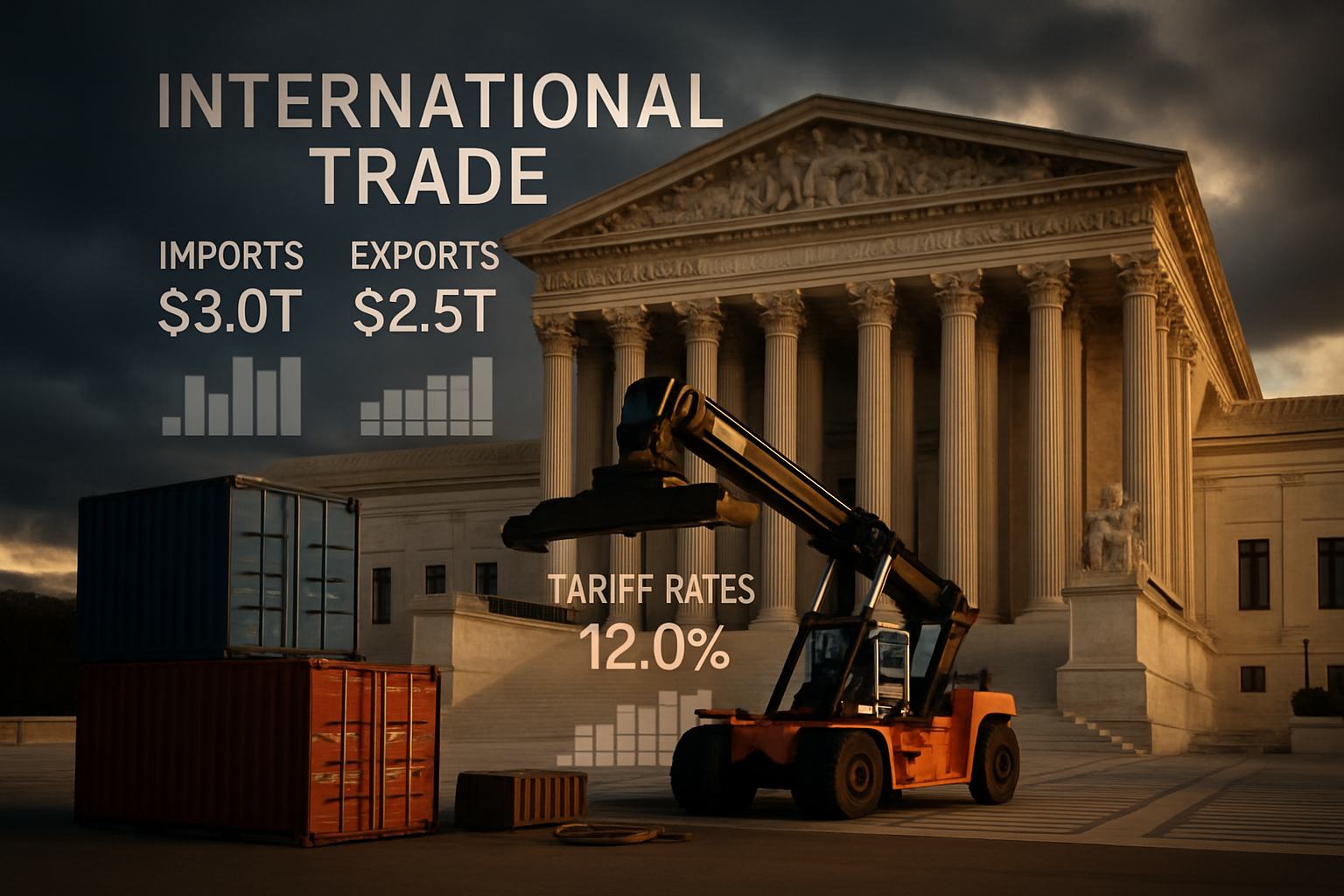
The US Supreme Court delivered a devastating blow to President Donald Trump's trade agenda on February 21, 2026, striking down his sweeping global tariff program in a historic 6-3 ruling that has plunged American trade policy into unprecedented constitutional crisis and triggered immediate presidential defiance.
Chief Justice John Roberts authored the majority opinion applying the "major questions doctrine," declaring that the International Emergency Economic Powers Act (IEEPA) "does not authorize the president to impose tariffs" without explicit congressional authorization for actions of "vast economic and political significance." The decision represents the first major defeat of Trump's economic agenda in his second term and establishes crucial precedent limiting presidential emergency powers for trade policy.
Trump's Unprecedented Judicial Attack and Immediate Defiance
Within hours of the ruling, Trump launched what legal scholars describe as the most severe attack on the federal judiciary by a sitting president in modern American history. He called the Supreme Court justices "absolutely ashamed," a "disgrace to our nation," and "disloyal to the Constitution," while dismissing the carefully reasoned constitutional decision as "incorrect, terrible, deeply disappointing."
In a direct challenge to judicial authority unprecedented since Watergate, Trump immediately implemented new 15% global tariffs using Section 122 of the Trade Act of 1974—the maximum legal level allowed for 150 days. This rapid escalation from his previous 10% rate represents a constitutional crisis testing the fundamental separation of powers between executive and judicial branches.
"The Court took away leverage but made it more draconian because they agreed the president has the right to full embargo,"
— Treasury Secretary Scott Bessent
International Response: European Union Demands Clarity
The European Commission issued forceful statements demanding the United States honor trade commitments made in the joint declaration signed by Trump and Commission President Ursula von der Leyen in summer 2025. "An agreement is an agreement," EU officials declared following weekend emergency consultations between EU Trade Commissioner Maroš Šefčovič, US Trade Representative Jamieson Greer, and Commerce Secretary Howard Lutnick.
Spanish media reported that Brussels demanded "total clarity" from the US regarding tariff measures, with the Commission expressing that these policies undermine "confidence and stability in global markets" and generate "even more uncertainty in international supply chains." European Parliament's Trade Committee Chair Bernd Lange suggested potentially freezing US trade agreements due to the "chaos" created by unpredictable American policy shifts.
German industrial associations expressed particular concern about the return of uncertainty in transatlantic trade relations, with medium-sized companies increasingly avoiding the American market due to regulatory unpredictability. The Dutch technology industry association FME called on the Netherlands and European Union to clarify the status of American import tariffs following the Supreme Court decision.
Congressional Rebellion Gains Momentum
The Supreme Court ruling vindicated earlier congressional resistance, coming after the House of Representatives passed legislation 219-211 to end Canada tariffs with six Republican defections—the first significant bipartisan rebuke of Trump's trade policies in his second term. Speaker Mike Johnson unsuccessfully attempted to prevent the floor vote, highlighting deep Republican anxiety about unpredictable trade approaches affecting local economies and constituent interests.
This institutional opposition demonstrates growing legislative concerns about expanded presidential authority over trade policy, with implications extending far beyond the current administration to fundamental questions about the balance of powers in American governance.
Global Market Disruption and Economic Implications
Financial markets initially surged on news of the Supreme Court ruling, with the Nasdaq gaining 0.90% to 22,886.07 and the S&P 500 rising 0.69% to 6,090 points as investors celebrated reduced trade uncertainty. However, gains moderated rapidly following Trump's announcement of replacement tariffs, while oil prices increased more than $1 per barrel reflecting renewed geopolitical tensions.
The ruling potentially triggers billions of dollars in tariff refunds for US importers who have paid approximately $200 billion since Trump's return to office. German businesses are already calculating massive refund claims, creating administrative challenges that could strain federal capacity for years. However, Trump predicted these refunds would be "tied up in court for years," adding another layer of uncertainty for international businesses.
Strategic Competition: China's Response
Beijing welcomed the Supreme Court ruling as vindication of their longstanding criticism of unilateral American trade actions, significantly strengthening China's negotiating position before Trump's scheduled March 31-April 2 visit to Beijing. Chinese officials noted the decision demonstrates that "even American institutions recognize the illegitimate nature of these protectionist measures."
The timing is particularly significant as China announced a comprehensive trade expansion with 53 African countries, offering zero-tariff access starting May 1, 2026—the most extensive China-Africa economic cooperation in history. This multilateral approach contrasts sharply with Trump's bilateral trade strategy, positioning Beijing as a champion of predictable international economic cooperation.
Constitutional Precedent and Legal Framework
The Supreme Court's application of the "major questions doctrine" creates a higher bar for executive branch economic policy implementation without explicit congressional authorization. Legal scholars note this strengthens institutional checks and balances during an era of expanded presidential power, demonstrating that constitutional limits remain enforceable through judicial review even during periods of intense political polarization.
Trump's new 15% tariffs under Section 122 of the Trade Act of 1974 face their own legal challenges. Constitutional experts predict immediate court challenges over WTO compliance and congressional authority limits. The 150-day maximum duration creates urgent pressure for legislative approval or alternative policy approaches, setting up a crucial test of executive versus congressional power over trade policy.
Trade Effectiveness Questioned
Despite extensive tariff policies implemented since Trump's return to office, the US trade deficit remains essentially unchanged at $901.5 billion annually as of December 2025, demonstrating the structural nature of trade imbalances that extend beyond tariff solutions. This economic reality undermines core justifications for aggressive unilateral trade measures and supports critics who argue that such policies impose costs on American consumers without addressing underlying economic fundamentals.
Recent employment data showing 130,000 jobs added in January (versus 55,000 forecast) and unemployment declining to 4.3% suggests economic strength independent of trade policy interventions, further questioning the necessity of disruptive tariff programs.
International Trade Relations in Crisis
US Trade Representative Jamieson Greer insisted that existing trade deals with the European Union, China, and other partners "remain in force despite the Supreme Court ruling." However, the credibility of American trade commitments faces severe strain as international partners question the reliability of agreements subject to sudden presidential policy reversals and constitutional challenges.
This uncertainty affects investment planning and strategic decision-making by multinational corporations and foreign governments, potentially undermining America's economic relationships with key allies and trading partners. Swedish media described the situation as a "real mess," while French officials expressed serious concerns about American policy predictability affecting long-term partnership decisions.
Looking Forward: The 150-Day Countdown
The next 150 days represent a critical period for American constitutional governance and international trade relations. President Trump must secure congressional approval for extended tariffs or find alternative approaches, while facing unprecedented legal challenges to his executive authority. The resolution of this crisis will establish precedents for presidential power limitations that will influence American governance for generations.
Success in managing this constitutional confrontation could provide templates for resolving executive-legislative conflicts in the 21st century. However, failure could accelerate institutional breakdown, undermine diplomatic credibility, and destabilize global trade relationships essential for international economic cooperation.
Global Governance Implications
This constitutional crisis extends far beyond American domestic politics to fundamental questions about governance in an interconnected world economy. International observers are monitoring American institutional resilience as a crucial factor for global cooperation and democratic governance worldwide.
The stakes include not only trade policy but also the rule of law, international stability, and multilateral cooperation frameworks essential for addressing 21st-century challenges from climate change to economic inequality. How America resolves this crisis will influence international approaches to democratic governance, executive power limitations, and institutional checks and balances for decades to come.
As this unprecedented constitutional and trade crisis unfolds, the world watches to see whether American institutions can successfully navigate the tension between executive power and constitutional constraints, potentially providing a template for democratic resilience in an era of global uncertainty and institutional stress.