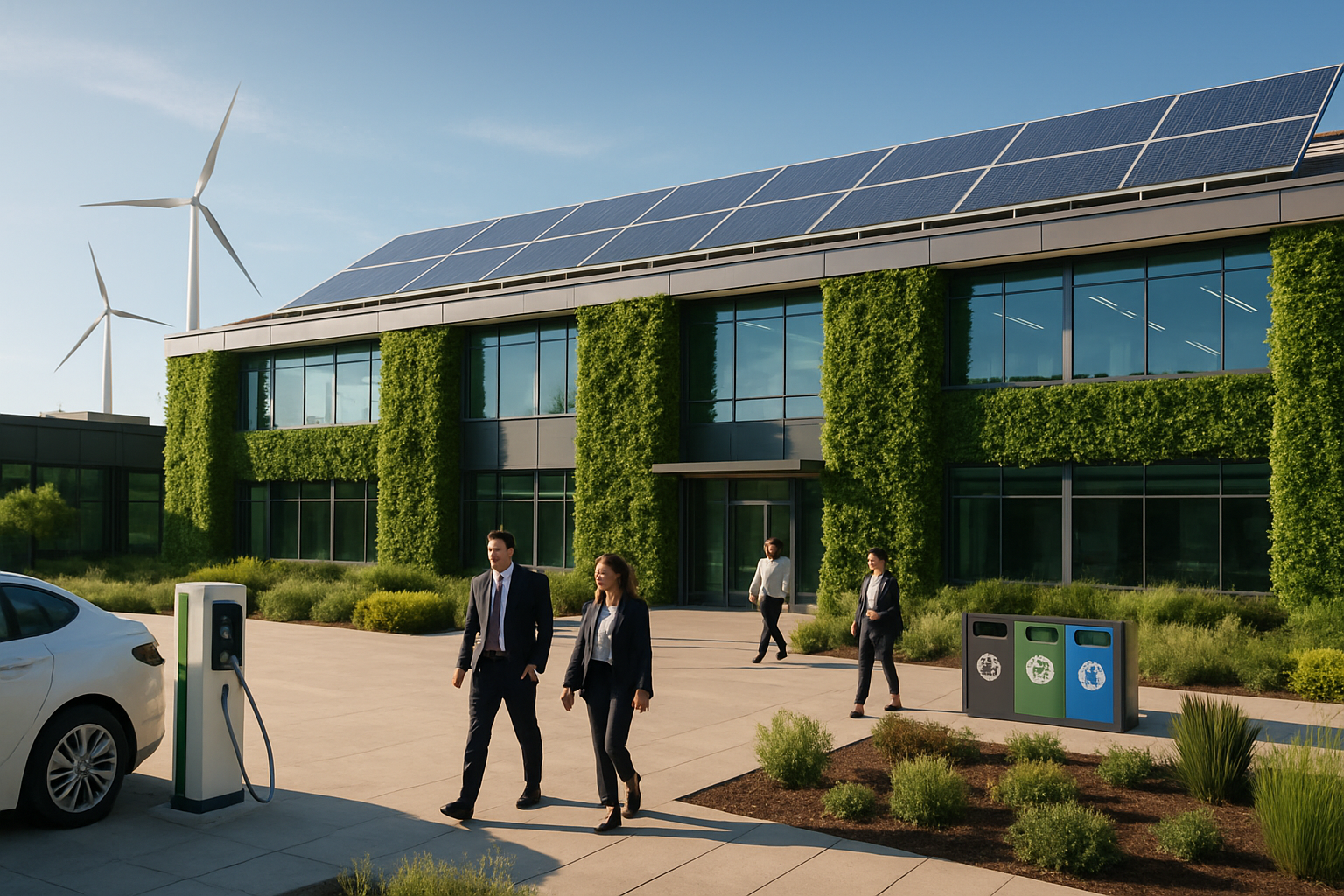
Companies across the globe are accelerating their investment in sustainable technologies and green business practices as 2026 emerges as a critical year for environmental transformation, with breakthrough innovations ranging from electric vehicle infrastructure to revolutionary wood-based construction materials driving unprecedented change in the business landscape.
The momentum for sustainable business practices has reached a tipping point, with major corporations and innovative manufacturers leading the charge toward environmental responsibility while simultaneously discovering that green technologies offer compelling economic advantages alongside their ecological benefits.
Automotive Industry Leads Sustainable Innovation
Lexus has positioned itself at the forefront of sustainable luxury through its ambitious "Beyond Zero" strategy, showcasing a comprehensive portfolio of hybrid, electric, and plug-in hybrid vehicles at Expomóvil 2026 in Costa Rica. The initiative represents a fundamental shift in how luxury automotive brands approach environmental responsibility, offering customers what the company describes as "an exclusive path to sustainable mobility without sacrificing performance or sophistication."
The Beyond Zero strategy employs a "multi-pathway" approach to sustainable transportation, recognizing that different markets and consumer needs require diverse technological solutions. This comprehensive framework includes advanced hybrid systems that optimize fuel efficiency while maintaining the performance standards expected by luxury vehicle buyers, alongside fully electric options for zero-emission driving.
"We are redefining luxury through sustainable innovation, proving that environmental responsibility and automotive excellence are not just compatible, but mutually reinforcing."
— Lexus Representative at Expomóvil 2026
The automotive sector's sustainability transformation extends far beyond individual vehicle technologies. Companies are implementing comprehensive approaches that encompass sustainable manufacturing processes, renewable energy adoption in production facilities, and circular economy principles throughout their supply chains.
Revolutionary Sustainable Materials Transform Construction
In Latvia, Stiga RM has launched what it describes as "the world's most advanced wood wool cement board factory" in Tukums, representing a breakthrough in sustainable construction materials. This facility exemplifies how traditional materials can be reimagined through innovative manufacturing processes to create products that are both environmentally responsible and technically superior.
Wood wool cement boards offer exceptional thermal and acoustic insulation properties while being manufactured from renewable wood resources combined with cement binding agents. The technology addresses multiple environmental challenges simultaneously: utilizing wood waste that might otherwise be discarded, creating building materials with superior energy efficiency properties, and reducing the carbon footprint of construction projects.

The facility's designation as the "world's most advanced" reflects not just its production capabilities, but its integration of digital monitoring systems, energy-efficient manufacturing processes, and waste minimization technologies. These innovations demonstrate how sustainable manufacturing can achieve both environmental objectives and operational excellence.
Technology Integration Drives Efficiency
The sustainable business transformation is characterized by sophisticated integration of cutting-edge technology with environmental responsibility. Companies are discovering that advanced monitoring systems, artificial intelligence, and automation technologies can simultaneously reduce environmental impact and improve operational efficiency.
Digital monitoring systems enable real-time tracking of energy consumption, waste production, and resource utilization across manufacturing operations. This data-driven approach allows companies to identify optimization opportunities that reduce environmental impact while cutting operational costs. The result is a virtuous cycle where environmental responsibility directly contributes to business profitability.
- Real-time energy monitoring reduces consumption by 15-25% through optimized operations
- Predictive maintenance systems minimize equipment downtime and material waste
- Automated quality control reduces defect rates and associated resource waste
- Supply chain optimization reduces transportation emissions and costs
Economic Advantages of Environmental Leadership
The business case for sustainability has evolved from risk mitigation to competitive advantage creation. Companies implementing comprehensive environmental protection strategies demonstrate greater economic resilience and attract substantial sustainable investment across multiple sectors, including green technology manufacturing, eco-tourism, and environmental services.
Economic analyses consistently show that ecosystem services and sustainable business practices deliver greater long-term economic value than traditional resource-extraction models. Wetlands prevent billions in flood damage annually, forests regulate water and climate patterns, and biodiversity supports pharmaceutical research and eco-tourism worth hundreds of billions globally.
The multiplier effects of sustainable business practices extend well beyond direct environmental benefits. Improved public health outcomes reduce healthcare costs, enhanced agricultural productivity through ecosystem services increases food security, and reduced infrastructure costs from natural disaster prevention create substantial economic value.
International Cooperation Accelerates Progress
The global nature of environmental challenges has necessitated unprecedented international cooperation in sustainable business development. Knowledge sharing creates global networks that strengthen local capacity while contributing to planetary sustainability. This cooperation has evolved from traditional North-South aid models toward peer-to-peer collaboration, with developing nations emerging as environmental solution providers.
Technology transfer mechanisms are supporting rapid infrastructure scaling while respecting local autonomy and cultural priorities. The diversity of approaches provides resilience against single-solution dependencies, offering multiple adaptation pathways for addressing complex environmental challenges spanning biological, physical, and human systems.
"Successful environmental initiatives demonstrate the sophisticated synthesis of cutting-edge technology with traditional ecological knowledge and community-based management."
— Environmental Policy Expert
Supply Chain Transformation and Resilience
Sustainable business practices are fundamentally reshaping global supply chains as companies recognize both the risks of traditional approaches and the opportunities presented by green technologies. The transformation encompasses materials sourcing, manufacturing processes, transportation methods, and end-of-life product management.
Companies are discovering that sustainable supply chains often prove more resilient to disruptions while reducing long-term costs. Renewable energy adoption shields businesses from volatile fossil fuel prices, circular economy principles reduce raw material dependencies, and local sourcing strategies minimize transportation risks and costs.
The integration of environmental considerations into supply chain management has revealed numerous opportunities for innovation and efficiency improvement. Companies are developing new partnerships with suppliers who share environmental commitments, creating collaborative networks that drive innovation throughout entire industries.
Consumer Demand Drives Market Transformation
Consumer awareness and demand for sustainable products and services have become powerful market forces driving business transformation. Companies are discovering that environmental responsibility is increasingly essential for brand reputation, customer loyalty, and market access, particularly among younger demographic segments.
This consumer-driven demand has created new market opportunities for companies that can effectively combine sustainability with quality and performance. The premium that consumers are willing to pay for genuinely sustainable products provides economic incentives for continued innovation and environmental improvement.
Market research consistently shows that consumers are increasingly making purchasing decisions based on environmental considerations, creating competitive advantages for companies that can demonstrate authentic commitment to sustainability through measurable actions and transparent reporting.
Future Outlook: Sustainability as Business Strategy
The convergence of environmental urgency, technological advancement, economic incentives, and consumer demand has positioned 2026 as a watershed year for sustainable business transformation. Companies that embrace comprehensive sustainability strategies are positioning themselves for long-term success in an increasingly environmentally conscious global marketplace.
The window for effective environmental action continues to narrow as ecological systems approach critical thresholds, but the tools, knowledge, and cooperation frameworks for comprehensive environmental protection have never been more sophisticated or widely available. Success depends on sustained international cooperation, enhanced coordination, and financial commitments that recognize environmental protection as essential infrastructure for human prosperity and planetary sustainability.
The sustainable business revolution of 2026 offers hope and practical guidance for the massive coordinated effort required to maintain planetary habitability during Earth's most environmentally challenging period in recorded history. Companies leading this transformation are proving that environmental responsibility and business success are not just compatible, but mutually reinforcing elements of 21st-century prosperity.