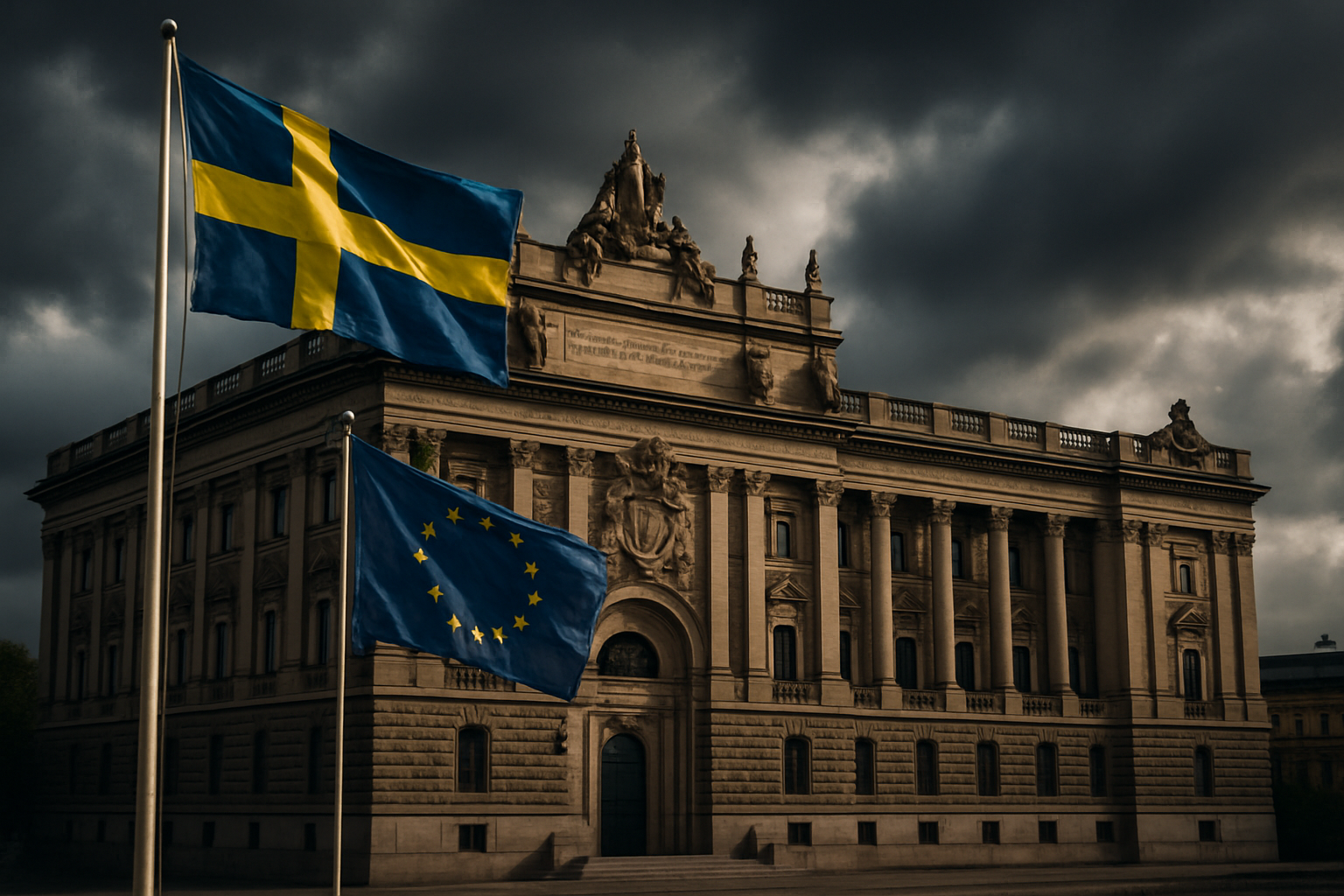
Swedish Prime Minister Ulf Kristersson announced Wednesday that his Moderaterna party is prepared to include the Sweden Democrats (SD) in a formal government coalition following the September 13, 2026 elections, marking a historic departure from decades of Nordic political consensus that marginalized far-right movements.
The announcement, delivered during a joint press conference with SD leader Jimmie Åkesson, represents the most significant political realignment in Swedish politics since the establishment of Social Democratic hegemony in the 20th century. For the first time since Sweden's democratic consolidation, a party with white nationalist historical roots would gain formal ministerial positions and policy influence.
Breaking the Last Barrier
"We have agreed to kick off the next mandate period and form a strong majority government if we receive the voters' trust," Kristersson declared, standing alongside Åkesson in what observers described as a watershed moment for European democracy. The partnership would end Sweden's status as the last major European democracy to exclude far-right parties from government participation entirely.
According to current polling data, the proportional representation system would likely grant the Sweden Democrats ministerial positions equivalent to their electoral strength. Åkesson himself has expressed interest in serving as Migration Minister, telling Dagens Nyheter: "I think it sounds great with Migration Minister Åkesson."
The announcement comes as Sweden has not had a majority government since 2006, with political fragmentation forcing increasingly complex coalition arrangements. The Moderaterna-SD partnership aims to create what both leaders termed a "strong majority government" capable of implementing substantial policy changes.
European Context: A Continental Pattern
Sweden's political realignment occurs within what analysts describe as the most challenging period for European democracy since World War II. Across the continent, traditional democratic safeguards against far-right participation are systematically eroding through electoral means rather than revolutionary violence.
Recent developments across Europe demonstrate this pattern of "authoritarian innovation" - sophisticated far-right movements operating within democratic systems while gradually undermining liberal norms:
- Germany: Alternative für Deutschland (AfD) achieved 18% support in Baden-Württemberg, traditionally one of Germany's most stable states
- France: Marine Le Pen's National Rally has evolved from rural populism to sophisticated urban campaigning, targeting major cities for municipal breakthroughs
- Spain: Vox surged 55% in Aragón, capturing over 30 municipalities from the Popular Party
- Netherlands: Coalition mathematics increasingly favor far-right participation despite mainstream resistance
A recent Eurobarometer survey revealed that 89% of Europeans demand greater EU unity, yet political reality demonstrates increasing fragmentation and sovereignty assertions - creating a dangerous disconnect between public aspirations and institutional capacity.
Internal Opposition and Democratic Strain
The Moderaterna-SD cooperation has triggered intense internal crisis within Sweden's political establishment. Liberal Party leader Simona Mohamsson faces unprecedented rebellion over similar cooperation discussions, with party members warning that collaboration with SD "risks killing our party."
"This is not the same Sweden Democrats we once knew. This represents a fundamental transformation of Nordic political culture."
— Political analyst, speaking anonymously due to security concerns
Regional Liberal Party organizations, particularly in Värmland, have demanded no-confidence votes against party leadership over SD cooperation. Gender Equality Minister Nina Larsson and Labor Market Minister Johan Britz have reportedly threatened mass resignation if cooperation proceeds, potentially triggering a broader governmental crisis.
The internal strife reflects deeper questions about democratic institutional adaptation. Traditional mechanisms - parliamentary coalitions, media scrutiny, civil society opposition - appear insufficient for containing movements that have adapted their messaging for mainstream consumption while maintaining radical policy agendas.
Policy Implications and International Concerns
The Moderaterna-SD partnership would grant the far-right significant influence over immigration policy, social services, and democratic institutions themselves. SD's historical opposition to multiculturalism and European integration could fundamentally alter Sweden's international positioning within NATO and the European Union.
During the press conference, Åkesson emphasized his party's commitment to "Swedish values" and reducing immigration, policies that would represent dramatic departures from Sweden's traditionally liberal approach. The partnership occurs as Sweden navigates NATO membership discussions and Baltic security concerns amid heightened regional tensions with Russia.
International observers have expressed concern about the precedent this cooperation sets for other Nordic countries. Finland and Denmark both face rising far-right movements that could use Sweden's normalization as justification for similar mainstream acceptance.
Historical Significance
The Sweden Democrats emerged from Sweden's white supremacist movement in the 1980s, maintaining neo-Nazi imagery and rhetoric well into the 1990s. Under Åkesson's leadership since 2005, the party has undergone systematic rebranding, moderating its public presentation while maintaining core anti-immigration and nationalist positions.
Current polling suggests SD commands approximately 20% voter support, making them Sweden's second-largest party and an indispensable coalition partner for conservative governance. This electoral strength has enabled them to demand formal government participation rather than remaining external supporters.
The transformation reflects broader European trends where far-right movements have abandoned revolutionary rhetoric in favor of democratic capture strategies. By working within institutional frameworks while gradually shifting policy boundaries, these parties pose sophisticated challenges to traditional democratic responses.
September Elections: Democratic Crossroads
The September 13, 2026 elections will determine whether Swedish voters endorse this historic political realignment. Opinion polls suggest the Moderaterna-SD coalition could achieve a working majority, though voter sentiment remains volatile amid economic pressures and security concerns.
Opposition parties have mobilized around themes of democratic preservation and international cooperation, arguing that SD inclusion would damage Sweden's reputation and effectiveness within European institutions. The Social Democrats, led by Magdalena Andersson, have pledged to maintain traditional Swedish values of openness and internationalism.
The electoral outcome will influence broader European democratic development, providing either a template for far-right mainstreaming or evidence of democratic resilience against extremist normalization.
Implications for European Democracy
Sweden's potential far-right government participation represents a critical test for European democratic institutions. The Nordic countries have historically served as models of democratic governance, making Sweden's transformation particularly concerning for EU leadership.
As one senior EU official noted: "We are writing the template for 21st-century crisis management, and the world is watching how democratic institutions adapt while preserving fundamental values."
The success or failure of various coalition strategies across Europe will influence approaches to extremism management through electoral versus extra-legal means. Whether institutional frameworks can channel political tensions constructively while maintaining democratic values will establish precedents for other nations facing similar challenges.
The coming months will prove decisive for Swedish democratic traditions and their adaptation to contemporary political realities. The stakes extend beyond Sweden's domestic politics to fundamental questions about democratic navigation in an era of rising authoritarianism and political extremism.