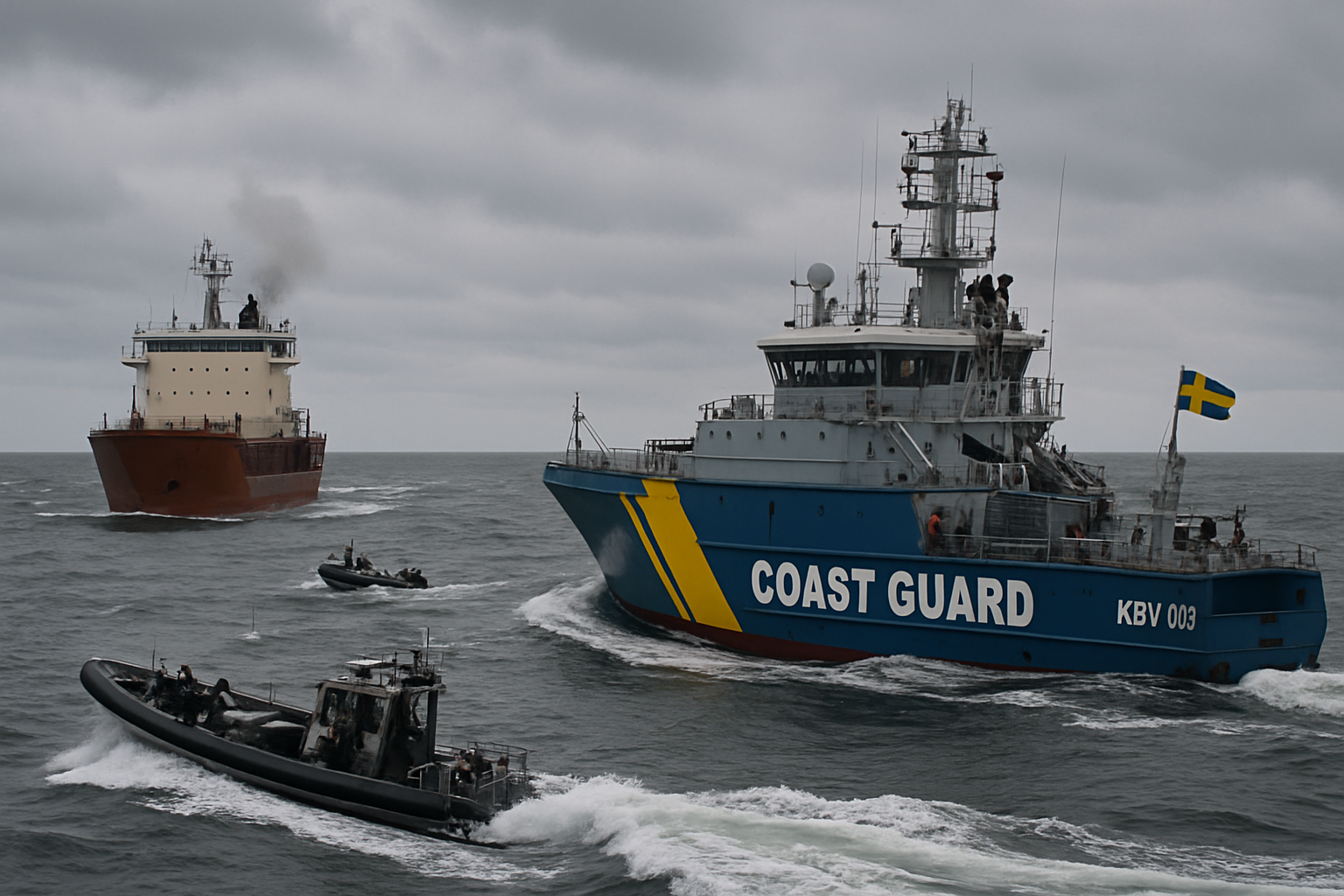
Swedish coast guard and police forces have seized a Russian shadow fleet cargo vessel suspected of carrying stolen Ukrainian grain, marking the most significant maritime enforcement action against sanctions-evading operations in European waters to date.
The cargo ship Caffa, sailing under a false Guinea flag with a predominantly Russian crew, was intercepted on Friday, March 6, 2026, as it attempted to reach St. Petersburg from Baltic Sea waters. Swedish authorities confirmed the vessel was operating without proper registration documents and is blacklisted under Ukraine's sanctions regime targeting Russia's extensive shadow fleet network.
Major Enforcement Operation
The seizure operation involved Swedish coast guard vessels and specialized police units conducting a sophisticated maritime interception off the coast of Trelleborg. A helicopter landed directly on the cargo vessel during the operation, demonstrating the coordinated nature of the enforcement action.
"The vessel has predominantly Russian crew, operates under a false flag and is on Ukraine's sanctions list,"
— Swedish Law Enforcement Officials
Swedish Defense Minister Carl-Oskar Bohlin personally boarded the suspected vessel during the operation, highlighting the high-level government attention to the case. The ship was formally seized upon arrival at a Swedish port, with all crew members detained for questioning.
Shadow Fleet Operations Exposed
Intelligence estimates suggest over 600 vessels worldwide participate in Russia's sophisticated shadow fleet operations, using false documentation and concealed ownership to circumvent international sanctions. The Caffa represents a significant breakthrough in efforts to combat these evasion networks.
The vessel was reportedly carrying agricultural products suspected to be stolen Ukrainian grain, part of a systematic effort by Russian forces to transport seized commodities from occupied territories. This practice has been documented extensively by international observers as a violation of international law regarding occupied territories.
European investigators have revealed that approximately one-third of Russia's shadow fleet operates without correct flag state authorization, creating legal enforcement opportunities under international maritime law that authorities have been increasingly willing to utilize.
EU Sanctions Framework
The seizure comes in the context of the European Union's comprehensive 20th sanctions package, which introduced a complete ban on maritime services supporting Russian crude oil exports. The package targeted insurance, maintenance, port access, and technical support services, representing a dramatic expansion beyond previous import restrictions.
Belgium previously conducted a historic shadow fleet seizure in the North Sea with French support and G7/Nordic/Baltic coordination, establishing a template for coordinated international enforcement actions. The Swedish operation builds on this precedent while demonstrating enhanced surveillance capabilities across European waters.
Iranian Naval Incident
The Baltic Sea operation occurred against the backdrop of broader maritime security concerns, including the mysterious sinking of the Iranian warship IRIS Dena off Sri Lanka's coast. The Moudge-class frigate went down with 100-150 personnel missing, representing a significant loss for Iran's naval capabilities in the Indian Ocean.
Sri Lankan Foreign Minister Vijitha Herath confirmed the vessel's sinking to parliament, with 32 survivors rescued and several bodies recovered. While the exact circumstances remain under investigation, defense sources suggest the possibility of a submarine attack by unknown forces.
Technology and International Cooperation
The successful enforcement operations demonstrate the effectiveness of advanced surveillance technology, including satellite tracking, AI-powered monitoring, and real-time analytics enabling better detection of suspicious maritime activities. However, coordination across different jurisdictions remains challenging for comprehensive enforcement.
The Swedish operation required extensive international cooperation, with intelligence sharing among NATO allies and EU members providing the foundation for successful interdiction. This template could influence future maritime enforcement operations across European waters.
Broader Security Implications
Maritime security experts note that these incidents occur during a period of heightened tensions in European waters. Nordic officials have reported a dramatic increase in Russian reconnaissance activities since Sweden and Finland joined NATO, fundamentally altering the strategic balance in the Baltic Sea region.
The successful seizure operations disrupt revenue streams supporting sanctioned entities while maintaining global oil market integrity by preventing unauthorized exports that undermine international trade restrictions. They also demonstrate that coordinated international efforts can effectively counter sophisticated sanctions violations.
The enforcement actions represent a shift toward more aggressive maritime operations against shadow fleet vessels, with hundreds of similar ships still operating in violation of sanctions across European waters. Success in these cases may encourage more systematic enforcement efforts across the region.
Economic Impact
The shadow fleet operations have significant economic implications, as they enable Russia to continue exporting energy and agricultural products despite international sanctions. The maritime services ban is expected to significantly increase global oil transportation costs and force Russia into expensive, inefficient shipping arrangements requiring state-controlled infrastructure development.
For Ukraine, the theft and transportation of agricultural products from occupied territories represents both economic warfare and a violation of international humanitarian law. The successful interdiction of vessels carrying stolen grain provides some measure of accountability for these practices.
The enforcement operations occur during a broader energy crisis, with the Strait of Hormuz effectively closed affecting 40% of global oil transit, demonstrating how maritime security incidents can have far-reaching economic consequences across global supply chains.