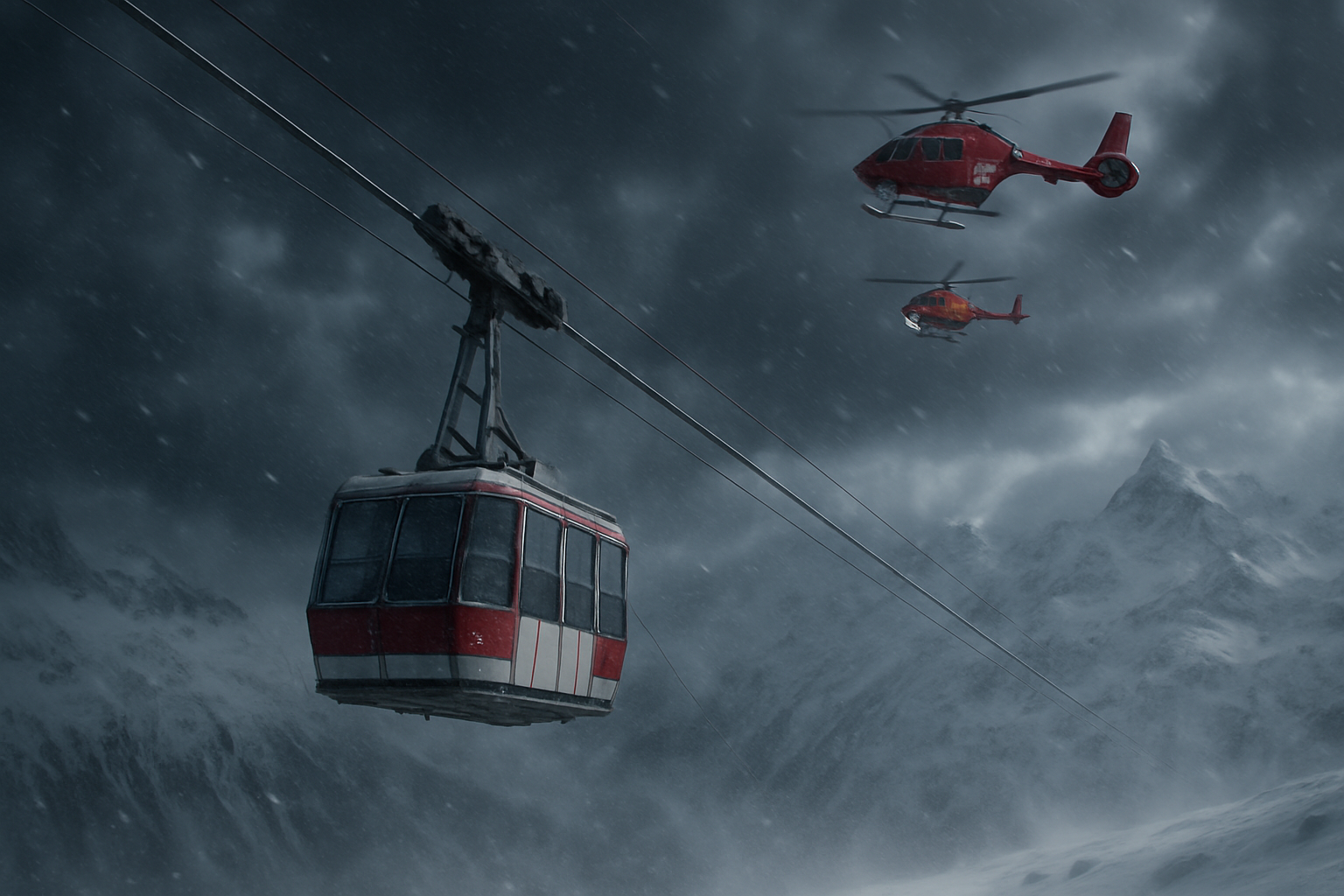
A cable car cabin plummeted to the ground at Switzerland's Engelberg ski resort on Wednesday afternoon, killing one person and highlighting mounting safety concerns as extreme weather conditions continue to batter Alpine infrastructure across Europe.
The tragedy occurred at approximately 2,000 meters altitude at the popular Titlis ski resort in Engelberg, central Switzerland, when powerful winds caused a gondola cabin to detach from its cables and crash into the mountainside. Emergency services confirmed one fatality, with the sole occupant of the cabin dying at the scene.
According to multiple European news sources, the cabin "overturned several times before crashing to the ground" in what witnesses described as terrifying scenes. Italian media reported that strong winds were the primary factor in the accident, which occurred during a period of severe weather warnings across the Swiss Alps.
Immediate Emergency Response
Swiss authorities launched an immediate emergency response operation, evacuating all remaining cabins on the cable car system as a precautionary measure. Rescue helicopters were deployed to the scene, though their operations were hampered by the same severe wind conditions that caused the initial accident.
The victim, whose identity has not yet been released, was reportedly alone in the cabin when it became detached from the cable system. Emergency medical personnel confirmed the death at the scene, despite rapid response efforts from local mountain rescue teams.
All other gondolas on the Titlis cable car system were successfully evacuated without further incident, though several passengers reportedly experienced significant distress during the emergency descent procedures.
Context of Alpine Infrastructure Crisis
This latest tragedy occurs against the backdrop of what experts are calling an unprecedented crisis in European Alpine safety. The 2025-2026 winter season has already claimed over 60 lives in avalanche incidents across the European Alps, with extreme weather conditions creating dangerous situations far beyond normal parameters.
The incident comes just weeks after the conclusion of the Milano-Cortina 2026 Winter Olympics, which themselves faced significant infrastructure challenges. During the Games, the incomplete Apollonio-Socrepes cable car system forced school closures in the Cortina region, highlighting ongoing concerns about aging Alpine transportation infrastructure.
Switzerland's cable car systems are generally considered among the world's safest, with rigorous maintenance protocols and advanced safety systems. However, the extreme weather conditions experienced across Europe this winter have pushed infrastructure beyond its designed operational limits.
Extreme Weather Patterns
The Engelberg tragedy is directly linked to the succession of Atlantic storms that have battered Europe throughout the winter season. Storms Leonardo, Marta, and Nils have created layered, unstable conditions not only in snow pack—leading to the avalanche crisis—but also in wind patterns affecting mountainous regions.
Weather experts note that the same atmospheric disturbances responsible for creating ideal snow conditions have also generated unprecedented wind speeds in Alpine valleys. These conditions have repeatedly forced the closure of cable car systems across Switzerland, Austria, France, and Italy.
Paradoxically, while January 2026 was confirmed as the hottest month in recorded history globally—the 20th consecutive month to exceed 1.5°C above pre-industrial levels—the regional European winter has been characterized by extreme cold, with temperatures dropping to -30°C in some areas.
Broader Transportation Safety Concerns
The Swiss cable car incident forms part of a troubling pattern of transportation safety challenges across Europe and beyond during early 2026. February witnessed significant railway sabotage in Italy during the Winter Olympics, major avalanche incidents in Austria and France, and widespread infrastructure failures due to extreme weather.
Transportation safety experts emphasize that traditional safety protocols, designed for historical weather patterns, are proving inadequate for the climate volatility now being experienced. The intersection of infrastructure aging, deferred maintenance, and unprecedented weather conditions creates compounding risk factors.
In Switzerland specifically, the cable car industry has maintained an exemplary safety record for decades, making Wednesday's incident all the more shocking for both authorities and the public. The Swiss Federal Office of Transport has announced a comprehensive investigation into the mechanical, weather, and operational factors that contributed to the tragedy.
Investigation and Industry Response
Authorities have launched a multi-faceted investigation examining the cable car's mechanical systems, maintenance records, and operational procedures during extreme weather conditions. Preliminary findings suggest that wind speeds exceeded the system's operational parameters, though investigators emphasize that the full investigation will take weeks to complete.
The Swiss cable car industry association has called for an urgent review of extreme weather protocols across all Alpine transportation systems. Industry leaders acknowledge that traditional safety margins may no longer be adequate given the increasing frequency and intensity of severe weather events.
European transportation authorities are expected to collaborate on updated safety standards that account for the new reality of climate volatility. This may include enhanced wind monitoring systems, revised operational limits, and improved emergency evacuation procedures.
Tourism Industry Impact
The tragedy strikes at the heart of Switzerland's crucial winter tourism industry, which relies heavily on cable car systems to transport millions of visitors annually to Alpine destinations. Engelberg, located in central Switzerland, is a popular destination for both skiing and year-round mountain activities.
Tourism officials face the challenging task of balancing safety restrictions with economic needs, particularly given the industry's importance to local communities. The incident is likely to prompt renewed discussions about liability, insurance, and risk management in mountain tourism operations.
The timing is particularly sensitive, coming just weeks after the successful completion of the Milano-Cortina Winter Olympics, which showcased the Alps' continuing appeal despite infrastructure challenges. Tourism authorities across the Alpine region are now reassessing their emergency preparedness protocols.
Climate Adaptation Challenges
Environmental scientists emphasize that Wednesday's tragedy illustrates the urgent need for climate-resilient infrastructure in mountainous regions. The current paradox of record global warmth coinciding with severe regional winter conditions represents exactly the kind of climate volatility that experts have long predicted.
Traditional infrastructure design assumes relatively stable historical weather patterns, but the new reality requires systems capable of handling much greater variability in temperature, precipitation, and wind conditions. This represents a massive challenge for existing cable car systems across the European Alps.
The broader implications extend beyond individual incidents to questions about the long-term viability of current Alpine transportation networks under changing climate conditions. Adaptation strategies may require fundamental rethinking of how mountain transportation systems are designed, operated, and maintained.
International Cooperation Imperative
The cross-border nature of Alpine safety concerns has prompted calls for enhanced international cooperation in transportation safety standards. The European Union's Civil Protection Mechanism, already activated for the broader winter crisis, may need to expand its scope to include infrastructure resilience planning.
Switzerland, despite its non-EU status, maintains close cooperation with neighboring countries on Alpine safety issues. The investigation findings from the Engelberg incident are likely to influence safety protocols across the broader Alpine region, including cable car systems in Austria, France, and Italy.
Experts emphasize that the simultaneous nature of extreme weather events across vast geographic areas requires coordinated international responses rather than purely national approaches. The traditional model of mutual aid assumes that some regions remain available to assist others during emergencies, but this assumption breaks down when extreme conditions affect multiple countries simultaneously.
Looking Forward
As investigations continue into the Engelberg cable car tragedy, the incident serves as a stark reminder of the new realities facing Alpine infrastructure. The death of one person in what should have been a routine transportation operation highlights how quickly normal activities can become dangerous under extreme weather conditions.
The Swiss transportation industry, long considered a global leader in mountain safety, now faces the challenge of adapting decades of proven safety protocols to unprecedented environmental conditions. The outcome of this adaptation will likely influence mountain transportation safety standards worldwide.
For the immediate future, visitors to Alpine resorts can expect enhanced weather monitoring, more conservative operational decisions, and potentially more frequent service suspensions during adverse conditions. While this may impact convenience, the priority must remain on preventing further tragedies like the one that struck Engelberg on Wednesday.
The broader lesson extends beyond the Alps to mountainous regions worldwide: infrastructure systems designed for historical weather patterns may no longer provide adequate safety margins in an era of increasing climate volatility. The challenge now is to adapt these systems before more lives are lost.