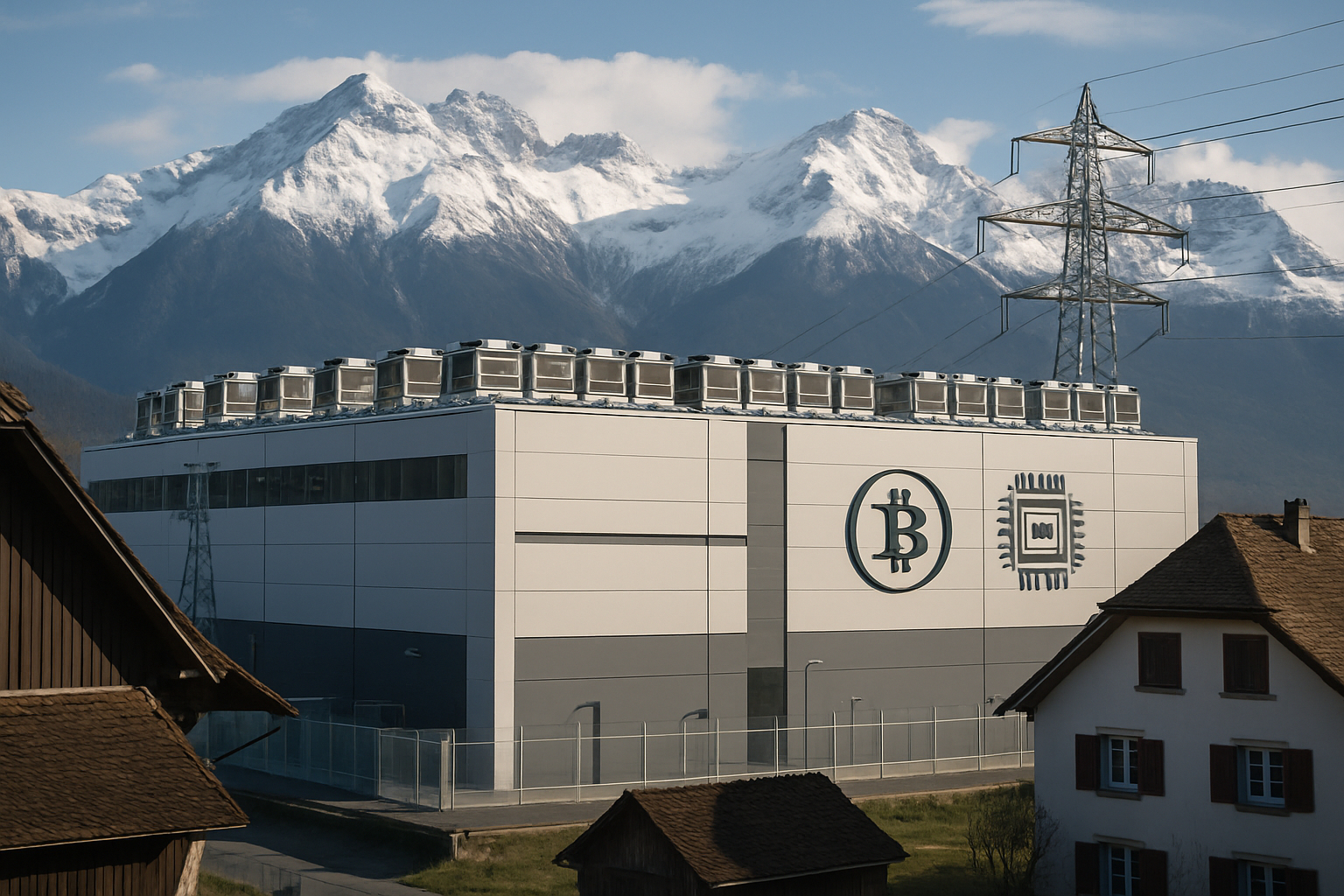
Switzerland stands at the epicenter of a growing global controversy over energy-intensive data centers and cryptocurrency mining operations, as massive electricity consumption threatens to overwhelm the nation's power infrastructure while government subsidies create unprecedented environmental justice concerns.
The Alpine nation, long celebrated for its environmental stewardship and renewable energy leadership, now confronts a stark reality: the boom in computing infrastructure is driving electricity consumption to unsustainable levels, forcing the government to massively invest in infrastructure upgrades while subsidizing the very industries creating the crisis.
According to a comprehensive investigation by Swiss media, data centers—many housing cryptocurrency mining and AI operations—have become the country's largest electricity consumers while simultaneously receiving federal subsidies and accessing discounted electricity rates. This paradox has ignited a fierce national debate about whether energy-intensive technology industries are paying their fair share for Switzerland's strained electrical infrastructure.
The Scale of the Crisis
The numbers paint a sobering picture of Switzerland's energy predicament. Data centers now consume approximately 4-6% of the nation's total electricity production, with some facilities requiring as much power as entire municipalities. This surge aligns with global trends documented by the World Bank, which projects that AI systems alone will require 4.2-6.6 billion cubic meters of water annually by 2027 for data center cooling—equivalent to four to six times Denmark's total annual water consumption.
The electricity hunger extends far beyond Switzerland's borders. The global semiconductor crisis has driven memory chip prices sixfold higher, affecting major manufacturers Samsung, SK Hynix, and Micron, creating a "critical vulnerability window" that industry analysts expect to persist until 2027 when new fabrication facilities come online. This scarcity has intensified competition for computing resources, driving up both demand and energy consumption across European data centers.
Swiss energy officials report that the country must now invest billions of francs in electrical grid upgrades specifically to accommodate these power-hungry facilities. The irony is not lost on critics: Switzerland is subsidizing an industry that forces taxpayers to fund massive infrastructure improvements while potentially compromising the nation's climate goals.
Cryptocurrency Mining's Energy Footprint
Cryptocurrency mining operations represent a particularly contentious segment of Switzerland's data center boom. These facilities run sophisticated computer arrays around the clock, solving complex mathematical puzzles to validate blockchain transactions and earn digital currency rewards. The process, known as "proof of work," requires enormous computational power and generates substantial heat, necessitating extensive cooling systems that further increase electricity consumption.
Switzerland's traditionally stable political environment, robust electrical grid, and competitive energy prices have attracted major cryptocurrency mining operations from across Europe. However, the concentrated nature of these facilities means that small communities often bear disproportionate environmental costs while receiving minimal economic benefits.
The situation reflects broader global tensions around cryptocurrency regulation. Spain recently implemented the world's first criminal executive liability framework for technology platforms, while France has conducted cybercrime raids on AI companies. The European Union is investigating Digital Services Act violations that could result in penalties worth billions of euros, signaling a coordinated regulatory intensification across the continent.
Government Subsidies Under Scrutiny
Perhaps most controversial is the revelation that many energy-intensive data centers receive government financial incentives while accessing electricity at below-market rates. These subsidies, originally designed to attract technology investment and create jobs, now appear to incentivize unsustainable energy consumption patterns.
The federal subsidy system operates through multiple mechanisms: direct cash rebates for technology infrastructure investments, reduced electricity tariffs for large consumers, and tax advantages for companies establishing operations in designated technology zones. Critics argue this amounts to socializing the environmental costs while privatizing the profits.
Environmental justice advocates point out that rural communities hosting these facilities often experience increased truck traffic, noise pollution, and strain on local infrastructure without corresponding economic benefits. Meanwhile, urban populations face higher electricity costs and potential power shortages as grid capacity is diverted to serve industrial consumers.
"We're essentially paying these companies to consume our electricity and then paying again to upgrade our infrastructure to support them. This is economically and environmentally unsustainable."
— Dr. Maria Schneider, Swiss Energy Policy Institute
The Global Context
Switzerland's dilemma reflects a worldwide reckoning with energy-intensive computing infrastructure. Major technology companies have committed unprecedented investments in AI and data center expansion: Alphabet allocated $185 billion for AI infrastructure in 2026—the largest single-year corporate technology investment in history—while Amazon announced plans exceeding $1 trillion over the coming decade.
This investment surge occurs amid the "SaaSpocalypse," a market disruption that has eliminated hundreds of billions in traditional software company market capitalization as artificial intelligence demonstrates direct replacement capabilities rather than merely complementary functions. Microsoft's Mustafa Suleyman predicts that AI will replace the majority of office workers within two years and lawyers and auditors within 18 months.
The infrastructure demands are staggering. Consumer electronics costs have increased 20-30% globally due to semiconductor shortages, while major technology companies compete for limited chip supplies. This scarcity has paradoxically spurred innovation in memory-efficient algorithms and sustainable deployment strategies that maximize capabilities while minimizing hardware requirements.
International cooperation on technology governance is intensifying. The United Nations has established an Independent Scientific Panel of 40 experts under Secretary-General António Guterres as the first fully independent global AI assessment body, representing the most sophisticated technology governance framework since internet commercialization.
Environmental Justice Concerns
The environmental impact extends beyond electricity consumption to broader ecosystem effects. Data centers require massive amounts of water for cooling systems, placing additional strain on Switzerland's water resources during increasingly hot summers. The heat generated by these facilities also creates localized temperature increases that can affect surrounding communities and wildlife habitats.
Community protests have emerged across several Swiss cantons, with residents demanding comprehensive environmental impact assessments and meaningful participation in planning decisions. These demonstrations echo similar movements globally, including Malaysia's first major community protest against data center development in February 2026, where over 50 residents demanded an end to dust pollution and compensation for health impacts.
The protests highlight a growing pattern of environmental resistance to AI infrastructure. Communities increasingly recognize that while technology companies profit from these facilities, local populations bear the environmental costs including air and noise pollution, increased truck traffic, and strain on public services.
Regulatory Response and Future Outlook
Swiss policymakers face a complex balancing act between maintaining the country's competitive position in global technology markets while protecting environmental quality and ensuring equitable distribution of costs and benefits. Several proposals are under consideration:
- Graduated electricity pricing: Implementing tiered electricity rates that increase substantially for high-consumption industrial users
- Environmental impact bonds: Requiring data center operators to post financial guarantees covering environmental remediation costs
- Community benefit requirements: Mandating that large facilities provide direct economic benefits to hosting communities
- Renewable energy mandates: Requiring all data centers to source electricity exclusively from renewable sources
The regulatory response must also address the global nature of these industries. Cryptocurrency operations can relocate quickly if regulatory environments become unfavorable, potentially shifting environmental problems to countries with weaker oversight rather than solving them. This mobility creates a "race to the bottom" dynamic that requires international coordination to address effectively.
Innovation in Sustainable Computing
Despite the challenges, Switzerland's crisis is driving innovation in sustainable computing solutions. Several Swiss companies are pioneering advanced cooling technologies that use ambient air rather than water-intensive systems, while others are developing more energy-efficient mining hardware that reduces electricity consumption per unit of computational power.
The global semiconductor shortage has paradoxically accelerated development of more efficient algorithms and alternative processing architectures. Edge computing solutions that distribute processing closer to end users can reduce the need for centralized data centers, while hybrid cloud-local processing systems optimize performance while minimizing energy consumption.
Some innovative approaches include locating data centers in cold climates where natural cooling reduces energy requirements, and integrating facilities with renewable energy projects where excess wind or solar power can be utilized for computing operations during peak generation periods.
International Models and Best Practices
Switzerland can learn from successful technology integration models worldwide. Malaysia operates the world's first AI-integrated Islamic school, demonstrating how technology can enhance rather than replace traditional educational approaches. Singapore's WonderBot 2.0 heritage education program successfully integrates AI while preserving cultural values. Canadian universities use AI teaching assistants that maintain critical thinking standards while improving educational efficiency.
These examples share common characteristics: sustained political commitment beyond electoral cycles, comprehensive stakeholder engagement, careful balance of technological advancement with human development, and prevention-first approaches that demonstrate superior outcomes through decreased crisis intervention costs and improved long-term sustainability.
"The future of computing infrastructure must serve human flourishing while preserving the environmental foundations of our prosperity. Switzerland has an opportunity to lead this transformation."
— Prof. Andreas Weber, ETH Zurich Sustainable Computing Initiative
Critical Decision Point
Switzerland's data center and cryptocurrency mining regulation represents a critical test case for 21st-century technology governance. The decisions made in the coming months will establish precedents for how democratic societies balance technological advancement with environmental protection, private profits with public costs, and national competitiveness with international cooperation on climate goals.
The stakes extend far beyond Switzerland's borders. As other European nations grapple with similar challenges, the Swiss approach will influence regional policy frameworks and potentially serve as a model for global technology governance. The European Union's coordinated approach to platform regulation, including Spain's criminal executive liability framework for technology platforms and France's AI cybercrime raids, demonstrates the potential for multinational cooperation on technology policy.
Success requires unprecedented coordination between government agencies, technology companies, environmental organizations, and affected communities. The goal must be ensuring that artificial intelligence and cryptocurrency technologies serve human flourishing while preserving the environmental systems that support civilization.
The Path Forward
Switzerland's energy crisis represents both a challenge and an opportunity. The nation can either continue subsidizing unsustainable energy consumption patterns or become a global leader in responsible technology development that prioritizes environmental sustainability alongside economic competitiveness.
The most promising path involves sophisticated human-technology collaboration that amplifies human capabilities while preserving Switzerland's environmental excellence. This approach requires treating AI and cryptocurrency infrastructure as tools for enhancing Swiss society rather than ends in themselves, with clear metrics for environmental impact, community benefit, and long-term sustainability.
The window for effective coordinated action is narrowing rapidly. Technology infrastructure decisions made in 2026 will establish patterns affecting Switzerland's energy security, environmental quality, and social cohesion for decades to come. The choice between reactive crisis management and proactive sustainable development may determine whether Switzerland maintains its position as a global leader in both technology innovation and environmental stewardship.
As global attention focuses on Switzerland's approach to regulating energy-intensive computing infrastructure, the nation has an opportunity to demonstrate that technological advancement and environmental responsibility are not mutually exclusive but rather mutually reinforcing when guided by thoughtful policy frameworks that prioritize human welfare and planetary sustainability.