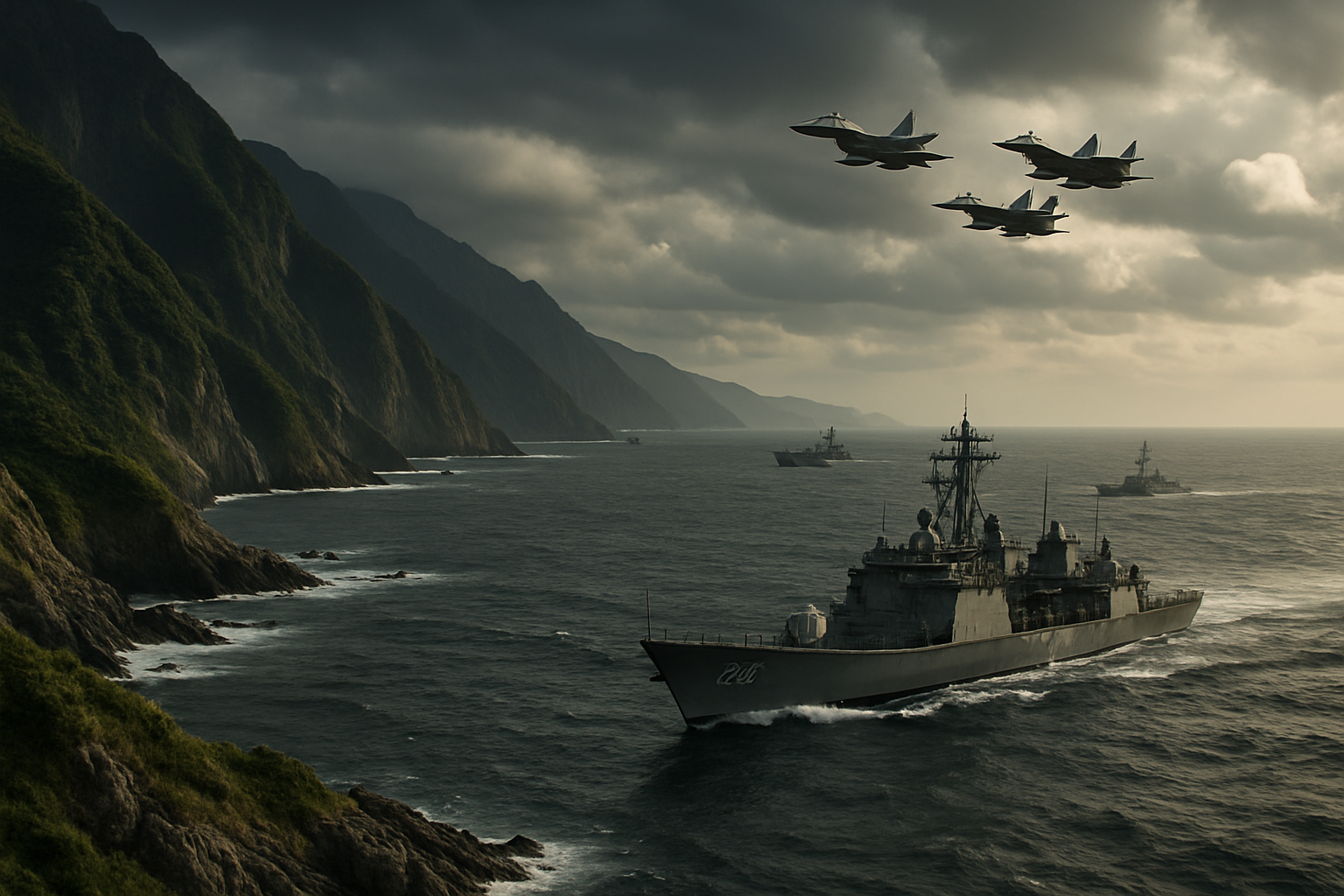
Taiwan's Defense Minister Wellington Koo has issued a stark warning about China's intensifying military pressure campaign, describing daily military exercises and psychological warfare tactics designed to exhaust Taiwan's population as Beijing pursues what officials characterize as a comprehensive strategy to weaken the island's resolve.
The warning comes as Chinese military activity around Taiwan reached unprecedented levels in 2025, with Defense Minister Koo revealing that the number of Chinese military aircraft detected near Taiwan, including fighter jets and drones, increased by 23% compared to the previous year. This escalation represents China's most sustained military pressure campaign against the democratic island to date.
Daily Military Pressure and Psychological Warfare
According to Albanian media reports citing Taiwanese officials, China has deployed increasingly "complex and precise" tactics throughout 2025, combining military pressure, cyber attacks, and psychological warfare in a coordinated effort to undermine Taiwan's democratic institutions and public morale.
"The daily military exercises and other pressure tactics by China to exhaust the island risk overwhelming or fatiguing the Taiwanese people against their neighbor," Defense Minister Koo stated, highlighting the systematic nature of Beijing's approach.
China, which views Taiwan as its territory despite the island's democratic government and de facto independence, has maintained a constant military presence around Taiwan, sending warplanes and naval vessels into the skies and waters surrounding the island on a daily basis. The campaign intensified significantly following China's most recent large-scale military exercises near Taiwan conducted in late December 2025.
Regional Security Context
The escalating Taiwan Strait tensions occur within a broader regional security environment marked by multiple flashpoints across the Asia-Pacific region. Recent developments in the South China Sea have added additional layers of complexity to the regional security situation.
The Philippines Navy has announced plans to establish a monitoring station at the UNESCO World Heritage site Tubbataha Reefs Natural Park in the South China Sea, a move designed to strengthen security in the Sulu Sea region. The site, located near areas where Chinese military vessels have previously operated, represents Manila's growing assertiveness in protecting its territorial claims.
Meanwhile, ongoing tensions between the United States and China over strategic islands continue to complicate the regional security landscape. President Trump recently engaged in discussions with UK Prime Minister Keir Starmer regarding Diego Garcia Island in the Indian Ocean, warning of potential military action if current agreements are altered—demonstrating how territorial disputes across multiple regions are interconnected.
Historical Context of Cross-Strait Relations
The current escalation builds upon years of deteriorating cross-strait relations, particularly following China's military modernization under President Xi Jinping's leadership. According to diplomatic sources familiar with recent developments, Xi has called Taiwan "the most important issue" in China-US relations during communications with the Trump administration, emphasizing Beijing's unwavering commitment to eventual unification.
China's approach has evolved significantly from previous decades, now employing what analysts describe as a "dual-track strategy" combining military pressure through regular exercises with diplomatic engagement targeting Taiwan's opposition political parties. Beijing has announced intentions to "continue strengthening exchanges and contacts" with Taiwan's main opposition party as part of efforts to "unite efforts" for what Chinese leadership terms the "great rejuvenation of the Chinese nation."
This strategy represents an attempt to circumvent Taiwan's current Democratic Progressive Party (DPP) government by cultivating alternative political channels, while simultaneously maintaining military pressure to demonstrate the potential costs of continued independence.
Military Modernization and Leadership Changes
The escalation in military pressure coincides with significant changes within China's military hierarchy. General Zhang Youxia, the 75-year-old vice-chairman of China's Central Military Commission and one of the most influential military figures in China, is currently under investigation for corruption as part of Xi Jinping's broader military reforms.
Zhang's investigation, described by the official PLA newspaper as removing obstacles to strengthening military power and combat capabilities, suggests Xi has now consolidated complete control over the People's Liberation Army. This development has raised concerns among regional security analysts that the removal of potential internal military opposition could clear the path for more aggressive actions toward Taiwan.
International Response and Implications
The United States continues to maintain its policy of strategic ambiguity while providing defensive support to Taiwan through advanced systems, intelligence sharing, and training programs. Taiwanese officials have welcomed recent Trump-Xi conversations as potentially stabilizing, stating their belief that such communications "will contribute to stabilizing the situation, especially given that China continues to escalate tensions in Taiwan Strait."
Taiwan maintains what officials describe as a "rock solid" relationship with the United States despite ongoing diplomatic evolution. However, the island faces the challenge of navigating between security needs and diplomatic constraints as regional powers monitor developments for their implications on trade and security.
Regional allies, including Japan, South Korea, and ASEAN nations, are closely watching Taiwan Strait developments given their potential impact on crucial shipping lanes that facilitate global supply chains. The Taiwan issue has become central to Asia-Pacific security dynamics, affecting everything from North Korea nuclear concerns to South China Sea disputes and Indo-Pacific alliance structures.
Taiwan's Defense Preparations
In response to mounting Chinese pressure, Taiwan has been upgrading its defensive capabilities and maintaining high levels of military readiness. The island's military regularly conducts exercises designed to counter potential Chinese invasion scenarios, while implementing new technologies and strategies to address the growing military imbalance across the strait.
Defense Minister Koo's public warnings about Chinese exhaustion tactics reflect Taiwan's awareness that Beijing's strategy extends beyond traditional military threats to encompass psychological and economic warfare designed to undermine public confidence in the democratic government's ability to maintain security.
Future Outlook and Regional Stability
The current trajectory of China-Taiwan tensions occurs against the backdrop of broader great power competition between the United States and China, with implications extending far beyond the Taiwan Strait. The situation requires careful diplomatic management to prevent miscalculation that could trigger a larger regional conflict.
Success in managing these tensions depends on what regional diplomatic sources describe as "pragmatic solutions addressing security concerns while respecting democratic principles and regional stability." The challenge lies in finding approaches that can address China's unification goals, Taiwan's democratic autonomy, and regional stability requirements simultaneously.
As Chinese military pressure continues to intensify and regional security concerns mount, the Taiwan Strait remains one of the world's most closely watched potential flashpoints, with implications for global security, economic stability, and the future of democratic governance in the Asia-Pacific region.