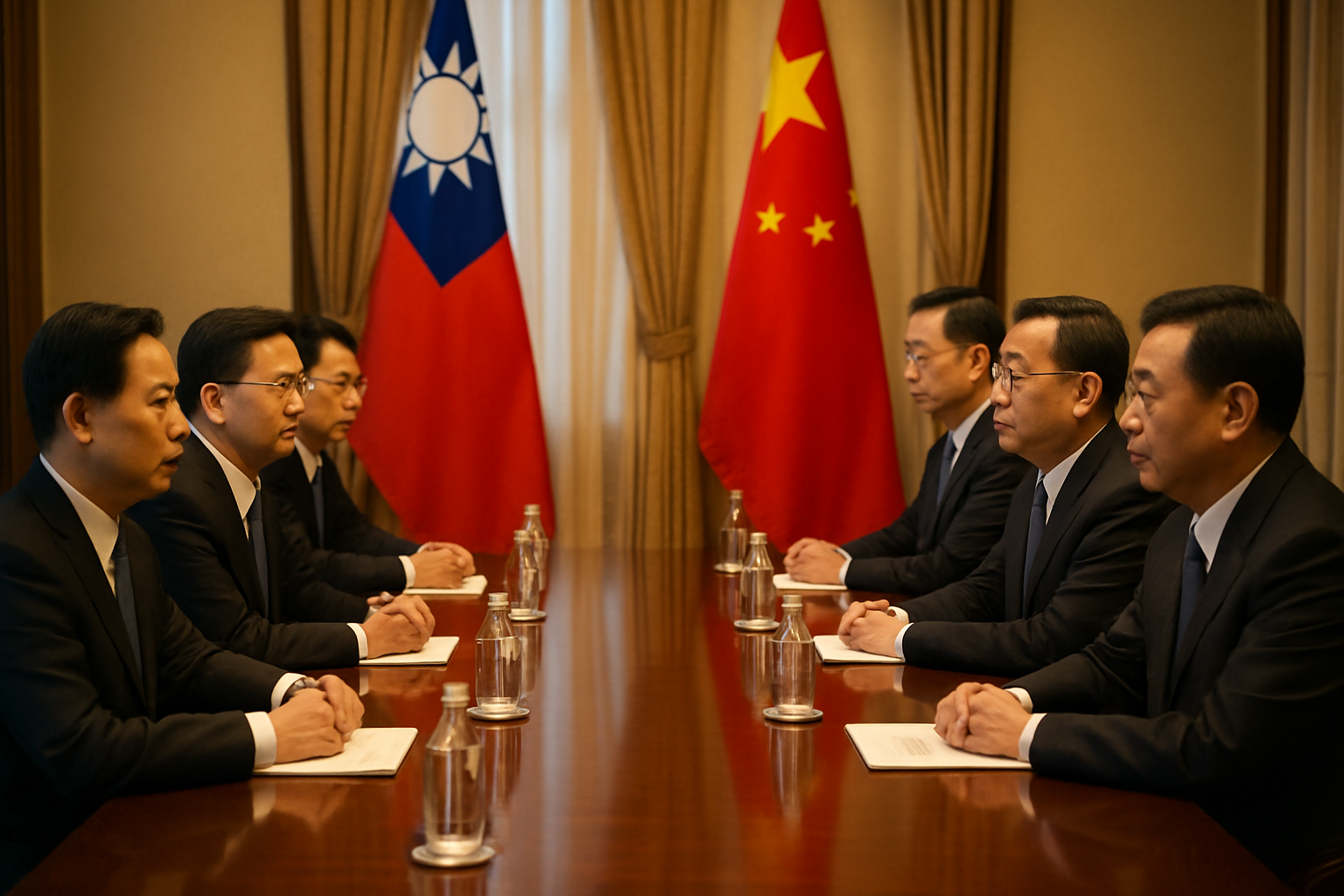
Taiwan's main opposition leader has accepted an unprecedented invitation from Chinese President Xi Jinping to visit mainland China from April 7-12, marking the most significant cross-strait diplomatic development in years amid escalating tensions between Taipei and Beijing.
Cheng Li-wun, chairwoman of Taiwan's largest opposition party, the Kuomintang (KMT), confirmed Monday that she will lead a delegation to Beijing, Shanghai, and Jiangsu province at the invitation of the Chinese Communist Party Central Committee. The visit represents her first trip to mainland China since assuming the KMT leadership position in November 2025.
Song Tao, head of Beijing's Taiwan Work Office, announced that Xi Jinping personally extended the invitation to "promote the peaceful development of cross-Strait relations." The Chinese leadership has positioned the visit as an opportunity to advance dialogue between the two sides of the Taiwan Strait, bypassing the current Democratic Progressive Party (DPP) government in Taipei.
Strategic Context of Cross-Strait Relations
The invitation comes during a period of unprecedented military pressure from Beijing. Chinese military aircraft activity around Taiwan increased 23% in 2025, with daily warplane and naval vessel deployments that Taiwan's Defense Minister Wellington Koo described as designed to "exhaust" and "fatigue" the Taiwanese population.
This systematic pressure campaign represents the most sustained military challenge Taiwan has faced, with China conducting large-scale exercises as recently as December 2025. Beijing has employed what analysts describe as a "dual-track approach" - maintaining military pressure while simultaneously engaging with Taiwan's opposition parties to circumvent the current DPP administration.
"The visit will focus on promoting the peaceful development of cross-Strait relations and advancing exchanges between the two sides."
— Song Tao, Taiwan Work Office Director
The timing is particularly significant as it occurs against the backdrop of broader regional tensions. Taiwan President Lai Ching-te has warned that if China seizes Taiwan, "the next countries under threat would be Japan, the Philippines, and others in the Indo-Pacific region," highlighting the international implications of cross-strait stability.
Historical Significance of Opposition Engagement
Beijing's strategy of engaging Taiwan's opposition parties while maintaining pressure on the ruling government reflects China's long-term approach to achieving its goal of "great rejuvenation of the Chinese nation." This diplomatic outreach represents an alternative channel for Beijing to influence Taiwan's political landscape without dealing directly with what it considers the "separatist" DPP government.
The KMT, founded in mainland China, historically favored closer ties with Beijing compared to the independence-leaning DPP. Cheng Li-wun's acceptance of Xi's invitation signals the opposition's willingness to maintain dialogue despite the current tensions and may influence Taiwan's domestic political dynamics ahead of future elections.
According to multiple international sources, including reports from Portugal's RTP and Romania's Digi24, the visit is being closely monitored by regional allies who view cross-strait stability as crucial for broader Asia-Pacific security and global supply chains.
Regional and International Implications
The diplomatic engagement occurs amid a complex international environment. The United States has completed a historic trade agreement with Taiwan, eliminating tariffs up to 26% on agricultural imports and securing $85 billion in Taiwanese purchases of American products. Meanwhile, a bipartisan delegation of U.S. senators recently visited Taiwan to discuss military spending increases.
Japan's Prime Minister Sanae Takaichi, who achieved a historic electoral supermajority in February 2026, has taken a firm stance supporting Taiwan, which prompted China's failed attempt to rally Southeast Asian nations against Japan. The lack of regional support for China's diplomatic offensive demonstrates the complexity of alliance structures in the Indo-Pacific.
European officials are also monitoring the situation closely, with Cyprus and other EU nations emphasizing the importance of peaceful resolution to cross-strait tensions. The Taiwan Strait's significance extends far beyond regional security, as it serves as a critical shipping lane for global supply chains, particularly for semiconductor production.
Economic Dimensions and Trade Relations
The visit comes as China pursues an ambitious expansion of its global economic partnerships. Beijing recently announced zero-tariff access for 53 African countries starting May 1, 2026, representing the most comprehensive China-Africa trade expansion in history. This demonstrates China's broader strategy of positioning itself as a champion of multilateral cooperation.
China's economic leverage remains substantial, controlling 60% of global critical minerals production and 90% of refining capacity. However, recent developments show challenges to Chinese dominance, including Japan's breakthrough in deep-sea rare earth mining and the formation of the U.S.-EU-Japan Critical Minerals Partnership involving 55 countries.
Taiwan's semiconductor industry adds another crucial economic dimension to the crisis. The island's technological leadership in chip manufacturing makes it strategically vital for global supply chains, affecting everything from smartphones to military systems.
Military Pressure and Security Concerns
Despite the diplomatic overture, China has shown no signs of reducing military pressure on Taiwan. The 23% increase in Chinese military activity throughout 2025 includes daily deployments of warplanes and naval vessels around the island, representing what defense analysts describe as a campaign of systematic intimidation.
Recent intelligence reports indicate that Beijing has consolidated control over the People's Liberation Army following corruption investigations, including the removal of General Zhang Youxia, the 75-year-old vice-chairman of China's Central Military Commission. This consolidation potentially removes internal opposition to military action against Taiwan.
The military pressure campaign employs sophisticated tactics combining traditional exercises with cyber attacks and psychological warfare. Beijing's approach demonstrates its commitment to achieving reunification through multiple channels while maintaining the threat of force as the ultimate option.
U.S.-China Relations Context
The Taiwan opposition visit occurs amid broader U.S.-China diplomatic developments. President Trump's planned meeting with Xi Jinping, originally scheduled for March 31-April 2, has been postponed due to the ongoing Iran crisis. The February 4 phone call between the two leaders, described as "excellent," covered Taiwan tensions among other issues, with Xi calling Taiwan "the most important issue" in China-U.S. relations.
Trump administration officials have expressed concerns about China's role in global conflicts, including allegations that Chinese company SMIC provided chipmaking tools to Iran's military. These developments complicate the broader strategic competition between Washington and Beijing, with Taiwan remaining at the center of their rivalry.
Future Implications and Strategic Assessment
Cheng Li-wun's April visit represents a critical test of whether diplomatic engagement can provide an alternative to the current trajectory toward confrontation. The success or failure of these discussions could influence both Taiwan's domestic politics and Beijing's strategy for achieving its reunification goals.
For Taiwan's democracy, the visit highlights the challenge of maintaining unity in the face of external pressure while preserving space for legitimate political opposition. The KMT's engagement with Beijing must balance the party's traditional ties with mainland China against the need to represent Taiwan's democratic values and sovereignty.
From Beijing's perspective, the visit offers an opportunity to demonstrate that alternatives exist to the current DPP administration's approach. Success in establishing productive dialogue could strengthen China's position that peaceful reunification remains possible, while failure might reinforce arguments for more coercive measures.
Regional allies and international observers will closely monitor the outcomes of this diplomatic engagement. The visit's results may influence future approaches to cross-strait relations and provide insights into whether dialogue can supplement or replace the current trajectory of military pressure and economic coercion.
As tensions continue to escalate in the Taiwan Strait, Cheng Li-wun's historic visit to mainland China represents both an opportunity for de-escalation and a test of whether diplomatic engagement can provide sustainable frameworks for managing one of the world's most dangerous territorial disputes. The stakes extend far beyond Taiwan and mainland China, affecting regional stability, global supply chains, and the broader evolution of international order in the 21st century.