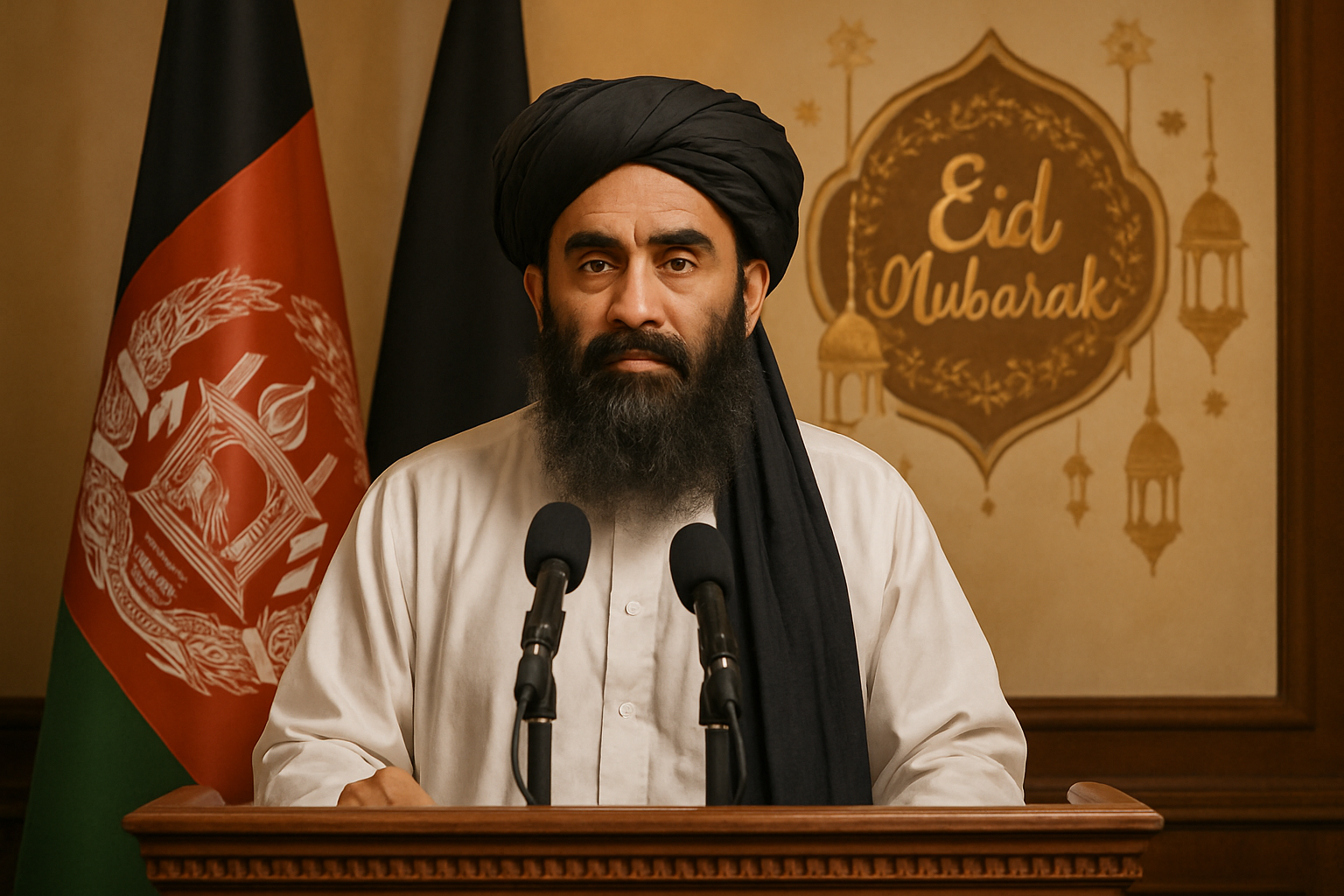
Taliban Supreme Leader Hibatullah Akhundzada used his Eid al-Fitr message to call for international non-interference in Afghanistan's internal affairs, marking the latest assertion of sovereignty by the Islamic Emirate amid ongoing regional tensions and diplomatic challenges.
The message, released Monday by Taliban Deputy Spokesperson Hamdullah Fitrat, emphasized Afghanistan's desire for constructive international relations while firmly rejecting external involvement in domestic governance. The timing of this diplomatic statement comes as Afghanistan faces mounting pressure over cross-border security concerns and ongoing disputes with neighboring Pakistan.
Sovereignty at the Center of Eid Message
According to the Taliban's official communication, Akhundzada extended Eid-ul-Fitr greetings to Afghans and Muslims worldwide while calling for unity, charity, and continued support for the country's Islamic system. The Supreme Leader congratulated the "Mujahid and devout people of Afghanistan" and prayed for divine acceptance of the fasting, prayers, and worship performed during Ramadan.
The message specifically urged Muslims to use Eid as an occasion to strengthen compassion and social solidarity, emphasizing the importance of Zakat-ul-Fitr and encouraging wealthy individuals to assist widows, orphans, and poor families. "On this blessed day Muslims should remove hatred and resentment from their hearts, forgive one another and exchange Eid greetings," the statement declared.
"Other countries should not interfere in our internal affairs. The Taliban seeks constructive relations with all nations while maintaining our sovereignty and independence."
— Taliban Deputy Spokesperson Hamdullah Fitrat
Regional Context and Border Tensions
The non-interference message carries particular significance given Afghanistan's recent military confrontation with Pakistan, which has created the most serious border crisis since the Taliban's return to power in August 2021. The conflict began with a February 16 attack by the Tehrik-e-Taliban Pakistan (TTP) that killed 11 Pakistani soldiers in Bajaur district, triggering a series of retaliatory strikes and counter-strikes.
Pakistan's Defense Minister Khawaja Asif declared "open war" against the Taliban government in late February, leading to sustained military operations along the disputed 2,640-kilometer Durand Line. The crisis has resulted in significant civilian casualties, with UNAMA documenting 185 casualties since late February, including 56 killed and 129 wounded, the majority being women and children.
The humanitarian impact has been severe, with 16,370 families newly displaced across 10 Afghan provinces. Bilateral trade between the countries has collapsed by 59%, with Pakistani exports dropping from $550 million to $228 million over seven months, affecting border communities and compounding Afghanistan's existing humanitarian crisis.
International Mediation Efforts
Despite intensive international mediation efforts by Turkey, Iran, Russia, and China, the military confrontation has continued. These diplomatic initiatives have included prisoner exchanges facilitated by Saudi Arabia and calls for ceasefires from Islamic scholars during Ramadan, but underlying security challenges persist.
The Taliban maintains that no armed groups operate from Afghan soil against neighboring countries, while Pakistan insists that TTP militants use Afghanistan as a sanctuary for launching attacks. This fundamental disagreement over territorial control and cross-border terrorism has complicated diplomatic solutions.
Emphasis on Unity and Islamic Governance
Beyond the sovereignty message, Akhundzada's Eid statement emphasized internal unity and support for Afghanistan's Islamic system. He called on Afghans to support the country's security forces and maintain unity, warning against ethnic, linguistic, or regional divisions.
The Supreme Leader urged the Afghan people to strengthen their commitment to Islamic values and support the Islamic Emirate's governance structure. This messaging reflects ongoing efforts by the Taliban to consolidate legitimacy and maintain social cohesion amid international isolation and economic challenges.
Afghanistan continues to face severe humanitarian challenges, with 88% of female-headed households unable to meet minimum living requirements according to UN data. The Taliban's restrictions on women's rights have contributed to Afghanistan ranking 181st out of 181 countries in the Georgetown Institute's Women, Peace and Security Index.
Strategic Implications for Regional Diplomacy
The non-interference call represents part of a broader Taliban diplomatic strategy that emphasizes sovereignty while seeking practical engagement with the international community. Despite lacking formal recognition from most countries, the Islamic Emirate has maintained functional diplomatic relationships with several regional powers.
Pakistan acknowledges its diminished influence in Afghanistan compared to wealthier powers such as Turkey, UAE, Qatar, Saudi Arabia, and China, which has forced it to rely increasingly on military solutions for border security concerns. This shift in regional dynamics has complicated traditional diplomatic approaches to Afghanistan-Pakistan relations.
The timing of the Eid message also coincides with ongoing efforts by multiple countries to mediate the border crisis. Chinese Foreign Minister Wang Yi recently expressed readiness to assist in resolving the Pakistan-Afghanistan dispute through diplomatic dialogue, while Turkish Foreign Minister Hakan Fidan has been shuttling between Kabul and Islamabad to promote reconciliation.
Challenges to Taliban Governance Claims
While the Taliban emphasizes its commitment to preventing Afghanistan's territory from being used against neighboring countries, international observers have raised concerns about the presence of various militant groups. Chinese officials have warned the UN Security Council about the continued presence of ISIS-K, al-Qaeda, and ETIM operatives in Afghanistan, contradicting Taliban claims of having defeated terrorism.
These security concerns have contributed to sustained international pressure on the Taliban government, even as the group has achieved some notable successes such as reducing opium cultivation to near-zero levels following a Supreme Leader decree - a development praised internationally given Afghanistan's previous production of 80% of global opium.
Looking Forward
As the Taliban government continues to consolidate control and seek international legitimacy, the balance between asserting sovereignty and addressing legitimate security concerns of neighboring countries remains a critical challenge. The Eid message's emphasis on non-interference reflects this ongoing tension between independence and regional cooperation.
The success or failure of current diplomatic mediation efforts will likely determine whether the sovereignty-focused approach advocated in Akhundzada's message can coexist with the practical needs of regional security cooperation. For Afghanistan's neighbors and the international community, finding frameworks that respect sovereignty while addressing transnational terrorism concerns remains one of the most significant diplomatic challenges in South Asian security architecture.
The coming weeks will be crucial in determining whether the Taliban's call for non-interference can be reconciled with regional security needs, potentially setting important precedents for 21st-century conflict resolution in areas where territorial sovereignty intersects with transnational security threats.