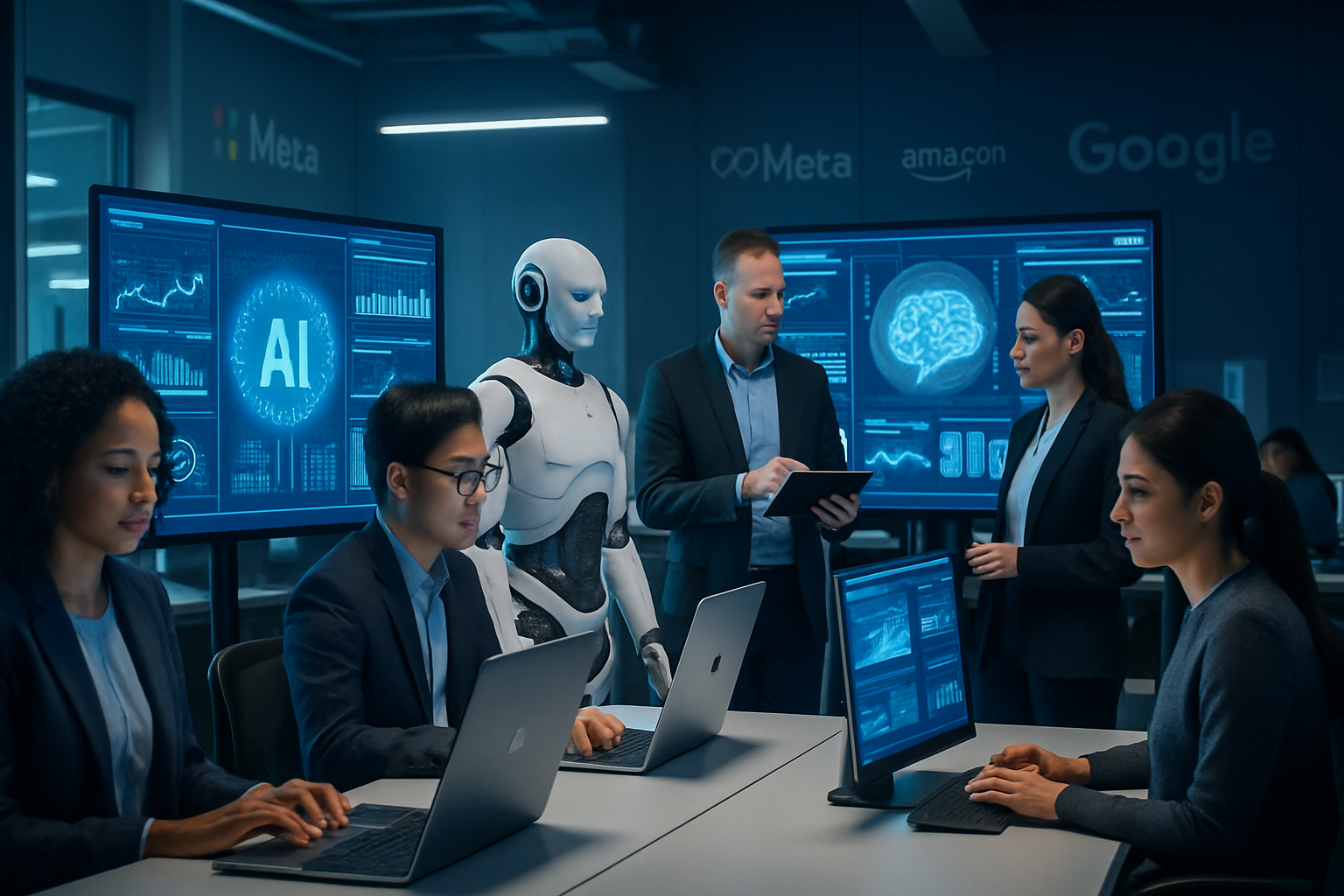
Technology giants Meta and Microsoft have announced significant workforce reductions while simultaneously accelerating their artificial intelligence investments, marking a critical inflection point in the industry's transformation as companies reshape their operations around AI-powered business models.
The simultaneous decisions by these industry leaders reflect a broader phenomenon sweeping through the technology sector, where companies are restructuring their workforces while redirecting billions toward AI development. This transformation occurs as artificial intelligence transitions from experimental technology to essential business infrastructure across multiple sectors globally.
Meta and Microsoft Lead Industry Restructuring
Meta Platforms, the parent company of Facebook, Instagram, and WhatsApp, has been preparing sweeping layoffs affecting potentially 20% or more of its workforce, representing tens of thousands of positions. The reductions stem from mounting AI infrastructure costs amid a global semiconductor crisis that has driven memory chip prices to unprecedented levels.
Microsoft, meanwhile, has continued its strategic pivot toward artificial intelligence, with company leadership, including Mustafa Suleyman, predicting that AI will replace the majority of office workers within two years, with lawyers and auditors potentially being displaced within 18 months. These predictions are gaining credibility as AI systems demonstrate increasingly sophisticated capabilities.
"We're witnessing the most significant technology sector transformation since the internet's emergence, determining the competitive landscape for the remainder of the decade."
— Industry Analysis Report, February 2026
The "SaaSpocalypse" Phenomenon
The current wave of restructuring is occurring within what industry analysts have dubbed the "SaaSpocalypse" – the systematic elimination of hundreds of billions in traditional software market capitalization as AI systems demonstrate direct replacement capabilities rather than merely complementary functions.
This transformation differs significantly from previous cost-cutting measures, as companies simultaneously eliminate traditional roles while hiring aggressively for AI-focused positions. Block Inc., led by Jack Dorsey, previously set a precedent in February 2026 by eliminating 4,000 positions (40% of its workforce), representing the first major tech layoff explicitly attributed to AI advancement rather than financial pressures.
WiseTech Global has implemented similar changes, cutting 2,000 positions (30% of its workforce), while Oracle terminated thousands of employees via email notifications, redirecting savings toward AI investments. These corporate decisions reflect a fundamental shift in how technology companies view workforce composition and operational priorities.
Infrastructure Constraints Drive Innovation
Despite facing a global semiconductor crisis with memory chip prices surging sixfold due to AI development demand affecting Samsung, SK Hynix, and Micron operations, major technology companies continue massive investments. Alphabet has committed $185 billion for AI infrastructure in 2026, representing the largest single-year corporate technology investment in history, while Amazon has announced plans exceeding $1 trillion for AI development over the next decade.
The infrastructure constraints have paradoxically spurred innovation in memory-efficient algorithms and sustainable deployment strategies. The World Bank projects that AI systems will require 4.2-6.6 billion cubic meters of water annually for data center cooling by 2027, equivalent to four to six times Denmark's annual consumption.
Regional Variations in Workforce Adaptation
The approach to workforce transformation varies significantly by region. Western companies typically implement traditional layoffs followed by selective AI hiring, while Asian corporations have adopted comprehensive worker transition programs emphasizing reskilling over displacement.
Indian IT giants including Infosys, Wipro, and HCL have demonstrated alternative workforce evolution strategies, focusing on comprehensive retraining programs rather than mass elimination of positions. Chinese company Unitree Robotics has scaled humanoid robot production from 5,500 to over 20,000 units, creating employment opportunities even as automation displaces workers elsewhere.
Successful Human-AI Collaboration Models
Amid the widespread restructuring, several successful models of human-AI collaboration have emerged that enhance rather than replace human capabilities. Canadian universities have implemented AI teaching assistants while maintaining critical thinking standards. Malaysia operates the world's first AI-integrated Islamic school, combining artificial intelligence with traditional learning approaches. Singapore's WonderBot 2.0 heritage education program has demonstrated how AI can amplify educational effectiveness while preserving cultural sensitivity.
These success stories share common characteristics: they treat AI as sophisticated amplification tools rather than replacement mechanisms, maintain sustained human development commitments, ensure comprehensive stakeholder engagement, and demonstrate cultural sensitivity in implementation.
"The future lies in sophisticated human-AI collaboration amplifying capabilities while preserving creativity, cultural understanding, and ethical reasoning that define human potential."
— Dr. Frank Bäumer, Productivity Research Institute
The Productivity Paradox
Research by Dr. Frank Bäumer has documented a concerning "productivity paradox" where AI implementation often creates more work rather than increased efficiency. Workers frequently perform their original responsibilities while also supervising and correcting AI outputs, creating a "double workload effect" that contradicts promised productivity gains.
Successful AI integration requires comprehensive change management, worker training, and workflow redesign rather than simply adding AI tools to existing processes. Organizations achieving superior outcomes focus on human-AI collaboration that preserves uniquely human qualities while leveraging computational advantages.
Regulatory Framework Evolution
The rapid transformation has prompted unprecedented regulatory responses globally. Spain has implemented the world's first criminal executive liability framework for technology platforms, creating potential imprisonment risks for executives. France has conducted AI company cybercrime raids, while the European Union pursues Digital Services Act violations that could result in billion-dollar penalties.
The United Nations has established an Independent Scientific Panel comprising 40 experts under Secretary-General António Guterres, representing the first fully independent global AI assessment body. This coordinated international response represents the most sophisticated global technology governance framework since internet commercialization.
Critical Choice Point for Civilization
Industry experts characterize April 2026 as a "civilizational choice point" that will determine whether AI serves human flourishing or becomes an exploitation tool beyond democratic accountability. The convergence of advancing AI capabilities, massive investments, infrastructure constraints, and regulatory pressures creates unprecedented coordination challenges.
Success requires balancing innovation acceleration with safety governance, commercial interests with human welfare, and national competitiveness with international cooperation. The window for coordinated proactive adaptation is narrowing rapidly, with decisions made in 2026 establishing decades-long human-AI relationship patterns affecting billions globally.
Implications for the Future of Work
Catherine Fisher from LinkedIn emphasizes that digital adaptability has become paramount – specifically, the capability for continuous learning rather than discrete technical proficiency. Essential competencies now include AI collaboration, data interpretation, emotional intelligence, creative problem-solving, and cultural competency spanning multiple domains.
The most promising path forward involves treating AI as sophisticated amplification tools that serve human goals while preserving creativity, empathy, and wisdom that define human potential. Organizations must focus on technological wisdom rather than technological dominance, ensuring that distinctly human qualities are preserved and valued.
Long-term Strategic Implications
The transformation occurring at Meta, Microsoft, and across the technology sector represents more than corporate restructuring – it's a fundamental reimagining of human-technology relationships that will shape civilization for generations. The challenge is ensuring that technological advancement serves humanity's highest aspirations while maintaining the qualities that provide meaning to human experience.
As the industry continues this unprecedented transformation, the decisions made by technology leaders will determine whether AI becomes a tool for human empowerment and creativity or a mechanism for increased inequality and social disruption. The stakes could not be higher, and the window for shaping this outcome continues to narrow with each passing month.