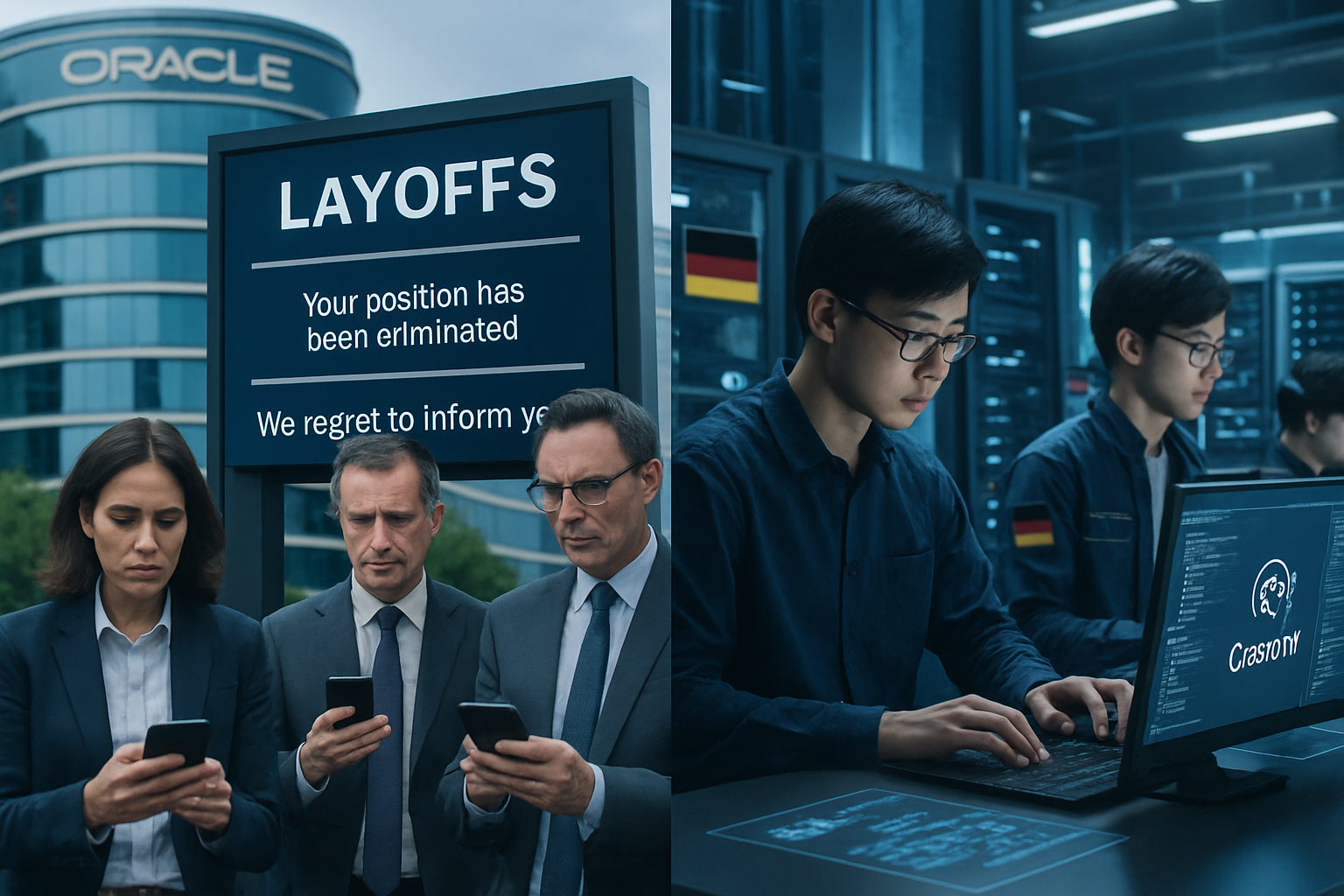
The global technology industry is experiencing its most dramatic transformation in decades, as Oracle's shocking email-based layoffs of thousands of employees collides with shifting AI market dynamics and massive infrastructure investments that signal the sector's evolution from experimental to essential digital infrastructure worldwide.
Oracle Corporation, the database giant founded by billionaire Larry Ellison, terminated thousands of employees through a simple email notification, citing a "broader reorganization" of the company. The abrupt dismissals, delivered at 6 AM without warning, represent the latest in a series of major corporate restructurings as technology companies redirect resources toward artificial intelligence investments amid what industry analysts are calling the "SaaSpocalypse" - the systematic elimination of hundreds of billions in traditional software market capitalization as AI demonstrates direct replacement capabilities.
AI Market Dynamics Shift Globally
Meanwhile, in Azerbaijan, ChatGPT's commanding 78.44% market share across all platforms in March 2026 masks underlying vulnerabilities as the AI chatbot experiences its fourth consecutive month of decline. This erosion of dominance reflects broader competitive pressures as Chinese AI companies, including Alibaba Cloud and Zhipu AI, pivot away from open-source strategies toward proprietary models designed to capture full commercial value through official revenue channels.
The strategic shift among Chinese AI giants represents a fundamental change in the global AI landscape. Industry sources report that while these companies haven't abandoned open-source strategies entirely, their most powerful models are growing in size and complexity, making them increasingly difficult to host on local hardware and pushing developers toward centralized, monetized platforms.
Infrastructure Crisis Drives Innovation
These developments occur against the backdrop of a global semiconductor crisis that has driven memory chip prices to surge sixfold, affecting major manufacturers Samsung, SK Hynix, and Micron with shortages expected to persist until 2027 when new fabrication facilities come online. Paradoxically, these constraints are spurring innovation in memory-efficient algorithms and sustainable deployment strategies that could democratize AI access while forcing more thoughtful implementation approaches.
The World Bank projects that AI infrastructure will require 4.2-6.6 billion cubic meters of water annually by 2027 for data center cooling - equivalent to 4-6 times Denmark's entire annual water consumption. This staggering demand is driving renewable energy investment and forcing companies to reconsider their expansion strategies.
Digital Sovereignty Movements Gain Momentum
Algeria's recent announcement of joining the global "50 in 5" campaign represents a significant development in the Global South's approach to digital transformation. The initiative, aimed at accelerating digital public infrastructure development in fifty countries over five years, positions Algeria within a growing movement of nations seeking to build domestic technological capabilities rather than remaining dependent on foreign platforms.
The Algerian Ministry of Post and Information and Communication Technologies emphasized that this participation aligns with the nation's vision for enhancing digital sovereignty, expanding financial inclusion, and ensuring equitable access to public services across the country's diverse regions.
SpaceX Prepares Historic IPO
Adding to the sector's transformation, Elon Musk's SpaceX is reportedly planning what could become the largest initial public offering in history this summer, with industry observers suggesting a valuation that would dwarf traditional technology companies. The aerospace manufacturer's potential IPO comes as space-based infrastructure becomes increasingly critical for global communications and data processing needs.
The timing is particularly significant as SpaceX has established itself as essential infrastructure for both civilian and military applications, with its Starlink satellite constellation providing critical communications capabilities for conflicts like the war in Ukraine while expanding global internet access.
Employment Transformation Accelerates
Oracle's layoff methodology - delivering termination notices via email during a corporate "reorganization" - reflects the broader employment upheaval affecting the technology sector. Microsoft's Mustafa Suleyman's predictions that AI will replace the majority of office workers within two years and lawyers/auditors within 18 months are gaining credibility as companies like Block Inc. have already eliminated thousands of positions explicitly citing AI advancement rather than financial pressures.
However, regional responses vary significantly. While Western companies pursue traditional layoff strategies followed by selective AI hiring, Asian corporations are implementing comprehensive worker transition programs that emphasize reskilling over displacement. Indian IT giants including Infosys, Wipro, and HCL Technologies are pioneering evolution strategies that adapt their workforce rather than eliminating it entirely.
Regulatory Frameworks Intensify
The technology sector's transformation is occurring under increasing regulatory scrutiny. Spain has implemented the world's first criminal executive liability framework for tech platforms, creating personal imprisonment risks for executives, while France has conducted AI company cybercrime raids. The European Union is investigating Digital Services Act violations with potential billions in penalties.
Most significantly, the United Nations has established an Independent Scientific Panel of 40 experts under Secretary-General António Guterres - the first fully independent global AI assessment body representing the most sophisticated international technology governance attempt since internet commercialization.
Successful Human-AI Collaboration Models Emerge
Despite the disruption, successful integration models are emerging globally. Canadian universities have implemented AI teaching assistants that maintain critical thinking standards, Malaysia operates the world's first AI-integrated Islamic school combining technology with traditional learning, and Singapore's WonderBot 2.0 has achieved heritage education success.
These models share common characteristics: they treat AI as amplification tools serving human goals rather than replacement mechanisms, maintain sustained human development commitment, ensure comprehensive stakeholder engagement, and demonstrate cultural sensitivity in implementation.
Investment Surge Despite Constraints
Remarkably, massive corporate investments continue despite infrastructure constraints. Alphabet has committed $185 billion to AI infrastructure in 2026 - the largest single-year corporate technology investment in history - while Amazon has announced development plans exceeding $1 trillion over the coming decade. These investments demonstrate corporate confidence in AI's transition from experimental to essential business infrastructure.
The Civilizational Choice Point
Industry experts characterize March 2026 as a "civilizational choice point" determining whether AI serves human flourishing and democratic values or becomes a tool for exploitation and surveillance beyond democratic accountability. The window for coordinated action is narrowing rapidly as technological development accelerates faster than societal adaptation mechanisms.
Success will require unprecedented coordination among governments, technology companies, educational institutions, and civil society organizations. The challenge involves balancing innovation acceleration with safety governance, commercial interests with human welfare, and national competitiveness with international cooperation.
The emerging multipolar AI landscape - featuring Chinese technological advancement, European regulatory frameworks, and American corporate investments - creates distributed capabilities that prevent single-entity dominance while enabling culturally sensitive development approaches. This distribution may prove crucial for maintaining democratic oversight of technologies that are reshaping fundamental human relationships with work, creativity, and social organization.
As Oracle's stark email terminations and ChatGPT's market share fluctuations demonstrate, the technology industry's transformation extends far beyond corporate boardrooms to affect millions of workers and billions of users worldwide. The decisions made in 2026 will establish human-AI relationship patterns that persist for the remainder of the century, making this moment perhaps the most consequential in the history of digital technology.