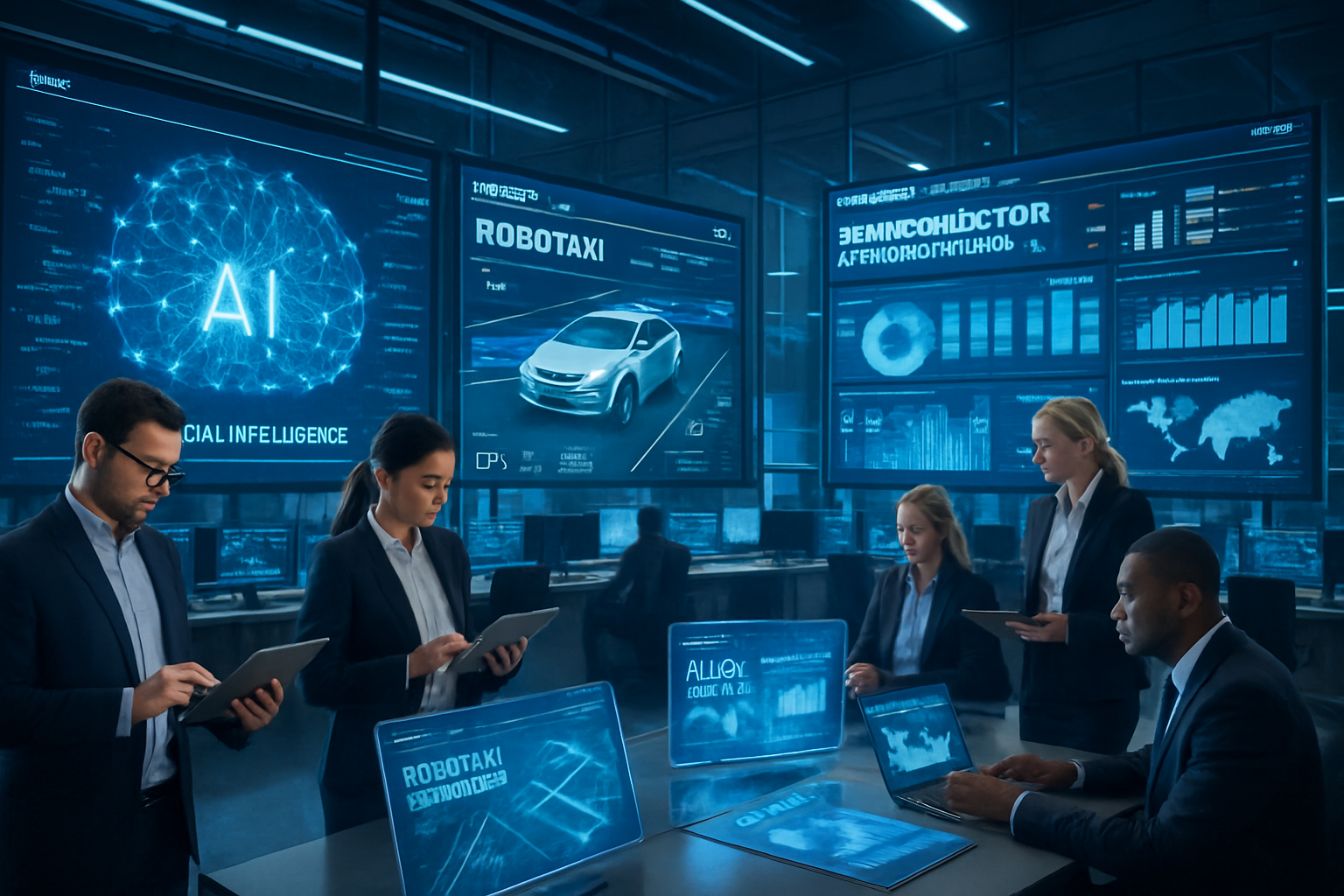
Major technological developments across artificial intelligence, autonomous vehicles, and semiconductor manufacturing are converging to create what experts characterize as a critical "civilizational choice point" for the global economy, with far-reaching implications for employment, innovation, and international competition.
Economists who once dismissed concerns about artificial intelligence disrupting the labor market are increasingly acknowledging the growing risks, warning that while large-scale shocks have not yet materialized, policymakers may not be prepared for the accelerating transformation ahead. This shift in expert opinion comes amid a series of breakthrough developments that signal AI's transition from experimental technology to essential business infrastructure.
Growing AI Employment Concerns
The economic establishment's changing tone on AI reflects mounting evidence of the technology's expanding impact across sectors. Multiple studies throughout early 2026 have documented what researchers term a "productivity paradox," where AI implementation often creates additional work rather than the promised efficiency gains, as employees must supervise and correct AI outputs while maintaining their original responsibilities.
Microsoft's Mustafa Suleyman's predictions that majority office workers could be replaced within two years, and lawyers and auditors within 18 months, are gaining credibility as the so-called "SaaSpocalypse" continues eliminating hundreds of billions in traditional software market capitalization. This market disruption reflects AI systems demonstrating direct replacement capabilities for conventional business solutions.
"It may only be a matter of time before we see more significant disruptions, and the question is whether our institutions and workforce are prepared for this transition."
— Economic analysts cited in AzerNews report
Waymo's European Expansion Strategy
In a significant development for autonomous vehicle deployment, Waymo is launching a pilot program in London, with plans for a full robotaxi service later this year. The British capital presents unique challenges for autonomous systems, including complex urban layouts, diverse traffic patterns, and varying road conditions that will test the technology's adaptability.
Simultaneously, Waymo has paused test drives in New York City, suggesting a strategic focus on international expansion while consolidating operations in proven markets. This move represents a broader trend of technology companies seeking global scale to justify massive infrastructure investments, particularly as the semiconductor crisis constrains expansion capabilities.
Intel-Musk Partnership Reshapes Chip Landscape
Intel's decision to join Elon Musk's Terafab AI chip complex project alongside SpaceX, Tesla, and xAI marks a pivotal moment in semiconductor strategy. The collaboration aims to produce one terawatt per year of computing power to support advances in AI and robotics, representing one of the largest technology infrastructure projects ever conceived.
The partnership comes as SpaceX prepares for what could be the largest initial public offering in history, having recently merged with xAI in a $1.25 trillion transaction that created the world's most valuable private company. Intel's participation provides crucial manufacturing expertise and capacity during a period when global semiconductor shortages have driven memory chip prices up sixfold.
"Our ability to design, fabricate, and package ultra-high-performance chips at scale will help accelerate Terafab's aim to produce 1 terawatt per year of compute to power future advances in AI and robotics," Intel stated in announcing the partnership.
Chinese Memory Market Expansion
As the global memory industry experiences an unprecedented "super cycle" fueled by AI demand, China's leading memory chipmakers are leveraging lower pricing and expanded production to capture significantly larger market share. Analysts report that Chinese manufacturers often enjoy a price advantage of more than 15 percent for products of the same specifications, making them highly attractive to price-sensitive server and consumer markets.
This development occurs within the context of a global semiconductor crisis that has seen memory chip prices surge sixfold, affecting major manufacturers including Samsung, SK Hynix, and Micron. The shortage is expected to persist until 2027 when new fabrication facilities come online, creating opportunities for Chinese companies to establish stronger market positions.
The expansion reflects broader Chinese strategic initiatives in technology sovereignty, as the nation seeks to reduce dependence on foreign semiconductor suppliers while building domestic capabilities across the AI value chain.
Educational AI Integration Advances
Greece's partnership between the Ministry of Education and Microsoft represents a significant step in educational AI adoption, with plans to develop a free digital assistant for high school students. This initiative exemplifies the "2026 Educational Technology Renaissance" - a coordinated global movement toward thoughtful integration of digital tools with traditional educational frameworks.
Successful models from Malaysia's world-first AI-integrated Islamic school, Canadian university AI teaching assistants that maintain critical thinking standards, and Singapore's WonderBot 2.0 heritage education program demonstrate that AI can enhance rather than replace fundamental human educational relationships when properly implemented.
Infrastructure Constraints Drive Innovation
Paradoxically, the global semiconductor shortage is spurring innovation in memory-efficient algorithms and sustainable deployment strategies. Companies are being forced to develop AI systems that require less computational power, potentially democratizing access to advanced AI capabilities.
The World Bank projects that AI will require 4.2-6.6 billion cubic meters of water annually by 2027 for data center cooling - equivalent to four to six times Denmark's total water consumption. These environmental constraints are driving investment in renewable energy solutions and more efficient computing architectures.
Regulatory Framework Development
International coordination on AI governance is intensifying, with Spain implementing the world's first criminal executive liability framework for technology platforms, creating potential imprisonment risks for executives. France has conducted AI cybercrime raids, while the United Nations has established an Independent Scientific Panel with 40 global experts under Secretary-General António Guterres.
This represents the most sophisticated global technology governance effort since internet commercialization, aimed at preventing regulatory arbitrage while ensuring innovation proceeds within responsible frameworks that protect human welfare.
Investment Despite Constraints
Major technology companies continue massive AI investments despite infrastructure limitations. Alphabet has committed $185 billion to AI infrastructure in 2026 - the largest single-year corporate technology investment in history - while Amazon has announced plans exceeding $1 trillion in AI development over the coming decade.
These investments reflect confidence that AI represents essential infrastructure for future economic competitiveness, comparable to electricity or telecommunications in previous technological revolutions.
Critical Decision Point
Industry experts characterize the current period as a "civilizational choice point" where decisions made in 2026 will establish decades-long patterns for human-AI relationships. The convergence of supply chain constraints, regulatory intensification, massive corporate investments, and international cooperation requirements creates unprecedented coordination challenges.
Success requires balancing innovation acceleration with safety governance, commercial interests with human welfare, and national competitiveness with international cooperation. The window for proactive adaptation is narrowing, making coordinated global action increasingly urgent.
The most promising path forward involves sophisticated human-AI collaboration that amplifies capabilities while preserving creativity, cultural understanding, and ethical reasoning that define human potential. Whether AI ultimately serves human flourishing or becomes a tool for exploitation and control depends on choices being made today across technology companies, governments, educational institutions, and civil society.