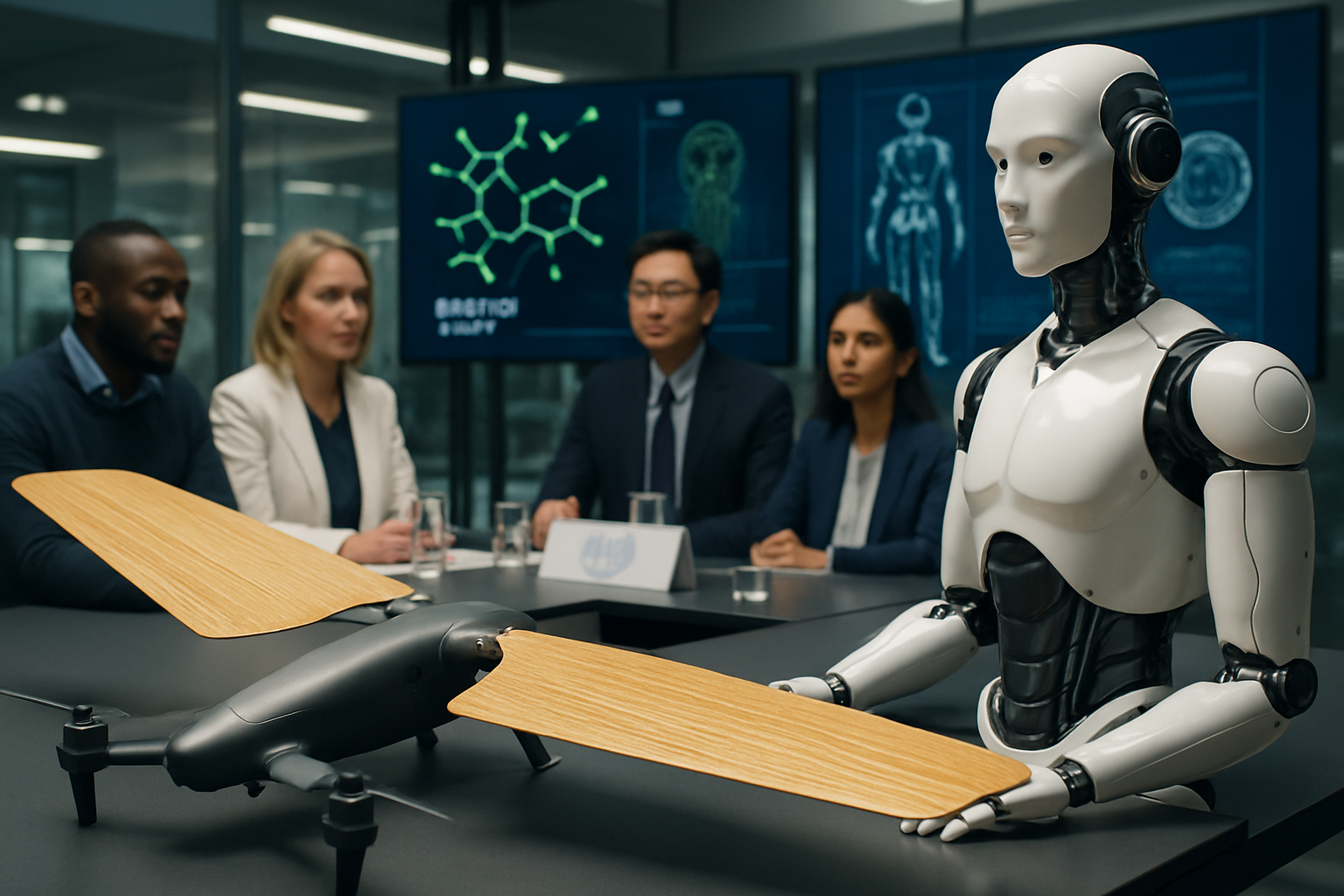
A convergence of groundbreaking technological innovations is reshaping multiple industries, with Chinese researchers unveiling the world's first bamboo fiber drone, Xiaomi deploying humanoid robots in electric vehicle manufacturing, and the United Nations establishing its first independent AI governance panel under Nobel laureate Maria Ressa and AI pioneer Yoshua Bengio.
China's Revolutionary Bamboo Drone Technology
Chinese researchers have achieved a remarkable breakthrough in sustainable aerospace technology with the development of the world's first fixed-wing drone constructed from bamboo fiber. According to state news agency Xinhua, this innovative unmanned aerial vehicle completed its maiden flight in Tianjin last month, demonstrating capabilities that could fundamentally transform drone manufacturing.
The bamboo-based drone offers compelling advantages over traditional carbon fiber alternatives, weighing 20 percent less while costing approximately 75 percent less to produce. The bamboo fiber material costs roughly one-quarter the price of carbon fiber cloth, creating significant cost savings that extend throughout the entire structural production process.
"This represents a quantum leap in sustainable aerospace technology, combining environmental responsibility with superior performance characteristics."
— Research Team Lead, Tianjin Aerospace Institute
The implications extend far beyond cost reduction. Bamboo's natural properties provide enhanced durability and flexibility compared to traditional materials, while its renewable nature addresses growing environmental concerns in the aerospace sector. The successful flight tests validate bamboo fiber as a viable alternative for commercial drone production, potentially revolutionizing an industry currently dominated by expensive synthetic materials.
Xiaomi's Humanoid Robot Integration in Manufacturing
Simultaneously, Xiaomi Corporation has begun deploying humanoid robots in its electric vehicle manufacturing facilities, marking a significant milestone in the integration of advanced robotics with automotive production. This initiative represents one of the first large-scale implementations of humanoid robots in EV manufacturing, positioning Xiaomi at the forefront of automated production technology.
The humanoid robots are specifically designed for EV plant operations, capable of performing complex assembly tasks, quality control inspections, and material handling operations. Unlike traditional industrial robots confined to specific stations, these humanoid units can navigate factory floors, adapt to various tasks, and collaborate with human workers in dynamic environments.
This development occurs within the broader context of China's aggressive expansion in humanoid robotics. Companies like Unitree Robotics have scaled production from 5,500 to over 20,000 units, demonstrating the rapid commercialization of robotics technology that was purely experimental just years ago.
UN Establishes First Global AI Governance Panel
The United Nations has created its first Independent International Scientific Panel on Artificial Intelligence, marking a watershed moment in global technology governance. The panel is co-chaired by two prominent figures: Maria Ressa, CEO of Rappler and 2021 Nobel Peace Prize laureate, and Yoshua Bengio, the renowned Canadian AI pioneer and Turing Award recipient.
This 40-member panel represents the first global scientific body dedicated entirely to artificial intelligence assessment and governance. The diverse composition includes experts from academia, private sector, civil society, government, and international organizations, with backgrounds spanning core technical AI expertise, applied AI, safety and infrastructure experience.
"This panel will deliver a substantive, evidence-based assessment of AI that serves humanity's best interests while ensuring democratic governance of transformative technology."
— Maria Ressa, Co-Chair, UN AI Panel
The panel's establishment comes at a critical juncture as AI technology transitions from experimental applications to essential infrastructure across all sectors. With AI systems now serving over 800 million weekly users globally and experiencing 10% monthly growth, the need for comprehensive international governance frameworks has become urgent.
Global Technology Infrastructure Challenges
These innovations emerge amid significant infrastructure constraints affecting the global technology sector. A persistent memory semiconductor crisis has driven prices up sixfold, affecting major manufacturers including Samsung, SK Hynix, and Micron. Industry analysts project these shortages will continue until 2027, when new fabrication facilities come online.
The crisis has paradoxically spurred innovation in efficiency and sustainability. Companies are developing memory-efficient algorithms, hybrid processing approaches, and alternative materials—such as the bamboo fiber breakthrough—to maintain technological advancement despite resource constraints.
Meanwhile, the World Bank projects that AI systems will require 4.2 to 6.6 billion cubic meters of water annually by 2027 for data center cooling operations, equivalent to four to six times Denmark's total annual water consumption. This environmental challenge is driving research into more sustainable computing solutions, including space-based data centers and renewable energy integration.
International Cooperation and Competition
The technology developments occur against a backdrop of intensifying international competition and cooperation efforts. The recent AI Impact Summit in New Delhi, featuring over 250,000 delegates from 100+ countries, resulted in the Delhi Declaration signed by 88 countries—the largest AI diplomatic agreement in history.
European regulatory frameworks are simultaneously intensifying, with Spain implementing the world's first criminal executive liability for tech platforms, while France has conducted cybercrime raids on AI companies. These coordinated regulatory responses represent the most sophisticated global technology governance effort since internet commercialization.
China's technological advances, including the bamboo drone and widespread humanoid robot deployment, demonstrate the multipolar nature of innovation. Chinese companies have achieved significant breakthroughs despite semiconductor export restrictions, suggesting indigenous development capabilities and alternative technological pathways.
Successful Human-Centered Integration Models
Amid rapid technological change, several success stories demonstrate effective human-centered approaches to technology integration. Malaysia has launched the world's first AI-integrated Islamic school, combining artificial intelligence with traditional religious and academic learning. Canadian universities have successfully implemented AI teaching assistants while maintaining critical thinking standards, and Singapore's WonderBot 2.0 has achieved remarkable success in heritage education applications.
These examples illustrate a crucial principle: the most successful technology implementations enhance rather than replace human capabilities. They treat technology as amplification tools serving human goals rather than ends in themselves.
Employment and Economic Implications
The rapid pace of technological change is creating significant employment implications. Microsoft's Mustafa Suleyman predicts AI could replace the majority of office workers within two years, with lawyers and auditors following within 18 months. The ongoing "SaaSpocalypse" has already eliminated hundreds of billions in market capitalization from traditional software companies as AI demonstrates direct replacement capabilities.
However, regional responses vary significantly. While Western companies often implement traditional layoffs, Asian companies are investing in comprehensive reskilling programs. Indian IT giants including Infosys, Wipro, and HCL are adapting through worker transition programs rather than mass layoffs, demonstrating alternative approaches to technological transformation.
Strategic Implications for Global Technology Development
March 2026 represents a critical inflection point in global technology development. The convergence of sustainable materials innovation (bamboo drones), advanced robotics deployment (Xiaomi's EV robots), and international governance frameworks (UN AI panel) suggests a maturing approach to technological advancement.
Success in this environment requires unprecedented coordination between governments, technology companies, educational institutions, and civil society. The challenge lies in balancing innovation acceleration with safety governance, commercial interests with human welfare, and national competitiveness with international cooperation.
The bamboo drone breakthrough demonstrates that sustainable alternatives can offer superior performance characteristics while reducing costs. Xiaomi's humanoid robot integration shows practical pathways for advanced automation that enhance rather than eliminate human employment. The UN AI panel represents growing recognition that transformative technology requires democratic oversight and international coordination.
Looking Ahead: The Future of Innovation
These developments collectively point toward a future where technological innovation increasingly emphasizes sustainability, human-AI collaboration, and international governance. The shift from purely performance-driven development to solutions that consider environmental impact, social implications, and democratic governance represents a fundamental maturation of the technology sector.
The window for proactive adaptation is narrowing rapidly as AI and robotics transition from experimental technologies to essential infrastructure. Countries and organizations implementing comprehensive approaches—combining infrastructure investment, educational reform, worker retraining, and international cooperation—are positioning themselves most advantageously for this transformation.
The success of these emerging technologies will ultimately depend on their ability to serve human flourishing while preserving the creativity, empathy, and wisdom that define human potential. The bamboo drone, humanoid manufacturing robots, and international AI governance represent different facets of this challenge, each offering pathways toward a more sustainable, equitable, and democratically governed technological future.