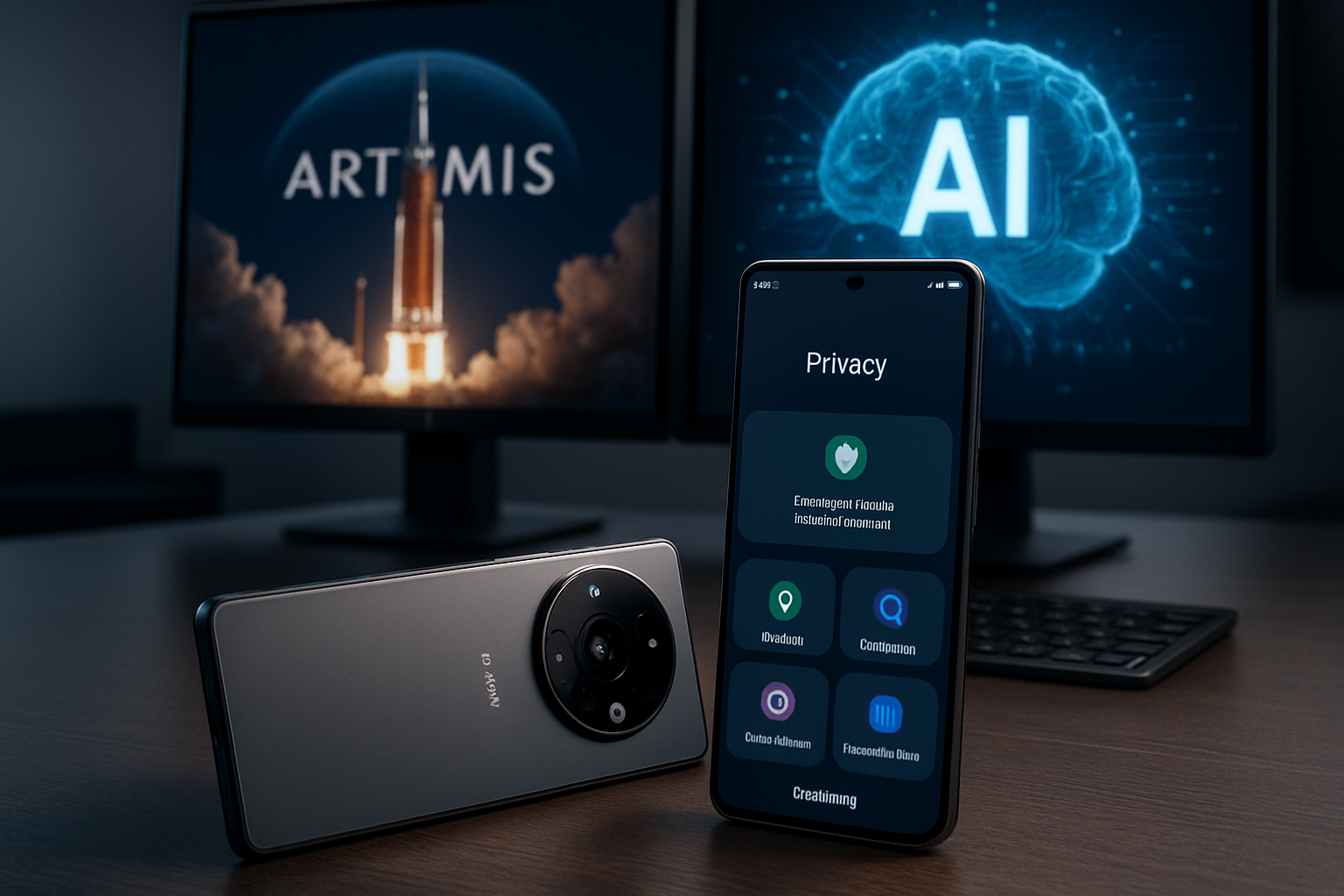
April 2026 marks a critical convergence point in global technology innovation, as cutting-edge smartphone developments, advanced imaging sensors, and space exploration technologies intersect during one of the most challenging periods in recent industry history.
Samsung Galaxy S26 Ultra Real-World Performance
CNA Lifestyle's month-long testing of Samsung's Galaxy S26 Ultra reveals a device that successfully balances revolutionary privacy features with practical daily performance. The flagship smartphone, launched in February 2026 with industry-first Privacy Display technology, demonstrates how Samsung has evolved from hardware manufacturer to AI-powered technology platform.
The device's standout privacy display technology, which controls pixel light dispersion to prevent side-angle viewing, performed exceptionally in real-world scenarios. During testing across workplace environments, public transportation, and café settings, the on-demand privacy activation maintained full display quality while effectively eliminating "shoulder surfing" concerns without permanent screen protectors.
"The Privacy Display represents more than technological advancement - it establishes hardware-level privacy precedents potentially influencing industry standards for mobile device security."
— Technology Industry Analysis, February 2026
The Galaxy S26 Ultra's camera system, featuring a 200MP main sensor with computational photography AI, consistently delivered professional-grade results. The multi-agent Galaxy AI ecosystem, integrated across Notes, Clock, Gallery, Reminders, and Calendar applications through the Perplexity AI partnership, proved particularly valuable for productivity workflows during the extended testing period.
Sony's Strategic Image Sensor Investment
Sony's announcement of up to $380 million in Japanese government subsidies for image sensor factory expansion represents a strategic response to surging demand from smartphone manufacturers worldwide. This investment comes as the global semiconductor crisis continues to drive memory chip prices up sixfold, affecting Samsung, SK Hynix, and Micron operations until expected relief in 2027.
The Japanese subsidy underscores Sony's dominant position in mobile camera sensors, supplying advanced imaging components not only for its own devices but for major smartphone manufacturers globally. This vertical integration advantage becomes increasingly valuable as consumer electronics costs have risen 20-30% over the past year due to supply chain constraints.
Space Technology and Consumer Electronics Convergence
The Artemis astronaut mission description of charring on heat shields during the crew's fiery return to Earth highlights the extreme technological challenges of space exploration while demonstrating advances in materials science that increasingly influence consumer technology development.
During the historic Artemis II mission, which achieved a new human spaceflight distance record of 406,777.8 kilometers from Earth, crew members successfully captured unprecedented Earth photography using approved smartphone technology - marking a significant convergence between consumer electronics and professional space operations.
Global Supply Chain Adaptation
The current technology landscape reveals an industry adapting to unprecedented constraints while maintaining innovation momentum. Global memory manufacturers operating at full capacity cannot meet AI development and consumer electronics demand, creating what experts term a "critical vulnerability window" until 2027 when new fabrication facilities come online.
Despite these challenges, massive technology investments continue. Alphabet committed $185 billion to AI infrastructure in 2026, representing the largest single-year corporate technology investment in history, while Amazon plans exceed $1 trillion in development initiatives.
Innovation Through Constraint
The semiconductor shortage has paradoxically accelerated innovation in memory-efficient algorithms, hybrid processing approaches, and alternative computing architectures. Companies like Samsung, with vertical integration across semiconductors, displays, and manufacturing, demonstrate competitive advantages during supply chain constraints while introducing advanced features like Privacy Display technology.
This constraint-driven innovation is forcing the industry toward more thoughtful technology integration, treating digital tools as amplification mechanisms for human capabilities rather than wholesale replacement systems. Success stories include Malaysia's world-first AI-integrated Islamic school, Canadian AI teaching assistants maintaining critical thinking standards, and Singapore's WonderBot 2.0 heritage education platform.
Regulatory Framework Evolution
The technology developments occur amid intensifying global regulatory frameworks. Spain's implementation of the world's first criminal executive liability framework for tech platforms creates personal imprisonment risks for executives, while France conducts AI cybercrime raids and the European Commission investigates platform violations with potential billions in penalties.
The UN's establishment of an Independent Scientific Panel with 40 experts represents the first fully independent global AI assessment body under António Guterres, marking the most sophisticated international technology governance effort since internet commercialization.
Future Trajectory
April 2026 represents what industry experts identify as a "critical inflection point" in the transition from experimental AI features to essential infrastructure. The convergence of breakthrough consumer technologies, space exploration advances, and global supply chain adaptation creates unprecedented coordination requirements.
Success depends on resolving infrastructure constraints while maintaining innovation momentum, developing sustainable business models that prioritize human welfare, and fostering international cooperation frameworks that balance competitive advantage with global stability.
"The future belongs to systems that successfully integrate advanced technologies while preserving fundamental human relationships, critical thinking skills, and cultural authenticity that define meaningful technological progress."
— Educational Technology Renaissance Analysis, March 2026
As the technology sector navigates these transformative challenges, the decisions made in 2026 regarding AI integration, supply chain resilience, and sustainable innovation will influence competitive dynamics and technological trajectories for the remainder of the decade. The convergence of consumer electronics excellence, space exploration capabilities, and thoughtful AI integration suggests humanity's technological future lies not in choosing between innovation and responsibility, but in achieving both simultaneously through sophisticated human-technology collaboration.