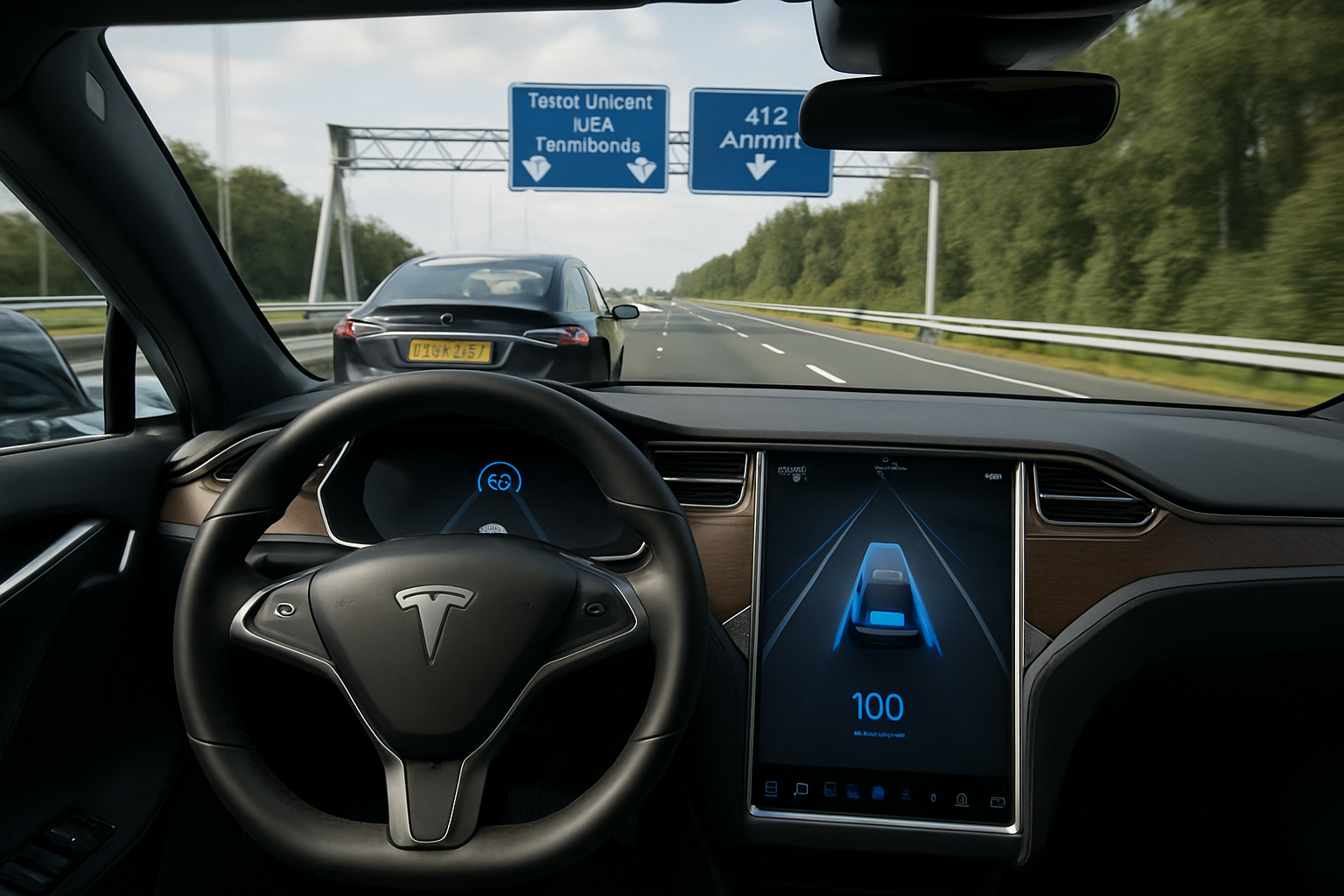
Tesla has achieved a historic milestone in European automotive regulation, receiving approval from Dutch authorities to deploy its supervised self-driving software throughout the Netherlands, marking the first comprehensive European Union approval for the electric vehicle manufacturer's advanced autonomous driving technology.
The approval from Dutch transport regulators represents a watershed moment for Tesla's European expansion strategy, enabling the deployment of Full Self-Driving (FSD) Beta capabilities with mandatory human supervision on both highways and city streets. The decision positions the Netherlands as the first EU member state to grant operational approval for Tesla's most advanced driver assistance systems.
Regulatory Breakthrough After Extensive Testing
The Netherlands approval follows an intensive regulatory review process that began in early 2025, involving comprehensive safety assessments and real-world testing protocols. Dutch transport authorities have established rigorous monitoring requirements, including mandatory data sharing protocols, continuous driver attention monitoring, and regular safety performance evaluations.
According to Tesla Europe's announcement on X platform, the system has been "trained with billions of kilometers of real-world road data" and is capable of navigating drivers "to almost any destination you control – from residential neighborhood streets to city roads and highways." The approval specifically covers Tesla's Navigate on Autopilot, Auto Lane Change, Autopark, and Summon functionality.
The regulatory framework requires drivers to maintain constant attention and readiness to take immediate control, with the system utilizing eight cameras, twelve ultrasonic sensors, and forward-facing radar combined with Tesla's custom AI chips for real-time processing and decision-making.
Strategic Implications for European Market
Industry analysts view the Netherlands approval as strategically significant beyond the immediate market access. The decision establishes the Netherlands as a European leader in autonomous vehicle technology adoption while creating a potential catalyst for broader EU approvals across the bloc's 400+ million consumer market.
The timing is particularly crucial as Tesla faces intensifying global competition in the autonomous driving sector. Chinese competitor Xpeng has been pushing accelerated development, with CEO He Xiaopeng advocating for China to skip intermediate autonomous driving development stages and move directly to advanced capabilities. Meanwhile, traditional European automakers like Volkswagen have been conducting their own testing programs in markets including Sweden.
"Wide FSD adoption is central to Tesla's growth strategy, and this approval represents a critical step toward establishing Tesla as the dominant European autonomous vehicle platform."
— Industry Analysis, AzerNews
Technical Infrastructure and Implementation
The Netherlands provides an ideal testing ground for Tesla's technology, with the country maintaining over 90,000 public charging points supporting its extensive electric vehicle ecosystem. This robust charging infrastructure complements Tesla's autonomous driving capabilities by ensuring reliable operation throughout the country's dense urban and highway networks.
The approval comes amid global challenges in the automotive technology sector, including a severe semiconductor crisis that has driven memory chip prices to six times normal levels, affecting vehicle control systems across the industry. Despite these supply chain constraints, Tesla has maintained its technological development momentum through its custom AI chip architecture.
Tesla has committed to establishing local service infrastructure to support the expanding autonomous vehicle fleet in the Netherlands, including specialized technical support for the advanced driver assistance systems and ongoing software updates delivered through the company's over-the-air update platform.
Broader European Expansion Strategy
The Netherlands approval serves as a template for Tesla's anticipated expansion across other European Union markets. The company hopes to see similar regulatory action from additional EU member states, leveraging the Netherlands precedent to accelerate approval processes in Germany, France, and Scandinavian markets.
This European push occurs within the context of broader discussions about European digital sovereignty and technological independence, as the region seeks to balance innovation adoption with regulatory oversight. The approval demonstrates how rigorous safety standards and innovative technology can coexist within the EU's regulatory framework.
The success in the Netherlands could establish Tesla as the dominant European autonomous vehicle platform through gradual market-by-market expansion, potentially capturing significant market share before competitors achieve similar regulatory approvals.
Global Context and Competition
Tesla's European breakthrough comes as the global autonomous driving landscape becomes increasingly competitive. The approval provides Tesla with a strategic advantage in establishing European market presence while competitors navigate their own regulatory approval processes.
The development represents part of broader European efforts to balance technological innovation with consumer protection, establishing frameworks that enable advanced automotive technologies while maintaining safety standards. The Dutch regulatory approach provides a model for other EU nations considering similar approvals.
For Tesla, the Netherlands approval validates the company's strategy of pursuing market-by-market regulatory approval rather than waiting for EU-wide harmonization. This approach allows the company to begin generating European revenue from its advanced driver assistance systems while building the operational experience needed for broader continental deployment.
Safety Protocols and Monitoring Systems
The Dutch approval includes comprehensive safety protocols designed to ensure responsible deployment of autonomous driving technology. These include real-time monitoring systems that track driver attention, vehicle performance metrics, and traffic interaction data.
Mandatory data sharing requirements will provide Dutch transport authorities with continuous oversight capabilities, enabling rapid response to any safety concerns while gathering data to inform future regulatory decisions. The monitoring framework includes provisions for immediate suspension of operations if safety thresholds are not maintained.
Regular safety assessments will evaluate system performance across various driving conditions, traffic patterns, and weather scenarios typical of Netherlands road networks. This comprehensive monitoring approach reflects the Dutch commitment to innovation balanced with public safety responsibilities.
The Netherlands approval for Tesla's supervised self-driving software represents a transformative moment for both the company and European autonomous vehicle adoption. As the first EU nation to grant comprehensive operational approval, the Netherlands has positioned itself at the forefront of automotive technology regulation while providing Tesla with a crucial foothold in the European market. The success of this implementation will likely influence regulatory approaches across the European Union and establish precedents for the global deployment of autonomous driving technologies in the coming decade.