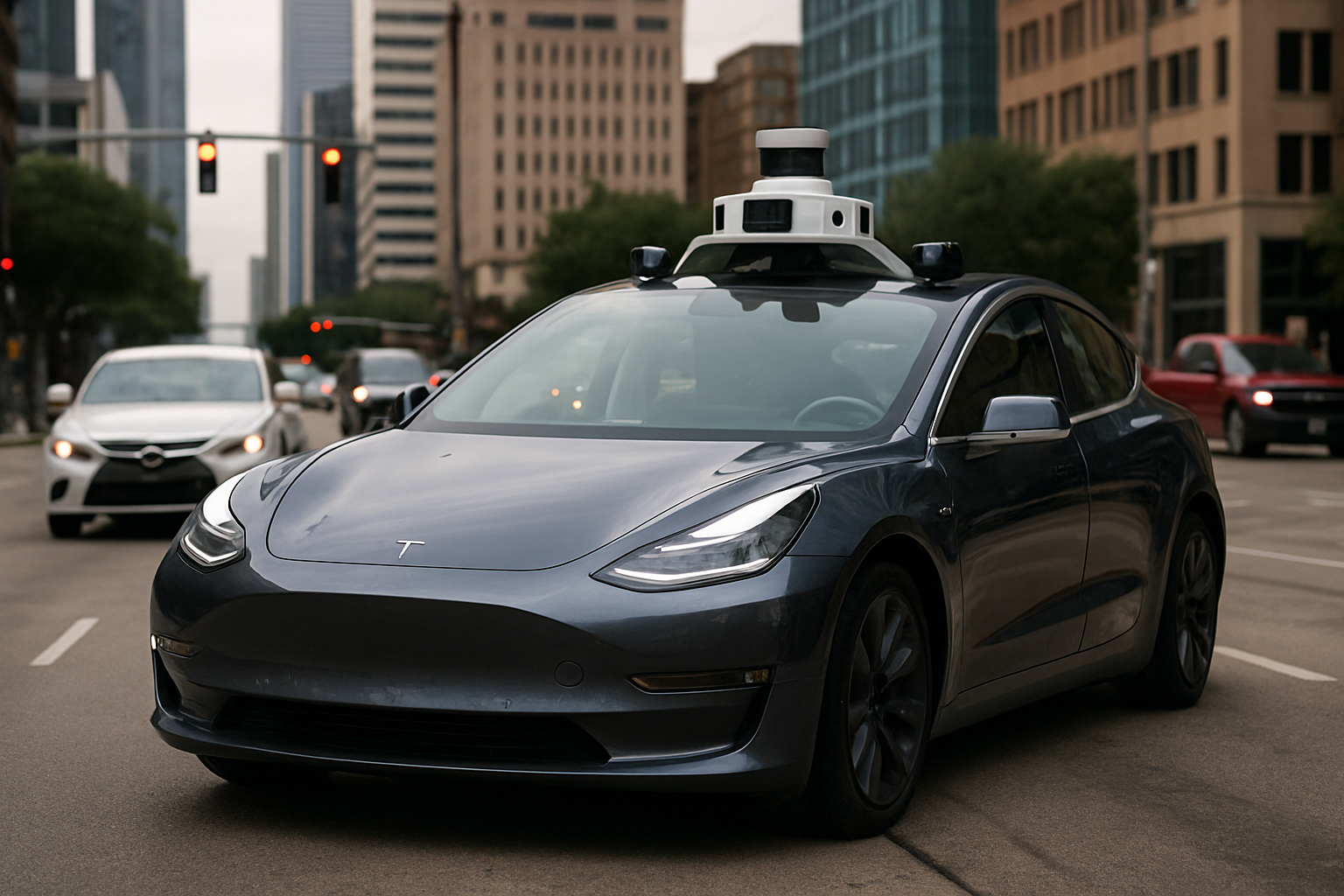
Tesla has officially launched its robotaxi service in Houston and Dallas, marking a significant but measured step into the autonomous vehicle market, though the service is currently available only in narrowly defined areas of both cities.
The deployment represents a cautious approach to autonomous vehicle commercialization, contrasting sharply with the ambitious timelines Elon Musk has historically promoted for Tesla's self-driving capabilities. According to Austrian media reports, the service remains limited in scope, with Musk's broader autonomous vehicle plans continuing to advance at a slower pace than initially projected.
Limited Geographic Coverage
The Tesla robotaxi service is currently operational only within tightly controlled zones in Houston and Dallas, two of America's largest metropolitan areas. This restricted deployment strategy reflects the complex technical and regulatory challenges facing autonomous vehicle operators across the global market.
The limited coverage areas allow Tesla to gather real-world data while minimizing potential safety risks and regulatory complications. This approach mirrors deployment strategies used by other autonomous vehicle companies, including Waymo, which has similarly started with geofenced operations in specific urban zones before considering broader expansion.
Industry Context and Challenges
Tesla's robotaxi launch occurs during a particularly challenging period for the autonomous vehicle industry. In April 2026, approximately 100 Baidu Apollo Go robotaxis simultaneously failed in Wuhan, China, stranding passengers across central areas of the city and highlighting the vulnerabilities of centralized autonomous vehicle management systems.
The global autonomous vehicle sector also faces significant infrastructure constraints. A semiconductor crisis has driven memory chip prices sixfold higher, affecting companies like Samsung, SK Hynix, and Micron until at least 2027. These supply chain disruptions impact the sophisticated computing systems required for autonomous vehicle operations.
"The service is currently only available in a narrowly defined area of both cities. Musk's grand plans continue to progress only very slowly."
— Austrian media report, April 2026
Regulatory Environment
The robotaxi deployment benefits from increasingly supportive regulatory frameworks in certain jurisdictions. Tesla recently achieved a historic breakthrough in the Netherlands, becoming the first company to receive comprehensive EU approval for supervised self-driving software deployment, including Full Self-Driving (FSD) Beta capabilities.
However, regulatory approaches vary significantly across global markets. China has implemented new automotive safety requirements, including a comprehensive ban on hidden door handles effective January 2027, requiring all vehicles to have visible, mechanically-operated interior and exterior door releases that function independently of electrical systems.
International Competition
Tesla's measured approach contrasts with more aggressive autonomous vehicle deployments elsewhere. Waymo recently launched a robotaxi pilot program in London with full service planned for later 2026, while pausing operations in New York City. Chinese companies like Xpeng are pushing for accelerated autonomous driving development, with CEO He Xiaopeng calling for China to skip intermediate development stages and move directly to advanced self-driving capabilities.
Technical Infrastructure Requirements
The robotaxi service utilizes Tesla's existing Full Self-Driving technology, which employs eight cameras, twelve ultrasonic sensors, and forward-facing radar integrated with Tesla's custom AI chips for real-time processing. The system requires continuous over-the-air updates and maintains comprehensive data sharing protocols with regulatory authorities.
Tesla's approach emphasizes gradual expansion based on demonstrated safety performance rather than rapid geographic scaling. This methodology aligns with growing industry consensus that autonomous vehicle deployment requires extensive real-world validation before broader commercial availability.

Economic and Market Implications
The Houston and Dallas markets represent significant economic opportunities for autonomous vehicle services. Both metropolitan areas feature extensive suburban sprawl and limited public transportation infrastructure, creating substantial demand for alternative mobility solutions.
Tesla's entry into the robotaxi market occurs amid broader industry transformation. The global space economy is transitioning from what experts term an "AI revolution" to a "space economy golden age," with Tesla's parent company SpaceX preparing a potential June IPO valuation exceeding $1 trillion.
Battery technology advances support the economic viability of electric robotaxis. Studies of Tesla Model S vehicles from 2012-2014 show battery capacity retention of 85-92% after 200,000+ miles, suggesting practical lifespans of 15-20 years that exceed initial manufacturer warranties.
Safety Protocols and Monitoring
Tesla's robotaxi implementation includes comprehensive safety monitoring systems with mandatory human supervision requirements during initial phases. The company maintains continuous data sharing protocols with transportation authorities and implements regular safety assessments as conditions for operational approval.
The safety-first approach reflects lessons learned from autonomous vehicle incidents globally. The Wuhan robotaxi failure in April 2026 demonstrated the importance of robust failsafe systems and emergency protocols when deploying autonomous vehicle technology at commercial scale.
Future Expansion Plans
While Tesla has not announced specific timelines for expanding beyond Houston and Dallas, the company's historical pattern suggests gradual geographic expansion based on operational performance and regulatory approval. The success of the current limited deployment will likely influence both the pace and scope of future robotaxi availability.
Industry experts expect Tesla to leverage data and experience from these initial markets to refine its autonomous driving systems before considering expansion to additional cities. This methodical approach marks a notable shift from Musk's previously announced timelines for widespread robotaxi deployment.
The Texas launch represents Tesla's most significant autonomous vehicle commercialization to date, providing crucial market validation for the company's self-driving technology while establishing operational frameworks for potential future expansion across larger geographic areas.