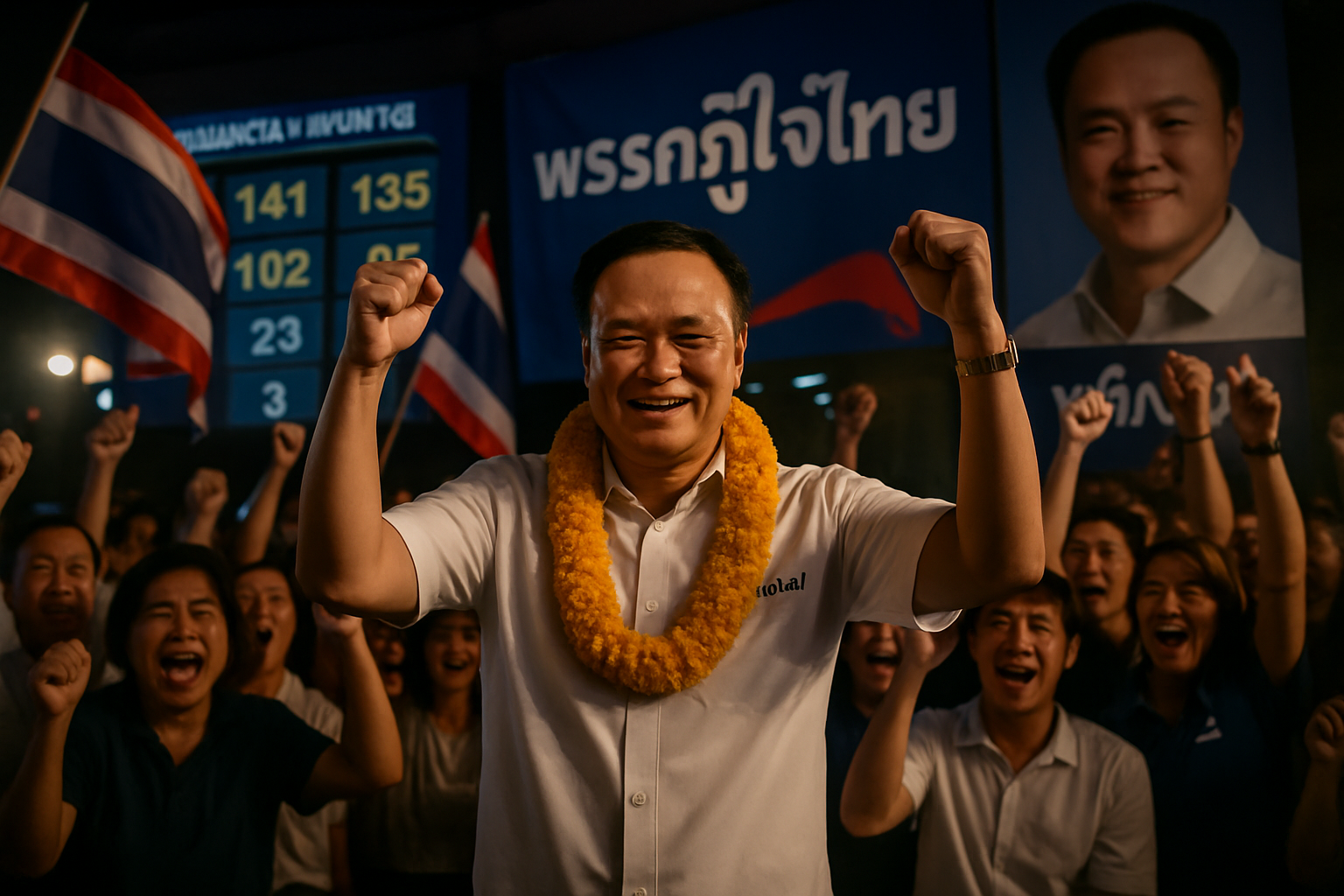
Thailand's ruling Bhumjaithai Party, led by incumbent Prime Minister Anutin Charnvirakul, achieved a surprising landslide victory in Sunday's snap general election, securing approximately 191-192 seats out of 500 in the House of Representatives and marking the first electoral triumph this century for a party aligned with the country's royalist establishment.
According to preliminary results from Thailand's Election Commission with 94-95% of votes counted, the Bhumjaithai Party significantly outperformed pre-election polling that had placed the reformist People's Party as the frontrunner. The progressive People's Party managed only 115-117 seats, while the populist Pheu Thai Party, backed by billionaire former Prime Minister Thaksin Shinawatra, secured just 77 seats.
Strategic Gamble Pays Off for Conservative Leadership
Prime Minister Anutin Charnvirakul's decision to call a snap election in mid-December during a border conflict with Cambodia appears to have been a calculated political masterstroke. Political analysts suggest the conservative leader successfully capitalized on surging nationalism following military clashes between Thailand and Cambodia, transforming a crisis into electoral opportunity.
The election was triggered when Anutin took power after former Premier Paetongtarn Shinawatra of the Pheu Thai Party was ousted over the Cambodian border crisis. Anutin then dissolved parliament less than 100 days later, representing one of the boldest political gambles in recent Thai political history.
"Bhumjaithai's victory today is a victory for all Thais, whether you voted for Bhumjaithai Party or not,"
— Anutin Charnvirakul, Prime Minister
Defying Polls and Political Expectations
The results represent a dramatic reversal from opinion polling conducted in the weeks leading up to the election, which consistently showed the People's Party leading. The reformist opposition's failure to translate polling leads into electoral success highlights the persistent challenges faced by progressive movements in Thailand's complex political landscape.
The Bhumjaithai Party's performance marks a significant surge from its previous third-place position, establishing it as the dominant political force in Thai politics. This transformation from a minor coalition partner to the commanding party represents one of the most significant political realignments in recent Thai history.
Electoral Complications and Democratic Resilience
Despite the clear victory, the election process faced notable complications. Thailand's Election Commission confirmed that 49 candidates were disqualified by Supreme Court order—18 constituency candidates and 31 party-list candidates—with votes for disqualified candidates counted as spoiled ballots, creating some voter confusion.
Election watchdog group iLaw urged the Election Commission to promptly publish polling station-level vote results, citing a "climate of public doubt over vote counting and aggregation." However, the election proceeded smoothly overall, demonstrating the resilience of Thailand's democratic institutions despite these administrative challenges.
Breaking the Reform Cycle
The election results continue what analysts have termed Thailand's "20-year political reform failure pattern," where voters repeatedly choose change but face institutional barriers that prevent dramatic policy shifts. The victory of the royalist-aligned Bhumjaithai Party suggests that Thai voters may have chosen stability over continued political uncertainty.
This marks a significant departure from the previous pattern of three prime ministers serving in just three years, potentially offering Thailand the political stability needed for long-term policy implementation. The decisive victory eliminates the need for complex coalition negotiations that have historically complicated Thai governance.
Regional and International Implications
The election outcome carries significant implications for Southeast Asian cooperation and Thailand's role within ASEAN. Anutin's conservative approach may signal a shift toward more nationalist foreign policy positions, particularly regarding the recent border tensions with Cambodia that helped propel the party to victory.
International observers, including from Taiwan's government, have expressed hopes for continued cooperation. Taiwan's Foreign Minister Lin Chia-lung stated expectations for "deeper substantive cooperation in various fields" between Taiwan and Thailand following the election results.
Economic Challenges Ahead
Despite the electoral triumph, the new government faces substantial economic challenges. Thailand's economy has struggled with stagnation, rising debt, and widening inequality—issues that have dominated political discourse for years. The tourism-dependent economy continues to face recovery challenges from pandemic impacts and regional competition.
The Bhumjaithai Party's decisive mandate provides it with the political capital necessary to address these long-standing economic frustrations, though success will depend on the party's ability to translate electoral victory into effective governance and policy implementation.
Opposition Response and Future Political Landscape
Reformist party leaders have conceded defeat, with the People's Party leadership acknowledging their failure to become the largest party despite early polling advantages. This represents a significant setback for Thailand's democratic reform agenda and signals a decline in the progressive movement's political influence.
The results suggest that Thai voters, faced with persistent economic challenges and political instability, chose continuity and nationalism over the reformist alternatives offered by the opposition parties.
Historical Significance and Democratic Consolidation
The election represents a critical test of Thailand's democratic institutions amid ongoing political polarization. Despite candidate disqualifications and procedural complications, the voting proceeded peacefully with strong citizen participation, demonstrating institutional strength.
With approximately 53 million registered voters participating in the electoral process, the results provide the Bhumjaithai Party with a clear mandate for governance. This decisive outcome may offer Thailand an opportunity to break free from the cycle of political instability that has characterized recent years.
The victory positions Prime Minister Anutin Charnvirakul to lead Thailand through a period of potential political consolidation, though the ultimate test will be whether his government can address the persistent economic and social challenges that have frustrated Thai citizens for decades. The international community will be watching closely to see how Thailand's new political alignment affects regional cooperation and democratic governance in Southeast Asia.