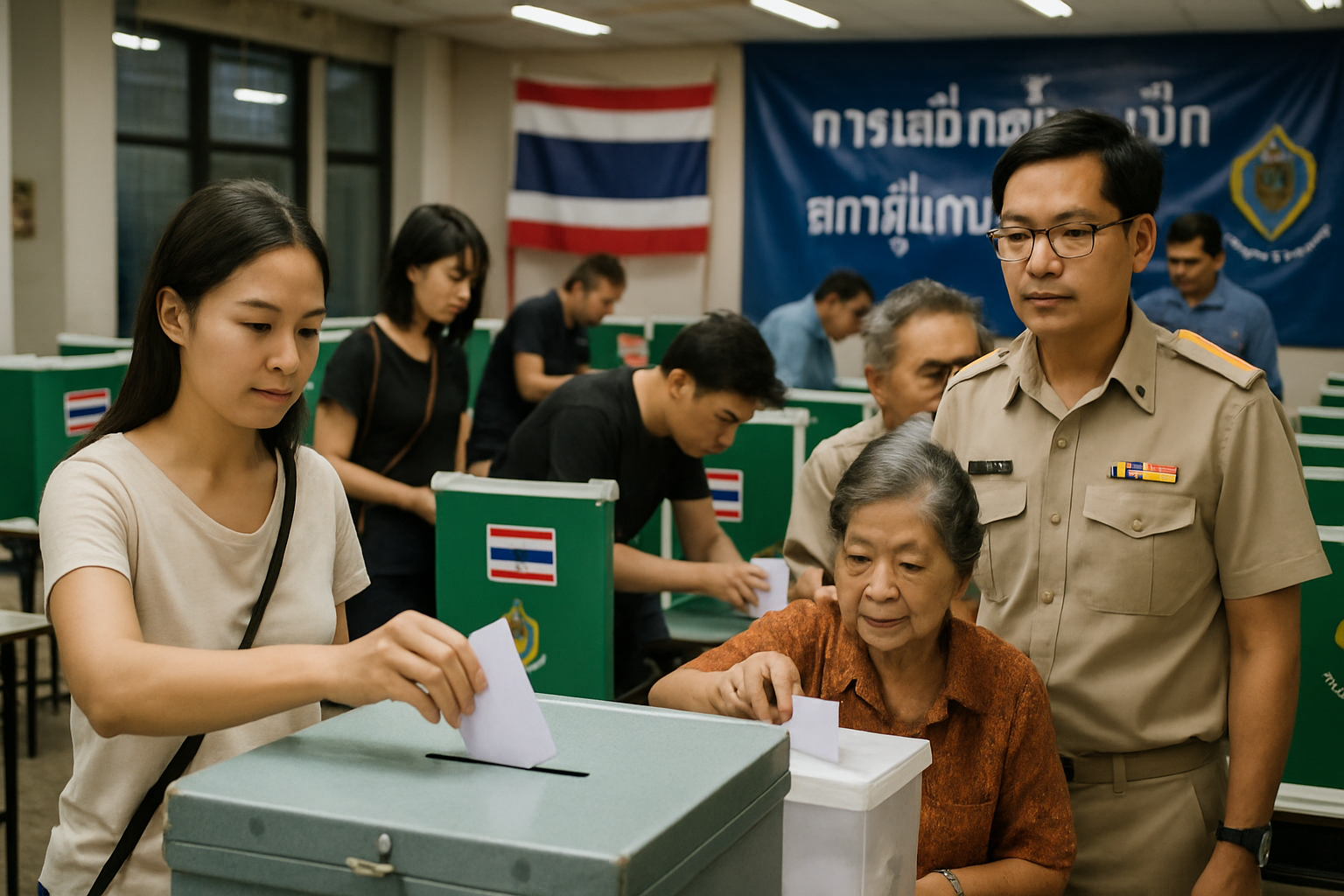
Thai voters began casting ballots on Sunday in a pivotal parliamentary election that pits the reformist People's Party against the conservative Bhumjaithai Party, marking a critical test of Thailand's democratic resilience after years of political turmoil and economic drift.
Around 53 million eligible voters are selecting 500 lower house lawmakers across the kingdom, with 400 representatives chosen directly from constituencies and the remaining 100 allocated through proportional representation based on party vote totals. The election comes amid heightened expectations from a divided public demanding an end to the country's prolonged political instability and economic stagnation.
The People's Party Phenomenon
The progressive People's Party, identifiable by its distinctive orange branding, emerged in 2024 as the successor to the dissolved Move Forward Party. According to French political analysis, the party has strategically muted its controversial proposals for reforming Thailand's monarchy and military institutions while maintaining its position as the embodiment of change in the eyes of most Thai voters.
Despite polling as the election favorite, the party faces the same institutional barriers that plagued its predecessor. The electoral system and political establishment have historically prevented reformist parties from translating popular support into governing power, contributing to what Bloomberg analysis describes as Thailand's "20-year political reform failure pattern."
"The People's Party represents the clearest alternative to traditional politics, but the question remains whether Thailand's system will allow meaningful change to occur."
— Political Analyst
A Fragmented Political Landscape
No single party is forecast to secure an outright majority, virtually guaranteeing complex coalition negotiations following the results. This fragmentation reflects deeper structural problems within Thai politics, where economic inequality, rising debt, and institutional constraints have created a cycle of voter dissatisfaction despite repeated attempts at reform.
The conservative Bhumjaithai Party, representing the establishment alternative, campaigns on stability and continuity. However, even Thailand's historically dominant Democrat Party faces marginalization, with former Prime Minister Abhisit Vejjajiva's Oxford-educated leadership polling under 40 seats despite being the country's oldest political party.
Electoral Complications
The Election Commission has warned voters about significant complications affecting ballot validity. Forty-nine candidates have been disqualified following a Supreme Court order—18 from constituencies and 31 from party lists. Votes cast for these disqualified candidates will count as spoiled ballots, creating potential confusion among voters unaware of the last-minute changes.
The Stakes for Democratic Governance
This election occurs against the backdrop of Thailand experiencing three different leaders in just two years, highlighting the country's ongoing political instability. The international community is closely monitoring the results as a measure of democratic resilience in Southeast Asia, where authoritarian tendencies have grown across the region.
The campaign has been marked by familiar promises of economic revitalization and political reform, but observers note the constrained environment in which opposition parties must operate. Thailand's complex relationship between elected governments, military influence, and traditional institutions creates unique challenges for democratic consolidation.
Economic Pressures Drive Voter Sentiment
Underlying the political competition are pressing economic concerns that have dominated the campaign. Thailand's economy has struggled with stagnation, rising household debt, and widening inequality—issues that have persisted despite multiple changes in government over the past two decades.
The election serves as a referendum not just on party politics, but on Thailand's capacity to break free from what analysts describe as a cycle of promising change while delivering continuity. Voters express frustration with the gap between campaign promises and governing realities, seeking leaders who can navigate the country's complex institutional landscape while delivering meaningful improvements to daily life.
Regional and International Implications
The election results will have significant implications for Thailand's role within ASEAN and its relationships with major powers including China and the United States. Thailand's democratic stability affects regional cooperation efforts and serves as an important test case for democratic governance in Southeast Asia.
International observers are particularly focused on whether Thailand's electoral system can produce legitimate governments capable of addressing citizen needs while maintaining democratic institutions. The outcome may influence approaches to democratic development across the region, where traditional political establishments face similar challenges from populist and reformist movements.
Coalition Calculations Ahead
With no party expected to win an outright majority, attention will quickly shift to coalition building following the announcement of results. The People's Party's ability to form a governing coalition will test whether reformist politics can overcome institutional barriers that have historically favored conservative arrangements.
The mathematical realities of Thailand's parliament mean that even a strong showing by the People's Party may not translate into governing power without complex negotiations involving smaller parties and independent lawmakers. These post-election dynamics will be crucial in determining whether this election produces genuine political change or another iteration of managed continuity.
"Thailand's voters continue to demand change, but the system's ability to deliver on that demand remains the fundamental question."
— Regional Democracy Expert
Looking Forward
As ballot counting begins across Thailand's thousands of polling stations, the nation stands at another crossroads in its democratic journey. The election represents both the persistence of popular demands for reform and the enduring strength of institutional constraints that have shaped Thai politics for decades.
The results will determine not only the composition of Thailand's next government but also the trajectory of democratic governance in one of Southeast Asia's most politically dynamic nations. Whether the reformist challenge can finally translate electoral success into governing power will have implications extending far beyond Thailand's borders.
For millions of Thai voters, Sunday's election offers another opportunity to express their desire for change while testing the system's capacity to respond to democratic demands. The outcome will provide crucial insights into the future of democratic politics in Thailand and the broader region as traditional establishments face mounting pressure for reform and renewal.