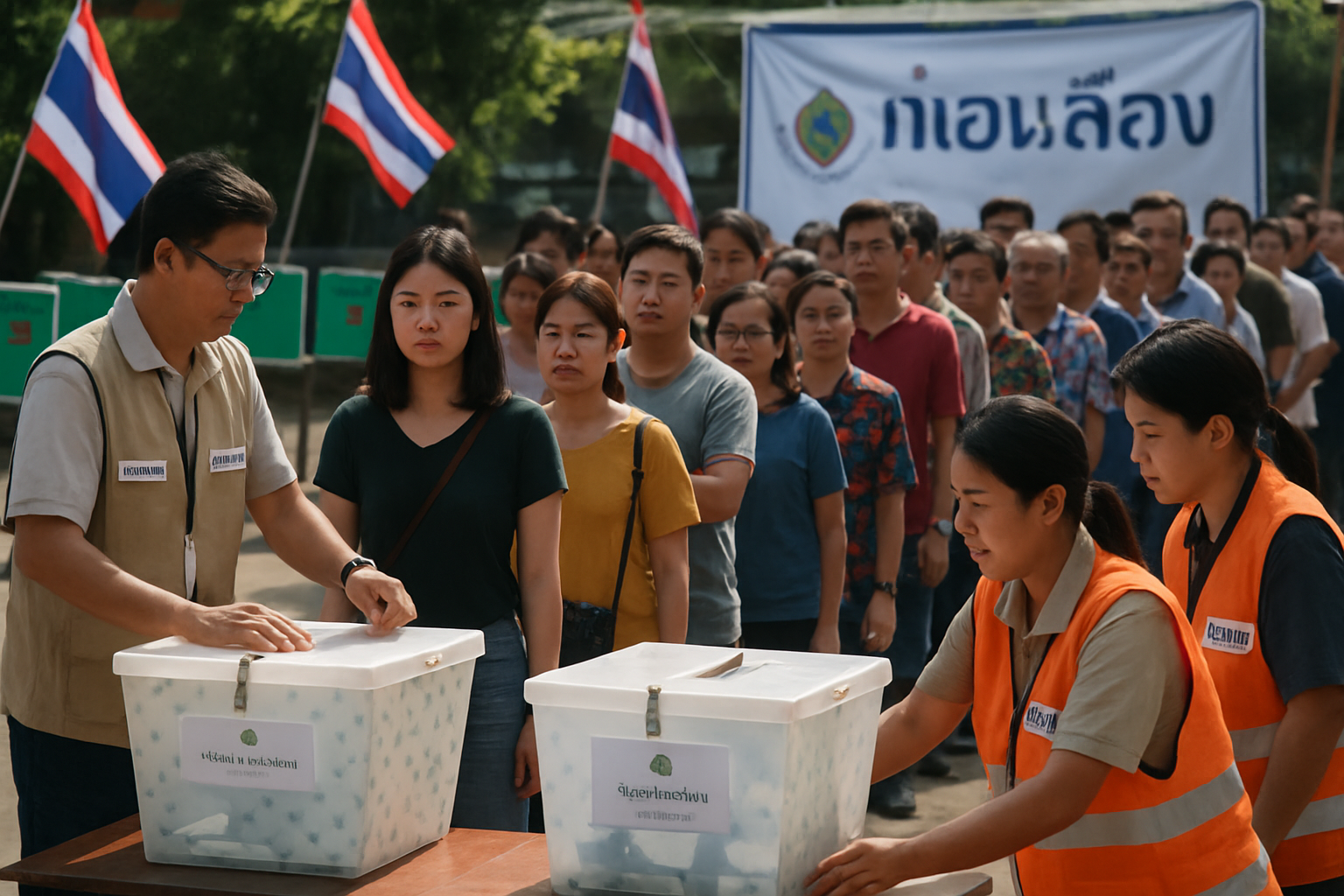
Thailand held its most significant general election in years on February 8, 2026, as 53 million eligible voters faced both a parliamentary election and a constitutional referendum that could reshape the nation's political landscape amid economic stagnation and persistent military influence.
The election pitted three major political forces against each other: the progressive People's Party (successor to the dissolved Move Forward Party), the military-backed conservative Bhumjaithai Party, and Thaksin Shinawatra's populist Pheu Thai Party. With no party expected to secure an outright majority, coalition negotiations appear inevitable in a nation that has cycled through three different prime ministers in the past three years.
Three-Way Race for Power
More than 50 political parties contested the polls, but only the People's Party, Bhumjaithai, and Pheu Thai were widely seen as having the nationwide support needed to form a government. Under Thailand's electoral system, the prime minister will be chosen by a majority vote of the 500 elected members of the House of Representatives—400 constituency-based seats and 100 proportional representation seats.
Natthaphong Ruengpanyawut, leader of the People's Party and its prime ministerial candidate, expressed confidence that voter turnout would exceed 70 percent, citing strong public interest during the campaign. After casting his ballot at Wat Thong Bang Chueak Nang polling station, he urged voters to participate in both the election and the constitutional referendum, declaring that the future of the country was "in the hands of the people."
The People's Party has strategically positioned itself as the change alternative while moderating earlier positions on sensitive monarchy and military reform issues that led to its predecessor's dissolution. The party adopted orange branding and reformist messaging that resonated with voters seeking political renewal without triggering institutional backlash.
Economic Concerns Drive Voter Sentiment
Economic stagnation emerged as the dominant campaign issue, with sluggish growth, rising debt, and widening inequality weighing heavily on voters' minds. Bloomberg analysis revealed a "20-year political reform failure pattern" despite repeated elections promising change, highlighting the structural challenges facing any new government.
"It's about getting the economy back up and running. Thai voters are craving better jobs and better pay."
— Tommy Walker, France 24 Correspondent
Voters expressed frustration with the country's economic performance, particularly the lack of well-paying employment opportunities for younger generations. The nation's traditionally tourism-dependent economy has struggled to fully recover from pandemic impacts while facing increased regional competition and global economic uncertainty.
The economic challenges have been compounded by infrastructure needs, educational reform requirements, and the necessity of transitioning toward higher-value industries. Campaign promises from all major parties centered on job creation, wage improvements, and economic modernization, though specific implementation plans varied significantly.
Constitutional Referendum Adds Complexity
Alongside the parliamentary election, voters participated in a referendum on whether to draft a new constitution to replace the charter introduced after the 2014 military coup. This dual democratic exercise represented the first time Thais could directly influence constitutional reform since the military intervention that reshaped the country's political framework.
The constitutional question carried particular significance given Thailand's history of military interventions and the role of institutional frameworks in shaping democratic governance. Previous constitutions had been criticized for creating barriers that prevented reformist parties from translating popular support into governing power, contributing to the cyclical political instability that has characterized Thai democracy.
Electoral authorities warned that 49 candidates had been disqualified by Supreme Court order—18 constituency candidates and 31 party-list candidates—with votes for disqualified candidates counting as spoiled ballots. This last-minute development created voter confusion and highlighted ongoing institutional tensions in Thailand's democratic process.
Military Oversight and Democratic Legitimacy
The election took place under the watchful eyes of Thailand's powerful military establishment, which has historically exercised massive influence on government formation. German media noted that while the military officially pledged to accept the electoral outcome, questions remained about whether the generals would honor democratic results if they produced outcomes contrary to institutional preferences.
The role of military oversight represented a critical test for Thai democracy, particularly given the progressive People's Party's reformist agenda and the potential for a coalition government that could challenge traditional power structures. International observers monitored closely for signs of interference or pressure on the democratic process.
Thailand's democratic institutions have struggled with legitimacy questions stemming from repeated military interventions, constitutional changes, and party dissolutions. The current election was viewed as an opportunity to demonstrate institutional maturity and respect for popular sovereignty, though skeptics questioned whether fundamental power relationships had truly changed.
Historical Context of Political Instability
The 2026 election occurred against the backdrop of Thailand's turbulent political history, including multiple military coups, constitutional crises, and the ongoing influence of traditional elite networks. The country has experienced significant political fragmentation, with voters repeatedly choosing change-oriented parties only to see reform agendas blocked by institutional resistance.
The Democrat Party, traditionally one of Thailand's major political forces, faced potential marginalization with former Prime Minister Abhisit Vejjajiva's party polling under 40 seats despite being the country's oldest political party. This decline reflected broader shifts in Thai political alignment and the emergence of new generational political movements.
International and Regional Implications
The election results carry significance beyond Thailand's borders, affecting ASEAN cooperation dynamics and broader Southeast Asian democratic resilience. As a key regional power, Thailand's democratic health influences diplomatic relationships with major powers including China and the United States, particularly in the context of great power competition in the Indo-Pacific region.
International observers viewed the election as a test of whether traditional establishments can maintain influence in the face of mounting pressure for democratic reform across Southeast Asia. The outcome could provide lessons for other regional democracies facing similar challenges of balancing institutional continuity with popular demands for change.
Thailand's experience with democratic transition has been closely watched by neighboring countries grappling with their own governance challenges, making the 2026 election results potentially influential for broader regional political development patterns.
Campaign Issues and Voter Priorities
Beyond economic concerns, the campaign addressed issues including educational reform, healthcare access, environmental protection, and social welfare expansion. Voters interviewed during polling expressed hopes that the election would bring greater political unity and stability after years of frequent government changes.
"Better economy, fewer scammers. We hope for real change this time."
— Bangkok Voter at Polling Station
The prominence of economic issues reflected broader global trends where voters prioritize material security and employment opportunities over abstract political reforms. However, younger voters showed particular interest in political modernization and institutional accountability, suggesting potential generational divides in political priorities.
Environmental concerns, including air pollution and climate adaptation, also featured prominently in urban constituencies, while rural voters focused more heavily on agricultural support, infrastructure development, and access to government services.
Looking Ahead: Coalition Politics and Governance Challenges
With no party expected to win an outright majority, the post-election period will likely witness intensive coalition negotiations that could determine Thailand's political direction for the next several years. The mathematics of coalition formation will test whether reformist forces can overcome institutional arrangements historically designed to prevent dramatic political change.
Successful government formation will require navigating complex relationships between elected politicians, traditional elite networks, military leadership, and civil society organizations. The ability of any resulting coalition to address voters' economic concerns while managing institutional sensitivities will determine the long-term success of Thailand's democratic experiment.
International partners and investors will closely monitor the post-election transition for signs of political stability and policy continuity that could affect Thailand's regional role and economic development prospects. The outcome may influence broader perceptions of Southeast Asian democratic resilience and institutional capacity.
As Thailand awaits official results and coalition negotiations begin, the nation stands at a critical juncture where democratic legitimacy, economic necessity, and institutional power converge in determining the country's future direction. The February 8 election may prove pivotal in determining whether Thailand can break its cycle of political instability and achieve the democratic consolidation that has long eluded this strategically important Southeast Asian nation.