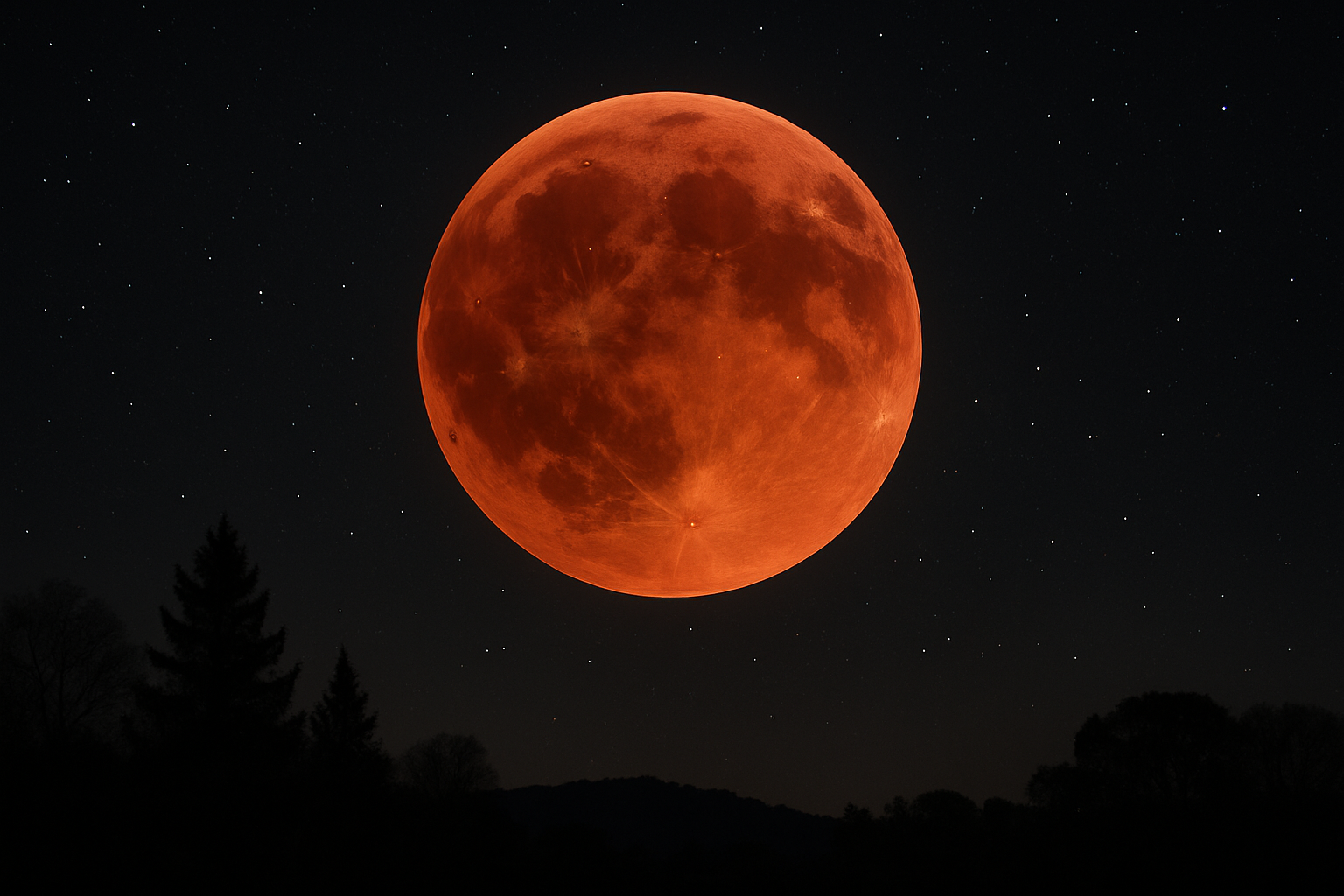
A spectacular total lunar eclipse painted the moon in deep crimson hues Tuesday night, creating a breathtaking "blood moon" phenomenon visible across vast regions of Asia, the Americas, and Oceania as Earth's shadow completely engulfed its natural satellite.
Vietnam joined millions of observers worldwide in witnessing this rare celestial event on March 3, 2026, as the Moon slipped gracefully into Earth's shadow, transforming from its familiar silver glow into the characteristic reddish-copper coloration that has captivated humanity for millennia.
A Global Astronomical Experience
This total lunar eclipse represented the culmination of 2026's extraordinary astronomical year, following February's six-planet alignment and occurring during what scientists call the "golden age of astronomical observation." The eclipse was visible across multiple continents, with optimal viewing conditions varying by geographic location.
According to historical records and astronomical data, this eclipse provided exceptional viewing opportunities for observers in East Asia, Australia, New Zealand, and much of North and South America. New Zealand enjoyed what experts called the "best seat in the world" with peak totality occurring at 12:30 AM local time, while various regions across the Americas experienced the phenomenon during pre-dawn hours.
"The Moon essentially becomes a projection screen for all of Earth's sunrises and sunsets simultaneously."
— Dr. Jean Suriel, Meteorological Analyst
The Science Behind the Blood Moon
The dramatic red coloration that gives lunar eclipses their "blood moon" moniker results from a fascinating interplay of physics and atmospheric chemistry. As sunlight passes through Earth's atmosphere during the eclipse, our planet's atmospheric gases scatter blue wavelengths while allowing red and orange wavelengths to bend around Earth and reach the lunar surface.
This atmospheric refraction process effectively projects the combined light of all Earth's sunrises and sunsets onto the Moon's surface, creating the ethereal reddish glow that has inspired countless myths and legends throughout human history. The intensity and exact hue of the red coloration depend on atmospheric conditions, including dust, pollution, and humidity levels in Earth's atmosphere at the time of the eclipse.
Safe Viewing and Photography Opportunities
Unlike solar eclipses, lunar eclipses are completely safe to observe with the naked eye throughout all phases of the event. This accessibility made the March 3 eclipse particularly special for families and amateur astronomers worldwide, requiring no special protective equipment or viewing precautions.
Modern smartphone technology, recently NASA-approved for space applications, enabled widespread documentation of the eclipse. Photography enthusiasts used everything from professional telescopes to consumer cameras to capture the lunar transformation, creating what may be one of the most extensively photographed astronomical events in history.
Historical and Cultural Significance
This total lunar eclipse holds particular significance as 2026's only total lunar eclipse, making it a truly rare opportunity for global observation. The next comparable eclipse visible from the Americas is not expected for several years, adding to the event's special importance for astronomy enthusiasts and researchers.
Throughout history, blood moons have held cultural and spiritual significance across civilizations. Ancient cultures interpreted these celestial phenomena as omens, while modern science has transformed our understanding of these predictable cosmic mechanics into opportunities for atmospheric research and lunar surface studies.
Scientific Research Opportunities
Beyond its visual spectacle, the eclipse provided valuable research opportunities for the global scientific community. Coordinated observations across multiple continents allowed researchers to study Earth's atmospheric composition through the way it filtered sunlight reaching the Moon.
These observations contribute to our understanding of atmospheric properties that affect climate research, while simultaneous measurements from different geographic locations provide insights into global atmospheric conditions. The eclipse also offered opportunities to study the lunar surface characteristics under the unique lighting conditions created during totality.
Connection to Space Exploration
The timing of this eclipse coincides with humanity's renewed focus on lunar exploration. As NASA's Artemis program prepares for humanity's return to the Moon and SpaceX develops lunar colonization capabilities, events like this total lunar eclipse serve as powerful reminders of our cosmic neighborhood's dynamic nature.
Understanding lunar phenomena, including how Earth's atmosphere affects lunar observations, provides valuable data for future astronauts and lunar settlements. The eclipse also demonstrates the precision of astronomical predictions, showcasing the mathematical models that enable space missions and lunar landing calculations.
Technology and Tradition Converge
The March 3, 2026 eclipse exemplified the intersection of ancient celestial phenomena with modern observation capabilities. While the eclipse itself follows the same physical laws that have governed lunar cycles for billions of years, contemporary technology enhanced the experience through real-time sharing, precise timing predictions, and unprecedented photographic documentation.
Mobile applications provided accurate local timing information, while social media platforms enabled real-time sharing of observations across time zones, creating a truly global shared experience that connected observers from Vietnam to the Americas in a moment of cosmic wonder.
Looking Forward
As the blood moon faded and normal lunar illumination returned, the eclipse served as both a spectacular natural display and a reminder of our planet's place in the larger cosmic dance. For the millions who witnessed this celestial event across Asia, the Americas, and beyond, March 3, 2026 will be remembered as a night when Earth, Moon, and Sun aligned to create one of nature's most beautiful phenomena.
The success of this global observation reinforces the enduring human fascination with celestial events and demonstrates how astronomical phenomena continue to unite people across cultures and continents in shared wonder at the cosmos. As space exploration enters its golden age, events like this total lunar eclipse remind us that some of the universe's most spectacular shows are visible right from our own backyard.