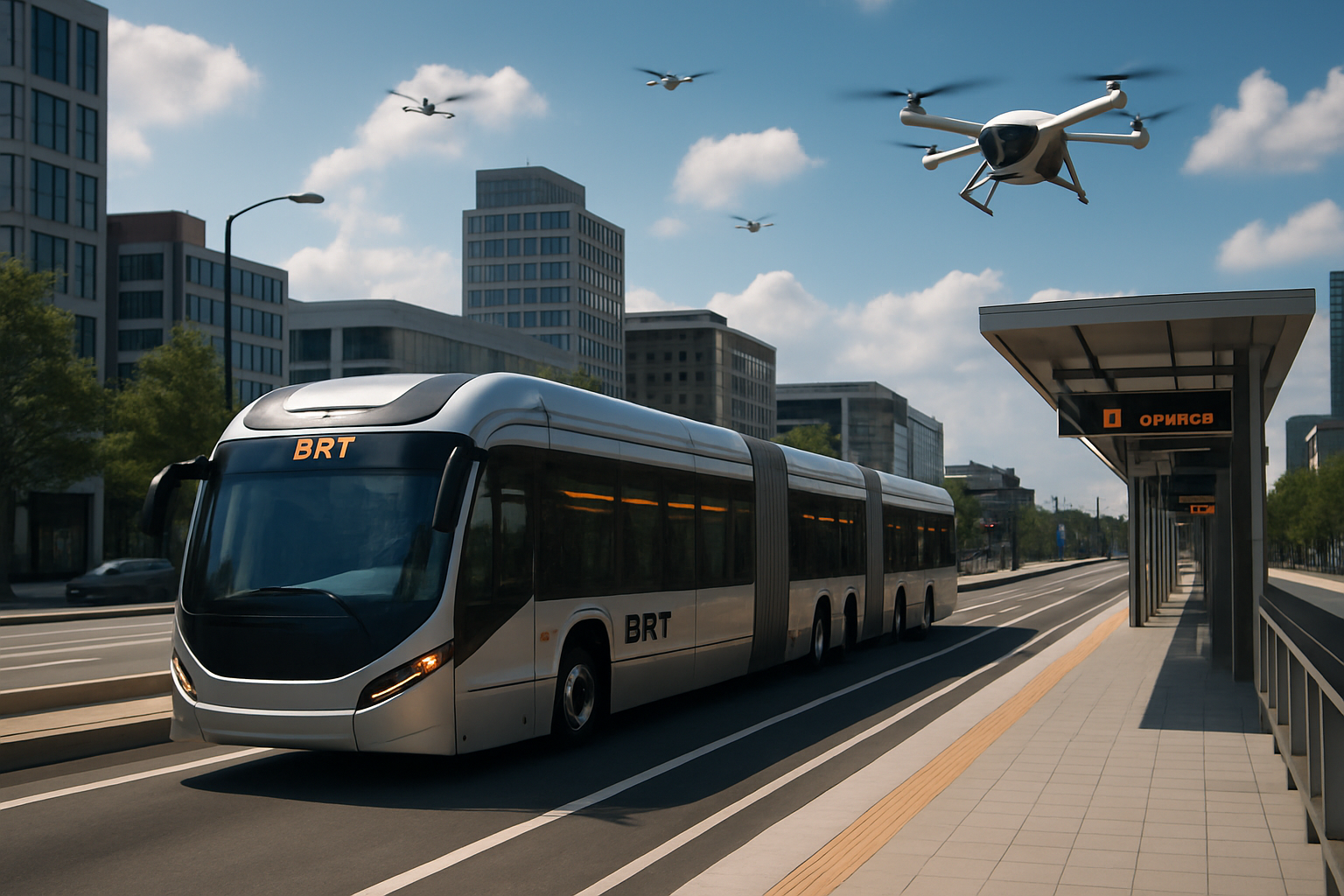
A new chapter in urban transportation began this week as the long-delayed Cebu Bus Rapid Transit officially commenced operations on March 13, while simultaneously, flying car technology received a massive investment boost with Aridge's $200 million funding round.
The convergence of these developments marks a pivotal moment in transportation innovation, demonstrating how both ground-level infrastructure projects and futuristic aerial mobility concepts are advancing simultaneously in the global push toward smarter, more efficient urban transportation systems.
Cebu BRT: A Hard-Won Victory
The Cebu Bus Rapid Transit (CBRT) officially began operations on Friday, March 13, after facing years of construction delays and operational challenges that had become emblematic of infrastructure project complexities in the Philippines.
According to the Department of Transportation's announcement, the system initially operates with free rides during peak hours—from 6 AM to 9 AM and 5 PM to 8 PM—providing immediate relief to commuters along the critical corridor connecting Il Corso in the South Road Properties to Cebu IT Park via Natalio Bacalso Avenue and Osmeña Boulevard.
"The CBRT represents more than just a transportation system; it's a catalyst for economic development and urban transformation in Cebu City."
— Department of Transportation Philippines
The interim bus service brought hundreds of residents on its inaugural run, marking a significant milestone for the Philippines' infrastructure modernization efforts. The system's median lanes along key arteries will remain closed to regular traffic as the BRT establishes its operational rhythm, potentially transforming commuting patterns across Metro Cebu.
This achievement comes within the context of a broader $570+ billion global infrastructure surge, where nations worldwide are investing in transportation networks as strategic foundations for economic competitiveness, climate adaptation, and international cooperation—far beyond their traditional role as simple physical assets.
Aridge Takes Flight: The Future is Airborne
While Cebu celebrated its ground-level transportation breakthrough, the skies beckoned with equally transformative news. Aridge, the flying car developer backed by Chinese electric vehicle giant Xpeng, successfully raised nearly $200 million in fresh funding as it prepares for a potential initial public offering in Hong Kong later this year.
The funding round, which included existing investors GL Ventures (Hillhouse Investment's venture capital arm) and HongShan (formerly Sequoia China), brings Aridge's total equity financing to approximately $1 billion—a testament to investor confidence in the emerging aerial mobility sector.
Aridge's advancement represents the maturation of flying car technology from science fiction concept to viable commercial venture. The company's progress, supported by Xpeng's automotive expertise and manufacturing capabilities, positions it at the forefront of the urban air mobility revolution that promises to reshape how people navigate increasingly congested cities.
A Global Transportation Renaissance
These developments are occurring within an unprecedented period of transportation innovation and investment worldwide. From Algeria's bus fleet modernization and Indonesia's LRT projects to Denmark's innovative public transit pricing experiments, nations are reimagining mobility infrastructure for the 21st century.
The timing is particularly significant given the ongoing climate crisis, with January 2026 marking the 19th consecutive month of global temperatures exceeding 1.5°C above pre-industrial levels. Transportation systems worldwide are being redesigned not just for efficiency and convenience, but for environmental sustainability and climate resilience.
Technology integration has become standard in modern transportation projects, incorporating real-time monitoring, predictive maintenance, digital payment systems, and environmental optimization from the design phase rather than as afterthoughts. This represents a fundamental shift from reactive to proactive transportation planning.
Challenges and Opportunities
Both the Cebu BRT and flying car developments face significant implementation challenges. For ground-based systems like the CBRT, coordination complexity involves multiple stakeholders, environmental compliance requirements, and the need to maintain existing services during transitions. The BRT's years of delays highlight how even well-intentioned infrastructure projects can encounter unexpected obstacles.
Flying car technology faces different but equally complex hurdles: regulatory frameworks for urban airspace management, public acceptance of aerial vehicles, integration with existing aviation systems, and the development of supporting infrastructure such as vertiports and charging networks.
However, these challenges are accompanied by tremendous opportunities. The economic multiplier effects of successful transportation innovation extend far beyond the transportation sector itself, creating employment, reducing logistics costs, enhancing market access, and improving overall business productivity.
Regional Integration and International Cooperation
Both developments reflect broader trends toward regional integration and enhanced international cooperation in transportation planning. The Cebu BRT connects to broader Philippine transportation networks and contributes to ASEAN connectivity objectives, while Aridge's international investment structure demonstrates how transportation innovation increasingly involves cross-border partnerships and knowledge sharing.
This pattern is evident globally, from the European Union's Trans-European Transport Networks (TEN-T) to African Continental Free Trade Area (AfCFTA) initiatives that prioritize improved regional connectivity as essential for economic integration and competitiveness.
The Convergence of Innovation
What makes March 2026 particularly significant is how different scales of transportation innovation are advancing simultaneously. While the Cebu BRT addresses immediate urban mobility needs through proven rapid transit technology, Aridge's flying car development pushes the boundaries of what's possible in urban transportation.
This convergence suggests that the future of urban mobility will likely involve multiple complementary systems rather than single solutions. Ground-level rapid transit, traditional public transportation, electric vehicles, and aerial mobility options may all coexist in an integrated ecosystem designed to serve diverse transportation needs across different urban contexts.
Looking Forward
The success of both initiatives will be measured not just in ridership numbers or flight hours, but in their contribution to broader sustainability goals, economic development, and quality of life improvements for urban residents. The Cebu BRT's performance will influence rapid transit development across Southeast Asia, while Aridge's progress could accelerate the timeline for commercial flying car services globally.
As cities worldwide grapple with increasing population density, environmental pressures, and the need for economic competitiveness, the transportation innovations showcased this week represent different approaches to the same fundamental challenge: how to move people efficiently, safely, and sustainably in an urbanizing world.
The convergence of ground-level infrastructure achievement and aerial mobility investment in March 2026 may well be remembered as a watershed moment when transportation innovation truly took flight—both literally and figuratively.