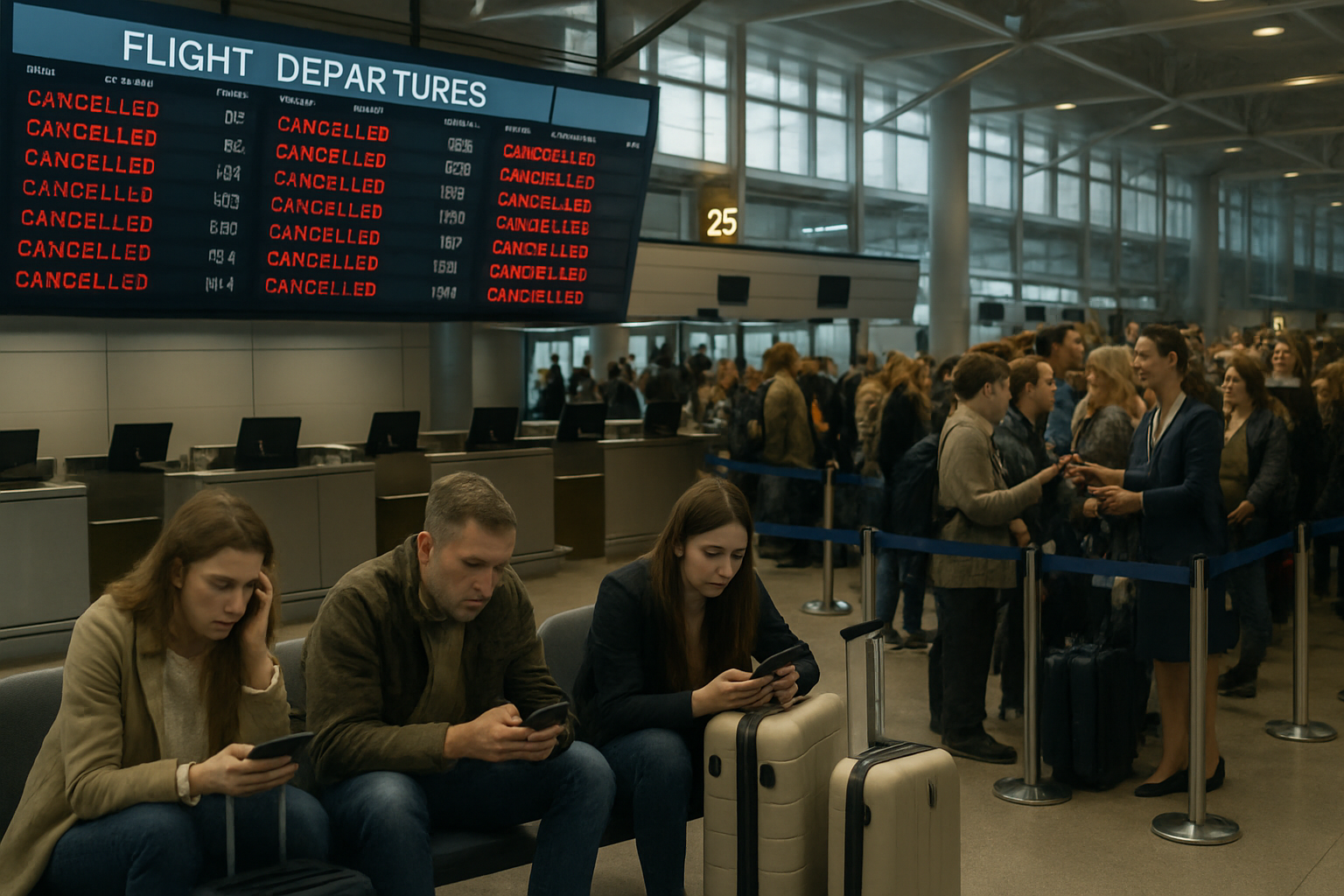
Australia's Qantas Airways announced major schedule adjustments from mid-April through late July, redeploying aircraft from US routes to boost Europe-bound capacity as the global aviation industry continues to reel from the most severe travel crisis since COVID-19.
The airline's decision comes as part of a broader industry response to ongoing conflicts in the Middle East that have seen thousands of flights cancelled throughout major transport hubs including Dubai, Abu Dhabi, and Doha. The disruptions have significantly impacted major carriers including Emirates, Etihad, and Qatar Airways, forcing airlines worldwide to implement emergency routing strategies.
Unprecedented Scale of Disruption
Since March 1, 2026, over 18,000 flights have been cancelled worldwide in what aviation experts describe as the most comprehensive regional disruption in modern history. Eight countries—Iran, Iraq, Israel, UAE, Qatar, Syria, Kuwait, and Bahrain—simultaneously closed their airspaces following military escalation, creating cascading effects throughout global aviation networks.
Dubai International Airport, the world's busiest with over 86 million passengers annually, remains completely shut down after sustaining missile damage. This closure has eliminated a critical Europe-Asia hub connection that millions of travelers relied upon for international journeys.
"The changes are in response to the ongoing conflict in the Middle East, which has seen thousands of flights cancelled throughout various major transport hubs in the region."
— Qantas Statement
Industry-Wide Adaptations
Airlines across Europe have been forced to implement emergency protocols. Air France-KLM, Wizz Air, and Bulgaria Air have suspended Middle East operations indefinitely, while carriers are exploring complex alternative routing strategies that often involve Caribbean stopovers for trans-Pacific routes.
The crisis has particularly affected passengers traveling between Australia and Europe, traditionally one of the busiest long-haul routes that relied heavily on Middle Eastern hubs. Qantas's response involves redeploying aircraft from US domestic routes to accommodate the surge in passengers seeking alternative pathways to Europe during the northern hemisphere summer travel season.
European Airlines Under Pressure
European carriers face additional challenges as the crisis compounds existing operational difficulties. Recent reports from Scandinavia indicate that over 1,500 airport employees in the Canary Islands may strike from March 27, potentially affecting multiple airports and adding to travel disruptions during the Easter holiday period.
Swedish travel agency executives report this is their busiest crisis period since COVID-19, with "every phone call an emergency" as they work to assist stranded passengers. One Swedish traveler, Emily Grosser, paid 6,000 SEK ($560) for alternative routing from Paris to Australia after her Dubai connection was cancelled—highlighting the extreme costs individuals face when emergency rerouting becomes necessary.
Swiss Market Response
Switzerland presents a microcosm of the broader European situation. At Zurich Airport, several routes to Gulf countries have been suspended, prompting some Swiss travelers to change destinations entirely while others delay booking decisions. The uncertainty has extended beyond immediate travel plans, affecting Easter holiday preparations as travelers seek assurances about route reliability.
Energy Market Pressures
The travel disruptions are being exacerbated by significant increases in fuel costs. Jet fuel prices have surged from $85-90 to $150-200 per barrel—a 122% increase—due to Iran's closure of the Strait of Hormuz, which affects 40% of global oil transit. This dramatic cost increase has forced airlines to implement emergency fare surcharges, with Air France-KLM adding 50 euros to long-haul economy tickets.
Oil prices have surged past $80 per barrel, while natural gas prices have increased 24% in Europe and 78% in the United States. These energy market disruptions create additional operational challenges for airlines already struggling with complex rerouting requirements.
Passenger Evacuation Operations
Beyond commercial disruptions, governments worldwide are conducting the largest coordinated international evacuation since the Arab Spring in 2011. Australia alone is working to extract 115,000 trapped nationals, while Germany is coordinating the evacuation of 30,000 stranded tourists. The European Union activated its ESTIA evacuation plan for the first time, coordinating the extraction of over 2,000 nationals from the UAE.
These evacuation operations represent a massive logistical challenge, with successful repatriations including Emirates flight EK414 carrying over 200 Australian citizens to Sydney and Cyprus Airways operating Dubai-Larnaca flights for European nationals.
Long-term Industry Transformation
Aviation experts suggest the current crisis will fundamentally reshape the industry's approach to route planning and risk assessment. The over-dependence on Middle Eastern hubs for Europe-Asia connectivity has been exposed as a critical vulnerability, particularly with Russian and Ukrainian airspace already closed due to ongoing conflicts.
Airlines are accelerating discussions about route diversification strategies to reduce dependency on single regional hubs. Enhanced security screening, mandatory conflict insurance, and pre-approval systems for high-risk destinations are expected to become standard industry practices.
Regional Tourism Redistribution
The crisis is creating clear winners and losers in the global tourism market. Croatia is benefiting as travelers seek safer European alternatives, while Spain, with its 513.6 million annual tourist nights, is positioned to capture additional redirected demand. Conversely, destinations dependent on Middle Eastern hub connections face significant challenges, with New Zealand particularly vulnerable as one-third of its European visitors typically use Middle Eastern airports.
Recovery Timeline Uncertainty
Unlike weather-related disruptions with predictable recovery timelines, the current crisis depends entirely on military and diplomatic resolution. Airlines are conducting daily operational reviews but cannot make long-term scheduling decisions while multiple airspaces remain closed and security conditions remain volatile.
Even when normal operations resume, industry experts estimate it will take weeks to clear the backlog of cancelled flights and stranded passengers. The crisis has demonstrated the fragility of modern transportation networks when exposed to geopolitical instability in strategic regions.
"Saker kommer att ta längre tid. Det kan bli stökigt [Things will take longer. It could become chaotic]."
— Adam Györki, TUI Communications Manager
Travel Insurance Gaps Exposed
The crisis has revealed significant gaps in travel insurance coverage, with standard policies typically excluding war-related cancellations. This has driven a shift toward package tours over independent travel, as tour operators can provide more comprehensive coverage frameworks during volatile periods.
Austrian consumer agencies have confirmed that travelers experiencing regional "anxiety" have no recourse unless they book organized tours with specialized coverage. This represents a fundamental change in travel purchasing behavior, accelerating a move away from independent travel toward more protected package arrangements.
Technology and Adaptation
Airlines are implementing sophisticated technological solutions to manage the crisis, including enhanced fuel loading systems to avoid refueling in affected zones, complex rerouting algorithms, and real-time security monitoring. These adaptations are becoming permanent features of international aviation operations.
The industry is also investing heavily in communication platforms to keep passengers informed during rapidly changing situations, with mobile applications providing real-time updates on flight status, alternative routing options, and evacuation procedures.
International Cooperation Framework
The crisis has tested international cooperation mechanisms to their limits while also demonstrating their value. The successful coordination of evacuation operations, shared intelligence about security threats, and collaborative rerouting strategies have provided templates for future emergency responses.
However, the varying levels of government preparedness have also exposed gaps in unified coordination mechanisms for mass civilian protection during regional conflicts. These lessons are influencing the development of enhanced crisis management frameworks for an increasingly volatile geopolitical environment.
Looking Forward
March 2026 represents a watershed moment for the global travel industry, potentially defining travel patterns for decades ahead. The industry faces a fundamental choice between maintaining robust systems that enable global mobility despite security challenges, or evolving toward more regionalized, security-conscious travel patterns.
Success in managing this crisis will provide valuable frameworks for future international emergencies, while failure could fundamentally reshape the nature of international travel in an interconnected but increasingly unstable world. The coming weeks will be crucial in determining whether the global aviation network can adapt while maintaining the connectivity that has defined modern international travel.
As Qantas and other airlines implement their adaptive strategies, the travel industry continues its largest operational test since World War II, with implications extending far beyond immediate scheduling challenges to fundamental questions about the future of international mobility in a volatile world.