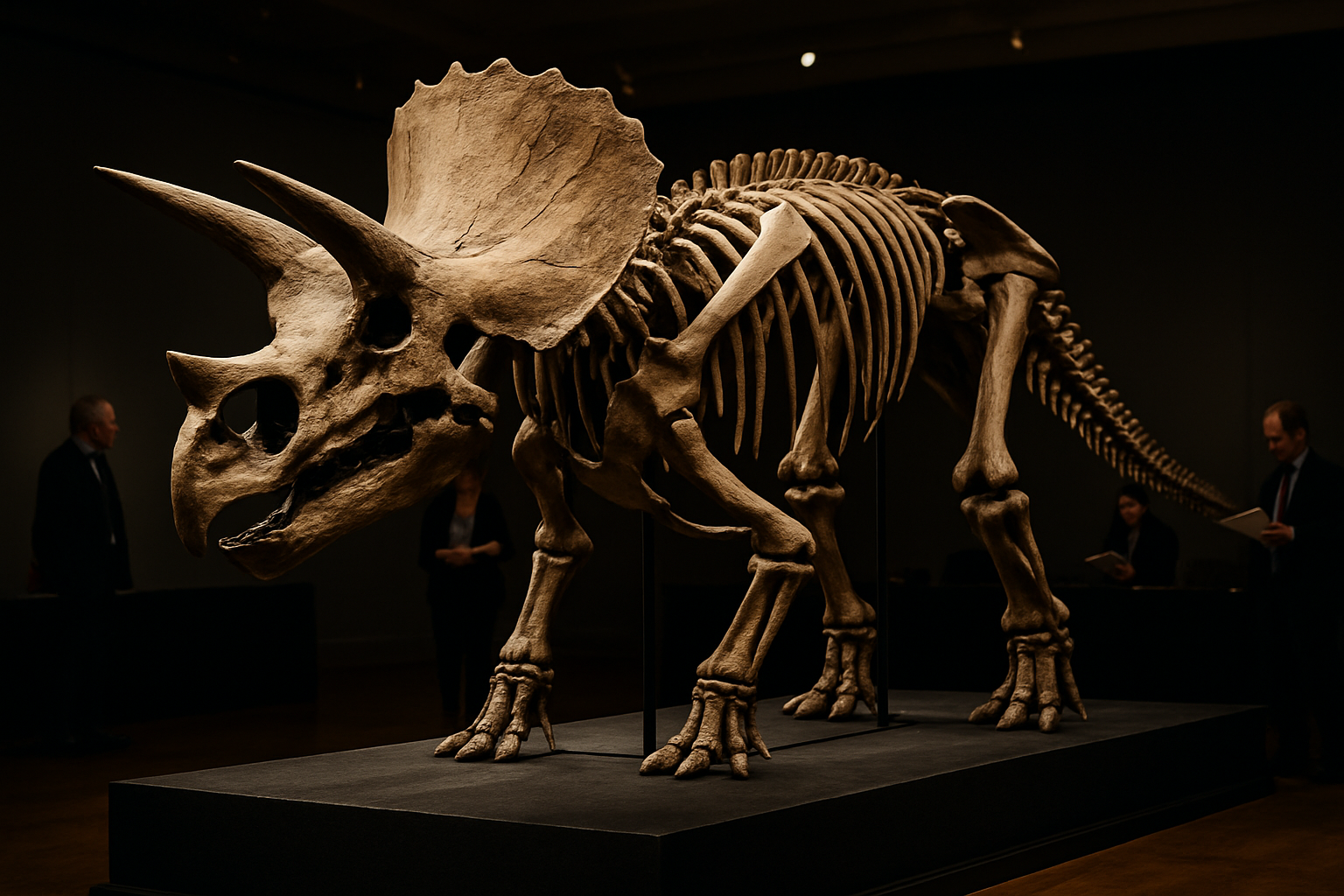
A magnificent Triceratops skeleton known as "Trey," which has stood sentinel in a Wyoming museum for decades, is set to make paleontological history when it hits the auction block next month, marking a rare instance of a museum-exhibited dinosaur entering the rapidly expanding fossil marketplace.
The 66-million-year-old specimen will be available for bidding from March 17 to 31 on Joopiter, the online auction platform founded by Grammy-winning artist and producer Pharrell Williams. With pre-auction estimates ranging from $4.5 million to $5.5 million, "Trey" represents both the growing commercialization of paleontology and the record-breaking prices commanding attention in today's dinosaur market.
A Museum Specimen Enters the Market
The decision to auction "Trey" represents an unusual move in the paleontological world, where museum specimens typically remain within academic institutions for research and public education. The skeleton's transition from museum halls to auction house reflects broader trends in the fossil market, where record-breaking sales have become increasingly common.
Dating back more than 66 million years to the Cretaceous period, "Trey" exemplifies the iconic three-horned dinosaur that once roamed what is now North America. Triceratops, whose name means "three-horned face," remains one of the most recognizable dinosaurs, making specimens particularly sought after by collectors and institutions worldwide.
The Booming Dinosaur Market
The auction of "Trey" comes at a time when the dinosaur fossil market is experiencing unprecedented growth. Recent years have witnessed a series of record-breaking sales, with private collectors and institutions competing for complete skeletons and rare specimens.
This market boom coincides with what paleontologists are calling a "February 2026 Archaeological Renaissance," characterized by major discoveries worldwide. Recent finds include intact dinosaur nests in Argentina containing 10 perfectly preserved eggs from the Jurassic period, and the first Spinosaurus skull material discovered in the Sahara Desert in over a century, complete with evidence of colorful crests used for visual communication.
"The current market reflects both increased public interest in paleontology and the rarity of museum-quality specimens becoming available for private acquisition."
— Industry Expert Analysis
The robust market has been fueled by several factors: growing public fascination with dinosaurs, increased wealth among collectors, and the relative scarcity of complete, well-preserved specimens. Museums and research institutions often find themselves competing with private collectors for significant finds, leading to complex discussions about scientific access versus commercial value.
Scientific and Cultural Significance
Triceratops played a crucial role in late Cretaceous ecosystems, serving as one of the primary herbivores in prehistoric North American landscapes. These massive creatures, which could reach lengths of up to 30 feet and weigh as much as 12 tons, are renowned for their distinctive skulls featuring three facial horns and a large bony frill.
The scientific value of specimens like "Trey" extends beyond their impressive appearance. Complete skeletons provide researchers with insights into dinosaur behavior, growth patterns, and evolutionary relationships. The potential removal of such specimens from academic settings raises important questions about balancing commercial interests with scientific research needs.
Recent discoveries have revolutionized understanding of dinosaur behavior and social structures. The colorful Spinosaurus discovered in the Sahara revealed sophisticated visual communication systems, while nest sites in Argentina provided unprecedented insights into dinosaur reproductive strategies and parental care.
The Joopiter Platform and Celebrity Involvement
The choice of Joopiter as the auction platform adds a modern twist to the paleontological marketplace. Founded by Pharrell Williams, the platform represents the intersection of celebrity culture, luxury collecting, and scientific specimens. This crossover appeal may contribute to increased visibility and potentially higher bidding for "Trey."
Celebrity involvement in dinosaur auctions is not unprecedented, but it does highlight how paleontological specimens have transcended purely academic circles to become cultural artifacts and investment opportunities. The platform's association with the entertainment industry may attract new demographics of collectors to the fossil market.
Market Dynamics and Competition
The $4.5-5.5 million estimate for "Trey" reflects current market conditions where complete dinosaur skeletons command premium prices. Factors influencing valuation include completeness, preservation quality, scientific significance, and rarity of the species.
Triceratops specimens are particularly valuable due to their iconic status and the completeness often achieved in finds. Unlike some dinosaur species known primarily from fragmentary remains, Triceratops fossils frequently preserve entire skulls and significant portions of the skeleton, making them ideal for both scientific study and public display.
The auction occurs within a broader context of global archaeological activity. Institutions worldwide are investing in advanced analytical techniques, from ground-penetrating radar to isotope analysis, enhancing both the scientific value and market appeal of well-documented specimens.
Implications for Museums and Research
The transition of museum specimens to private hands raises complex questions about the future of paleontological research and public education. While private collectors may provide excellent care and even public access to specimens, the scientific community often prefers specimens to remain in research institutions where they can be studied by multiple researchers over time.
Some institutions have developed innovative approaches to balance commercial realities with scientific needs, including partnerships with private collectors that ensure continued research access. Digital documentation and 3D modeling technologies also allow for broader scientific sharing of specimens regardless of ownership.
The success of "Trey's" auction will likely influence future decisions by museums and private owners of significant specimens, potentially setting precedents for the intersection of academic paleontology and commercial fossil markets.
Global Context and Future Trends
The auction takes place against the backdrop of remarkable global paleontological activity. From ancient turtle fossils revealing evolutionary connections in Argentina to 21-million-year-old whale specimens in Australia, 2026 has proven exceptional for major discoveries.
International cooperation in paleontology continues to expand, with researchers sharing advanced analytical techniques and collaborative approaches. However, the commercial market for fossils operates in parallel, creating both opportunities and challenges for the scientific community.
Climate change adds urgency to paleontological work, as some fossil sites face threats from extreme weather and environmental changes. This urgency may contribute to increased interest in preserving significant specimens, whether in museums or private collections with appropriate conservation standards.
Looking Ahead
As "Trey" prepares for its March auction, the paleontological community will be watching closely. The results may influence future decisions about specimen ownership, institutional policies, and the evolving relationship between commercial fossil markets and scientific research.
The auction represents more than a single transaction; it symbolizes the growing intersection of paleontology, commerce, and popular culture. Whether "Trey" finds a new home in a private collection, returns to a museum setting, or becomes part of a public-private partnership will provide insights into the future of significant fossil specimens.
Regardless of the outcome, "Trey" has already achieved distinction as a bridge between Wyoming's paleontological heritage and the global appreciation for these magnificent creatures that once ruled the Earth. The auction will determine the next chapter in this ancient skeleton's remarkable journey through time.