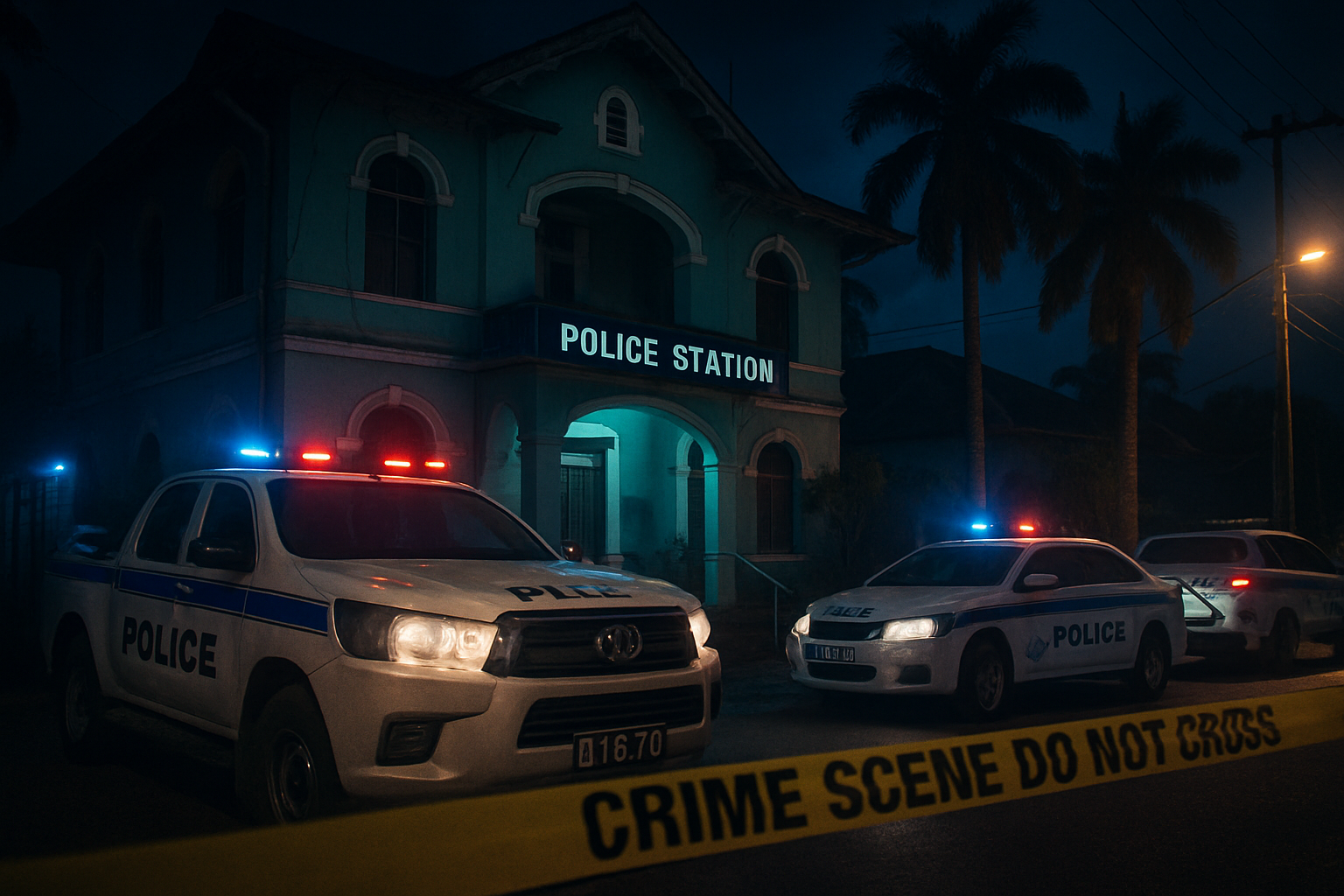
Acting Corporal Anushka Eversley was found shot dead inside the San Fernando Municipal Police Station on King's Wharf early Sunday morning, as perpetrators executed what security experts are calling one of the most sophisticated police facility breaches in Caribbean history, stealing 62 firearms and over 4,000 rounds of ammunition from the station's armory.
The 32-year-old officer, attached to the Trinidad and Tobago Municipal Police Service (TTMPS), was discovered at approximately 4:40 AM by a returning colleague who found the area in darkness, blood from the corporal's quarters, and the strong room compromised. Eversley had last been seen at 11:00 PM Saturday evening during regular duty.
Massive Weapons Cache Stolen
The stolen arsenal represents a catastrophic security breach that has sent shockwaves through the Caribbean region. According to law enforcement sources, the perpetrators made off with:
- 52 Glock pistols
- 6 shotguns
- 4 MPX-type firearms
- Over 4,000 rounds of 9mm ammunition
Law enforcement consultant and firearms expert Paul Daniel Nahous estimated the total value of the stolen weapons at $650,000, describing the cache as sufficient to arm a small militia. The sophisticated nature of the breach suggests intimate knowledge of police protocols and facility layout.
Government Activates National Security Response
Prime Minister Kamla Persad-Bissessar, while refusing to implement a nationwide curfew, acknowledged the gravity of the situation in a statement describing the incident as "internal betrayal" rather than an external attack on law enforcement. However, the characterization has done little to calm public fears about the security implications.
"This represents not just an attack on an individual officer, but a direct assault on the institution of law enforcement itself."
— Commissioner Allister Guevarro, Trinidad and Tobago Police Service
The Ministry of Defence immediately activated a coordinated national security response, with Minister Wayne Sturge extending condolences while emphasizing the unprecedented nature of the attack. The Trinidad and Tobago Defence Force (TTDF) has been placed on elevated operational posture, supporting the TTPS and municipal police services in ongoing security and investigative operations.
Political Reaction and Security Concerns
Opposition Leader Pennelope Beckles questioned the government's ability to protect ordinary citizens when police officers are not safe within their own stations. The criticism reflects broader concerns about escalating criminal sophistication that appears to challenge traditional law enforcement capabilities.
People's National Movement (PNM) Chairman Marvin Gonzales linked the incident to broader security failures, while Homeland Security Minister Roger Alexander maintained confidence in police capabilities despite acknowledging the severity of the breach.
The incident has prompted urgent calls from family members for accountability. Wendell Eversley, uncle of the slain officer and a prominent social activist, described the murder as "unprecedented and historic," demanding justice while calling for the resignation of the Homeland Security Minister.
Criminal Network Sophistication
Security analysts note that the attack demonstrates criminal organizations with operational capabilities that rival state-level operations. The perpetrators showed:
- Detailed knowledge of police shift patterns and facility security
- Ability to access and compromise heavily secured weapons storage
- Coordination suggesting extensive planning and reconnaissance
- Technical expertise in bypassing multiple security systems
This incident follows a pattern documented across the Caribbean and globally, where criminal networks have evolved to possess what experts term "state-like capabilities" including advanced surveillance, encrypted communications, and compartmentalized international structures that often exceed traditional law enforcement resources.
Historical Context of Caribbean Security Crisis
The San Fernando station attack occurs against a backdrop of escalating security challenges throughout the Caribbean region. Trinidad and Tobago has been under a State of Emergency since March 2026, implemented by Prime Minister Persad-Bissessar following urgent National Security Council advice about escalating gang violence and credible threats against law enforcement officials.
The country is also a participant in the Shield of the Americas Anti-Cartel Coalition, launched in March 2026 as a 17-nation alliance committed to enhanced security measures against transnational organized crime. Despite these efforts, criminal organizations continue to demonstrate remarkable adaptability and operational sophistication.
Previous security incidents have included the systematic targeting of law enforcement personnel, with criminals demonstrating willingness to directly confront state authority. The murder of soldier Jealani Williams in March 2026, killed with ammunition bearing "TTR" and "TTAG" markings indicating military or government sources, highlighted vulnerabilities in state weapons security.
Ongoing Investigation and Security Response
A comprehensive investigation is underway involving multiple security agencies, focusing on how the perpetrators gained access to the facility and whether the attack involved inside knowledge or assistance. The incident is being treated as a national security matter with intelligence coordination involving regional partners to track the stolen weapons and prevent their use in further criminal activities.
Enhanced security protocols have been implemented across police facilities nationwide, while a manhunt continues for the substantial weapons cache that could significantly enhance criminal capabilities across the region.
Minister Khadijah Ameen announced that authorities are awaiting a full report from the Assistant Commissioner as the investigation proceeds through multiple law enforcement agencies and international partners.
International Implications
The sophisticated nature of the attack has drawn attention from international security experts who view it as part of a broader global pattern of criminal organizations challenging state authority. The Caribbean region's strategic location makes it particularly vulnerable to transnational criminal networks involved in drug trafficking and weapons smuggling between South American production centers and North American markets.
The theft of such a large weapons cache raises concerns about regional security spillover effects, as firearms could potentially be trafficked to other Caribbean nations or used to enhance criminal capabilities in ongoing territorial disputes between organized groups.
Security cooperation frameworks, including enhanced intelligence sharing with U.S. agencies and participation in regional anti-crime initiatives, will likely be crucial for tracking the stolen weapons and preventing their use in future criminal activities.
Community Impact and Fear
The murder of Acting Corporal Eversley has sent shockwaves through law enforcement ranks and the broader community. Religious leaders, including Archbishop Charles Jason Gordon, have condemned the killing as representing "unacceptable loss of life" that undermines fundamental security for all citizens.
The incident highlights the psychological toll on communities when those sworn to protect become victims of sophisticated criminal violence. Families are reconsidering daily routines, while businesses reassess security protocols in recognition that criminal capabilities may have significantly expanded with access to professional-grade weaponry.
The case represents a critical test of Trinidad and Tobago's institutional capacity to maintain public safety while preserving democratic governance in the face of criminal organizations that operate with resources and capabilities that challenge traditional concepts of state authority.