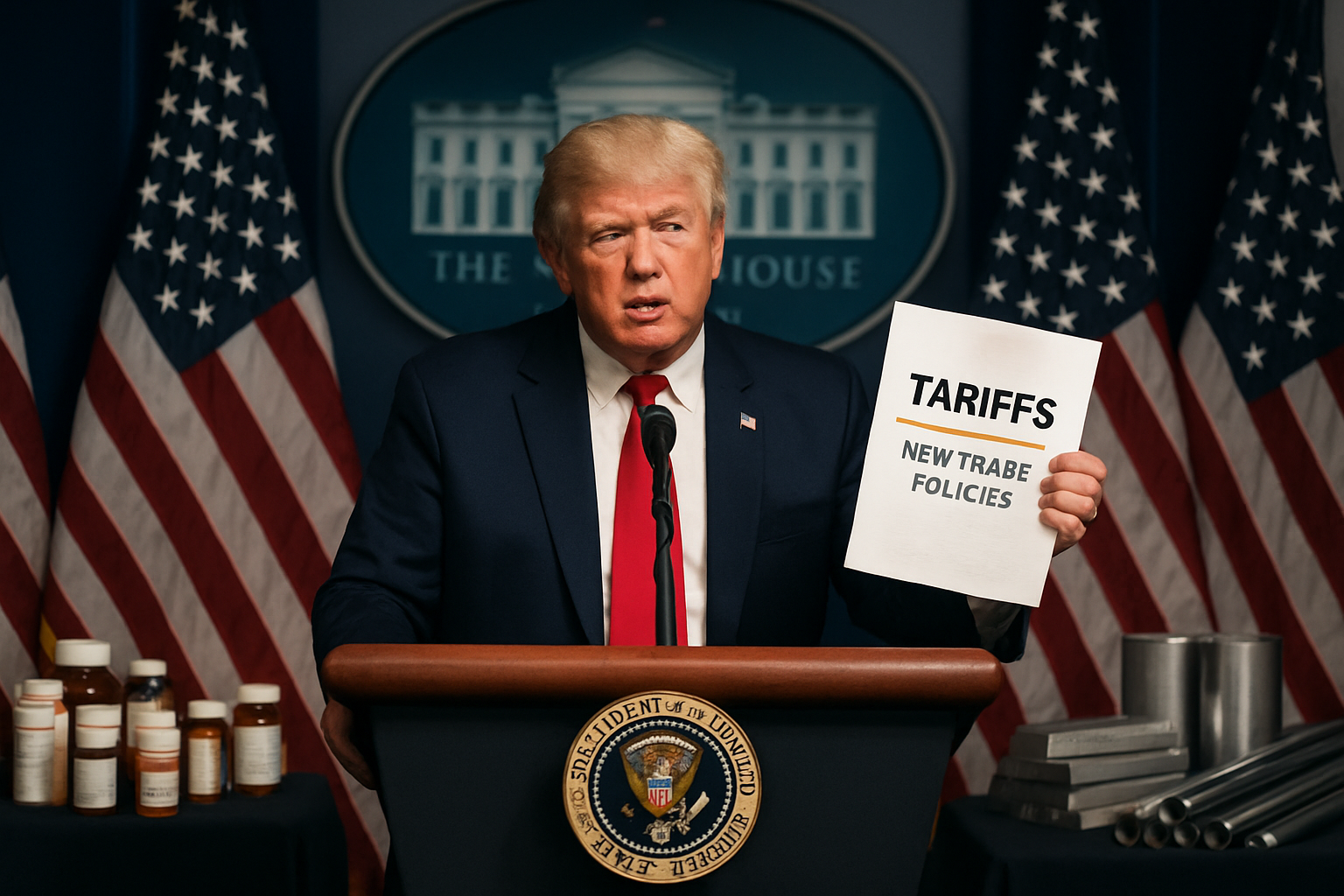
President Donald Trump announced sweeping new trade measures Thursday, imposing 100% tariffs on pharmaceuticals manufactured outside the United States while restructuring steel and aluminum duties, marking a dramatic escalation in global trade tensions exactly one year after his "Liberation Day" tariff program began.
The pharmaceutical tariffs, which will take effect in the coming months, target imports of patented drugs and their active ingredients in what the administration describes as an effort to pressure foreign manufacturers to relocate production to American soil. The move represents one of Trump's most aggressive trade actions since returning to office, potentially affecting billions of dollars in international pharmaceutical trade.
Pharmaceutical Industry Under Siege
The 100% tariff applies specifically to patented pharmaceuticals and active pharmaceutical ingredients (APIs) imported from countries outside the United States. According to administration officials, companies can avoid the tariffs by either negotiating direct pricing agreements with the U.S. government or by moving their manufacturing operations to American facilities.
Australia, which exports significant pharmaceutical products to the United States, faces particular exposure to these measures. The tariffs represent "a heavy blow for one of Australia's biggest exports to the country," according to Australian media reports. The long-threatened duties have "plunged a billion-dollar export industry into turmoil."
European Union countries are notably exempt from the pharmaceutical tariffs, suggesting the administration may be targeting specific trading partners while preserving relationships with key allies. Norwegian reports confirm that EU nations will not face the new pharmaceutical duties, indicating a strategic approach to trade enforcement.
Metal Tariffs Restructured
Simultaneously, Trump announced significant changes to existing steel and aluminum tariffs. While maintaining 50% duties on raw steel and aluminum imports, the administration plans to reduce tariffs on derivative products to between 15% and 25%, according to Austrian trade sources.
This restructuring appears designed to address complaints from American manufacturers who have struggled with higher costs for processed metal products while maintaining protection for primary steel and aluminum producers. The move affects companies accused by the administration of "artificially manipulating" metal prices in global markets.
Global Trade War Anniversary
The announcement comes exactly one year after Trump launched his comprehensive "Liberation Day" tariff program, which initially imposed sweeping duties across multiple sectors. However, the trade landscape has shifted dramatically since then, particularly following a historic Supreme Court ruling in February 2026 that struck down Trump's use of emergency powers for tariff implementation.
The 6-3 Supreme Court decision, authored by Chief Justice John Roberts, applied the "major questions doctrine" to rule that the International Emergency Economic Powers Act (IEEPA) "does not authorize president to impose tariffs" without congressional authorization for actions of "vast economic and political significance." This constitutional crisis forced the administration to rely on alternative legal authorities with more limited duration.
Congressional Resistance Grows
Trump's trade policies face increasing opposition from Congress, including from members of his own party. In February, the House passed legislation ending Canada tariffs by a vote of 219-211, with six Republican defections marking the first significant bipartisan rebuke of Trump's trade authority during his second term.
The constitutional constraints imposed by the Supreme Court ruling have created a 150-day limit on many tariff measures, forcing the administration to seek congressional approval or find alternative approaches. This has led to what critics describe as an increasingly chaotic trade policy environment.
International Reactions and Diplomatic Consequences
The European Union has responded forcefully to the escalating trade tensions, with the European Parliament preparing to suspend the EU-US trade agreement for the first time due to institutional concerns about American policy predictability. German parliamentarian Bernd Lange, chairman of the Trade Committee, has led efforts to freeze trade agreements citing policy "chaos" in Washington.
China, meanwhile, has welcomed the constitutional constraints on Trump's trade authority as vindication of its position. Beijing has announced zero-tariff access for 53 African countries beginning May 1, 2026, representing the most comprehensive China-Africa trade expansion in history and directly competing with American bilateral trade pressure tactics.
The trade tensions have particularly strained relationships with traditional allies. Canada faces ongoing tariff threats despite the strong economic integration between the two countries, while Australia's pharmaceutical industry confronts potentially devastating new duties.
Economic Impact and Market Response
Despite the extensive use of tariffs as a trade tool, the U.S. trade deficit remains essentially unchanged at $901.5 billion annually as of December 2025, demonstrating what economists describe as the structural nature of trade imbalances that cannot be resolved through tariff measures alone.
The pharmaceutical tariffs threaten to significantly increase healthcare costs for American consumers, as the United States relies heavily on imported medicines and active ingredients. Industry analysts warn that forcing rapid relocation of pharmaceutical production could create supply chain disruptions and drug shortages.
Global markets have reacted with volatility to the ongoing trade uncertainty. Oil prices have increased by over $1 per barrel in response to trade tensions, while manufacturing sectors that rely on global supply chains face continued disruption from unpredictable policy changes.
Strategic Implications
The pharmaceutical tariffs represent a significant expansion of trade policy into healthcare, a sector critical to national security and public health. The administration's approach of linking trade pressure to domestic production requirements reflects a broader strategy of economic nationalism and industrial policy.
However, the constitutional constraints imposed by the Supreme Court ruling limit the administration's ability to implement comprehensive, long-term trade policies without congressional support. The 150-day time limits on many measures create a recurring cycle of policy uncertainty that complicates international business planning and diplomatic relationships.
The timing of the announcements, exactly one year after the original "Liberation Day" program, appears designed to demonstrate continued commitment to aggressive trade policies despite legal and political obstacles. Yet the practical impact may be limited by the constitutional framework that now governs executive trade authority.
Looking Ahead
As the one-year anniversary of Trump's trade war initiative passes, the landscape has fundamentally changed from the initial sweeping tariff program to a more constrained approach limited by constitutional oversight and congressional resistance. The pharmaceutical tariffs represent an attempt to maintain trade pressure within these new legal boundaries, but their effectiveness and sustainability remain uncertain.
The international community increasingly views American trade policy as unpredictable and institutionally unstable, leading allies and competitors alike to develop alternative arrangements that reduce dependence on U.S. markets and supply chains. This trend may ultimately undermine the strategic objectives that the trade measures were designed to achieve.
The success or failure of these latest tariff measures will likely determine whether Trump's trade approach can adapt to constitutional constraints while achieving its stated goals of reshoring production and improving America's trade balance. With congressional elections approaching and international patience wearing thin, the stakes for U.S. trade policy have never been higher.