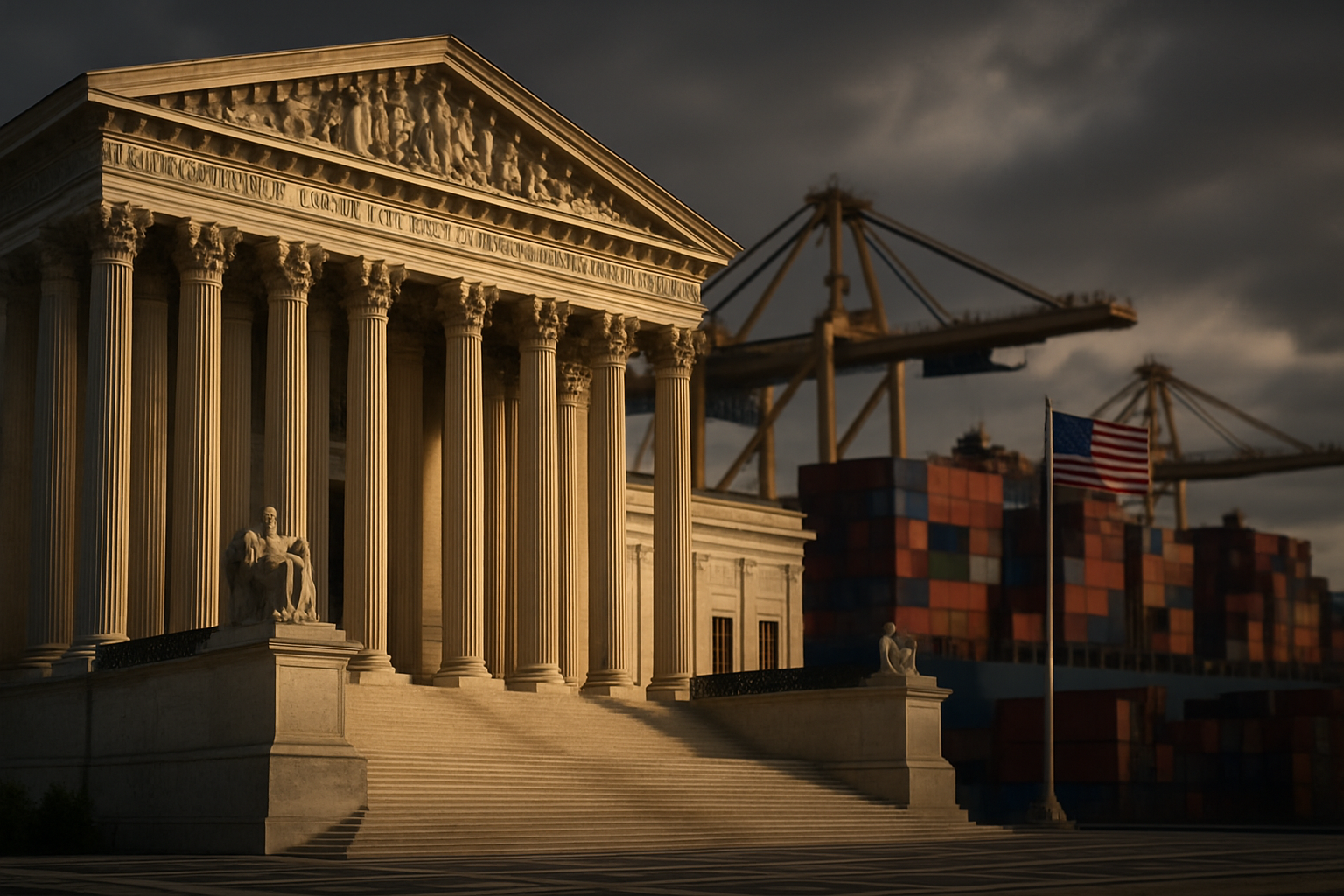
President Donald Trump escalated global tariffs to 15% — the maximum legal level allowed — following Friday's devastating Supreme Court ruling that struck down his comprehensive tariff program, creating the most serious constitutional crisis and executive-judicial confrontation since Watergate.
The 6-3 Supreme Court decision, authored by Chief Justice John Roberts, applied the "major questions doctrine" to rule that the International Emergency Economic Powers Act (IEEPA) "does not authorize president to impose tariffs" without explicit congressional authorization for actions of "vast economic and political significance."
Trump's immediate response was unprecedented in its defiance. Within hours of the Friday ruling, the president launched the most severe attack on the judiciary by a sitting president in modern history, calling the justices "absolutely ashamed," "disgrace to our nation," and "disloyal to Constitution." He immediately implemented the new 15% tariff using Section 122 of the Trade Act of 1974, representing direct judicial defiance that constitutional scholars say creates a separation of powers crisis.
Global Markets React with Volatility
International markets initially surged on hopes of reduced trade uncertainty, with the Nasdaq climbing 0.90% to 22,886.07 and the S&P 500 rising 0.69% to 6,090 points. However, gains moderated significantly after Trump announced the replacement tariffs. Oil prices jumped over $1 per barrel as energy markets reflected growing tensions.
The Australian sharemarket extended early losses as investors digested the implications of the trade policy upheaval. Australian meat producers expressed particular concern, with Meat & Livestock Australia Managing Director Michael Crowley noting that lamb, mutton, and goat meat products would be hit by the tariff increase from 10% to 15%.
"The tariff hikes will affect some of Australian imports significantly, creating new challenges for our exporters just as they were adjusting to the previous framework."
— Michael Crowley, Managing Director, Meat & Livestock Australia
European Union Demands Policy Clarity
The European Commission issued forceful statements demanding the US honor its 2025 joint declaration on trade commitments. After weekend talks between EU Trade Commissioner Sefcovic, US Trade Representative Greer, and Commerce Secretary Lutnick, European officials declared "an agreement is an agreement," expressing serious concerns about American policy predictability.
Italian media reported widespread disapproval of Trump's approach, with polling showing 60% of Americans disapproving of the president's handling of trade policy. The coverage noted that despite extensive tariff policies, the US trade deficit has increased rather than decreased, with industrial employment declining by 80,000 workers.
European Parliament trade committee chairman Bernd Lange suggested the possibility of freezing US trade agreements due to what he characterized as "chaos" in American trade policy. The EU's response highlights growing concern among traditional allies about the reliability of US economic commitments.
Congressional Resistance and Constitutional Implications
The Supreme Court ruling vindicated earlier congressional resistance, particularly the House's 219-211 vote ending Canada tariffs with six Republican defections — the first significant bipartisan rebuke of Trump's trade policies in his second term. House Speaker Mike Johnson had unsuccessfully attempted to prevent the vote, highlighting growing Republican anxiety over unpredictable trade approaches.
The new 15% tariff framework operates under Section 122 of the Trade Act of 1974, which permits maximum 15% tariffs for 150 days before congressional approval is required. This creates urgent legislative pressure and sets up a constitutional showdown testing executive authority versus congressional trade oversight.
The tariffs affect all countries except USMCA partners, with exemptions for minerals, fertilizers, metals, energy equipment, agricultural products, pharmaceuticals, and medical materials. However, the broad application still represents a significant escalation in global trade tensions.
International Reactions and Strategic Implications
China welcomed the Supreme Court ruling as vindication of its position, strengthening Beijing's negotiating stance ahead of Trump's scheduled March 31-April 2 visit to China. Chinese officials noted the decision removes a key leverage tool from US trade negotiations while potentially opening space for more conventional diplomatic approaches.
Russian presidential envoy Kirill Dmitriev commented that the new US tariffs would most greatly benefit countries that Trump had previously criticized, particularly noting that the EU and UK would be among the hardest hit by the new trade measures.
Singapore financial markets reflected the broader uncertainty, with Wall Street futures and the dollar dropping amid what analysts termed "US tariff tumult." The volatility demonstrates how American trade policy uncertainty affects global financial stability.
Economic Context and Trade Deficit Reality
Despite extensive tariff policies implemented since Trump's return to office, the US trade deficit reached $901.5 billion annually as of December 2025, remaining essentially unchanged from pre-tariff levels. This demonstrates the structural nature of trade imbalances that extend beyond tariff adjustments.
The persistence of trade deficits despite aggressive tariff policies has raised questions about the effectiveness of tariffs as a tool for addressing economic imbalances. Economic analysts note that the billions potentially owed in refunds to US importers — who have paid approximately $200 billion in tariffs since Trump's return — could strain federal administrative capacity.
Historical Significance and Future Implications
Constitutional experts describe this as the most significant executive-judicial confrontation since Watergate, with implications extending far beyond trade policy to fundamental questions of governmental power balance in the 21st century. The major questions doctrine application creates a higher bar for executive branch economic policy without explicit congressional authorization.
The 150-day limit on the new tariffs creates a critical period for American constitutional governance. Trump must either secure congressional approval for extensions or find alternative approaches. The resolution will establish precedents for presidential power limitations that could affect future administrations for generations.
International observers are closely monitoring American institutional resilience as a crucial factor for global cooperation. The success or failure of this constitutional crisis will influence how other nations approach their own governance challenges and international economic partnerships.
Looking Ahead
Legal challenges to the new 15% tariffs are expected immediately, as constitutional experts predict challenges to Section 122 authority similar to those that brought down the IEEPA-based system. The World Trade Organization rules also limit unilateral trade actions, providing additional grounds for international legal challenges.
The stakes extend beyond American borders to encompass future international trade governance, the credibility of multilateral frameworks, and the effectiveness of institutional checks on executive power during periods of constitutional stress.
As the 150-day countdown begins, this unprecedented constitutional crisis will test whether American democratic institutions can effectively balance executive authority with judicial oversight and congressional responsibility, setting templates for similar challenges in the multipolar era ahead.