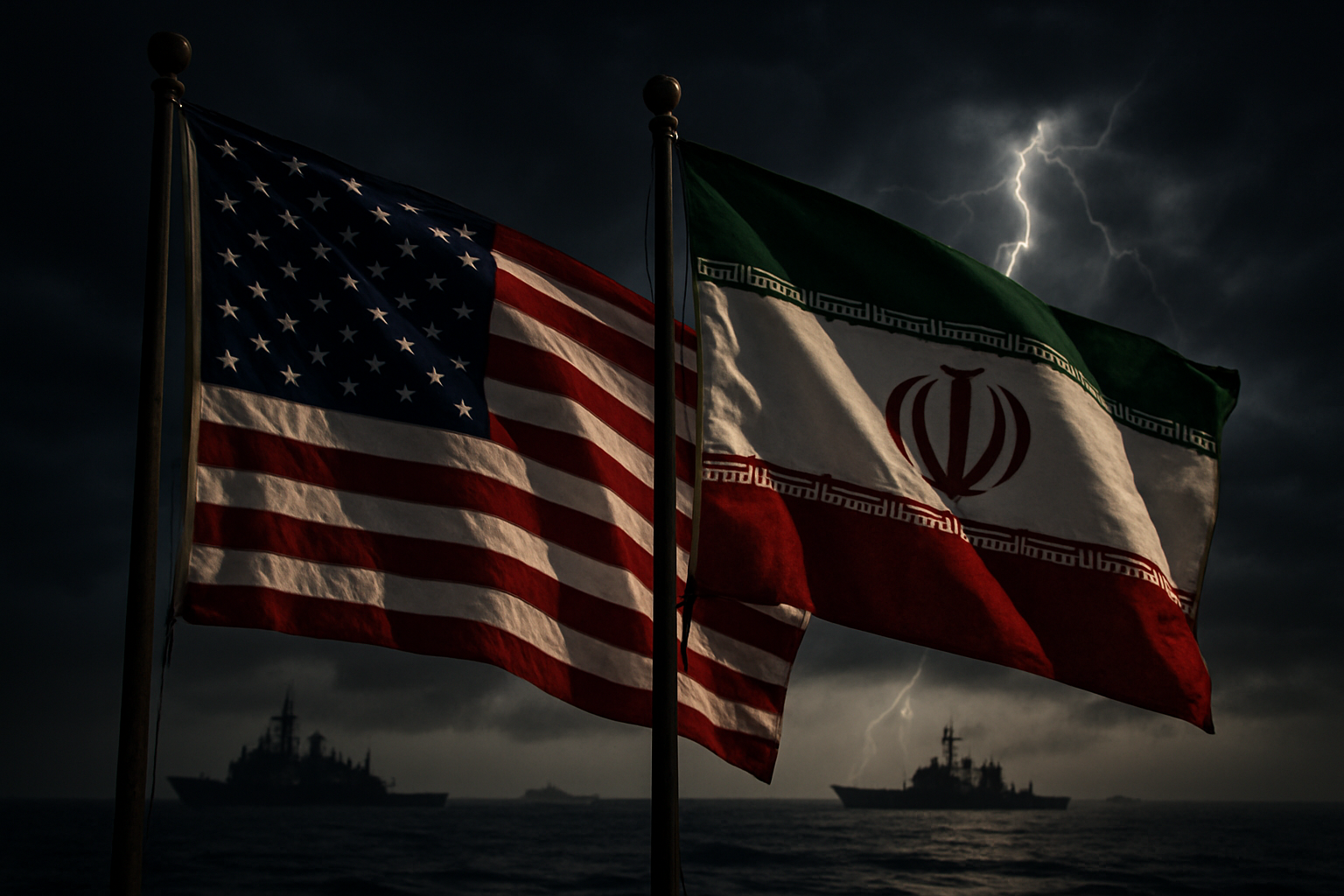
President Donald Trump has issued Iran a stark 48-hour ultimatum, warning Tehran must either reach a nuclear deal or face what he described as "hell," as US and Israeli forces launched their most intensive attacks on Iranian territory, raising fears of a broader regional war that could engulf the Middle East.
The escalation comes after overnight strikes hit multiple locations inside Iran, with Iranian media reporting significant damage to military installations and nuclear facilities. Trump's ultimatum, delivered during a White House briefing, represents the most explicit threat against Iran since his return to office.
Unprecedented Military Escalation
US and Israeli forces have intensified their coordinated military campaign against Iran, with sources confirming strikes on Revolutionary Guard facilities, petrochemical plants, and the controversial Bushehr nuclear plant. Iranian Foreign Ministry spokesman Abbas Araghchi warned of potential "radioactive fallout" from attacks on nuclear installations.
The operation involves the largest US naval deployment in the Middle East in years, with the USS Gerald R. Ford joining the USS Abraham Lincoln in creating an unprecedented dual-carrier strike force positioned approximately 800 kilometers from Iran's coast. Pentagon sources indicate the force represents roughly one-third of the active US Navy fleet.
"U.S. and Israeli attacks on Iran intensified early Sunday, as President Donald Trump reportedly issued Tehran a 48-hour ultimatum, warning that it must either reach a deal or face what he described as 'hell.'"
— Khaama Press Report
Iranian Military Response Escalates
Iran has responded with significant military action of its own. Iranian missiles have struck near military headquarters in Tel Aviv, while Iranian drones have successfully targeted an Israeli tanker, setting it ablaze. The Islamic Revolutionary Guard Corps (IRGC) has declared that "no red lines remain" in their response to US-Israeli attacks.
Iranian military commander Brigadier General Alireza Elhami announced that Iran's air defense forces have developed new indigenous methods and equipment capable of targeting "enemy fifth-generation fighter jets and advanced drones." He claimed Iranian forces had previously shot down several advanced enemy aircraft and more than 160 drones in joint US-Israeli operations.
The Iranian military has also demonstrated its naval capabilities, with IRGC vessels harassing US tankers in the strategically vital Strait of Hormuz, through which 40% of global seaborne oil transit passes.
Global Economic and Aviation Impact
The conflict is already having severe global repercussions. Over 18,000 flights have been canceled worldwide—the most extensive disruption since the COVID-19 pandemic. Eight countries have simultaneously closed their airspace, including Iran, Iraq, Israel, UAE, Qatar, Syria, Kuwait, and Bahrain, creating what aviation experts describe as an "aviation black hole" severing critical Asia-Europe air corridors.
Dubai International Airport, the world's busiest with 86 million annual passengers, remains completely shut down due to missile damage. Major airlines including Emirates, Air France-KLM, Wizz Air, and Bulgaria Air have suspended operations indefinitely, affecting hundreds of thousands of travelers globally.
Oil markets have reacted violently, with prices surging past $80 per barrel—a 10% increase—as Iran has effectively closed the Strait of Hormuz by declaring it "unsafe" and deploying between 2,000 and 6,000 naval mines. This has stranded over 150 tankers in the Persian Gulf, representing billions of dollars in cargo.
Regional Casualties Mount
The conflict has already claimed lives across the region. In the UAE, one civilian was killed in Abu Dhabi, while Dubai International Airport suffered damage from missile strikes. Kuwait reported 32 injuries from airport attacks, and Qatar registered 8 wounded despite Patriot missile systems intercepting 65 Iranian missiles and 12 drones.
Most significantly, Iran has struck European territory for the first time since World War II, attacking the RAF Akrotiri base in Cyprus. This unprecedented escalation has prompted the deployment of HMS Dragon and naval vessels from Spain, Italy, France, the Netherlands, and Greece in what represents the first Iranian attack on European soil since 1945.
Diplomatic Efforts Strain Under Military Pressure
Despite the military escalation, some diplomatic channels remain open. Pakistan's Foreign Minister Ishaq Dar has confirmed that both the US and Iran have expressed confidence in Pakistan's ability to facilitate talks, with potential negotiations in Islamabad in the coming days. China has offered "full support" for Pakistan's mediation initiative.
However, Iranian officials have categorically rejected Trump's reported 15-point peace proposal, maintaining that ballistic missiles and regional proxy activities remain "red lines" that cannot be included in any nuclear-focused negotiations.
"The illusion about defeating the Islamic Republic of Iran has turned into a swamp in which you will sink."
— Iranian Military Response, as reported by Haber.ba
Congressional Opposition Grows
In Washington, bipartisan Congressional opposition to the conflict is mounting, with only 25% of Americans supporting military strikes against Iran—historically unprecedented levels of early-stage unpopularity for a US military operation. Senator Richard Blumenthal expressed being "more concerned than ever" about the potential deployment of ground troops.
The Pentagon has confirmed that military operations could continue through September 2026, far beyond the initial 4-6 week timeline suggested by the Trump administration. Current costs have reached $11.3 billion in just the first week, running at approximately $1 billion daily.
Historical Context and Nuclear Implications
The current crisis occurs against the backdrop of a broader nuclear governance breakdown. The New START treaty expired in February 2026, marking the first time in over 50 years without US-Russia nuclear constraints. With both countries controlling 80% of global nuclear weapons, UN Secretary-General António Guterres has warned that nuclear risks are at their "highest levels in decades."
Iran continues to enrich uranium at 60% purity, approaching the 90% threshold needed for weapons-grade material. Intelligence assessments suggest Iran possesses sufficient enriched uranium for multiple nuclear weapons if it chooses to weaponize its program.
Regional Coalition Under Strain
The unprecedented regional coalition that had supported diplomatic efforts—including Saudi Arabia, UAE, Qatar, and Egypt—is now severely strained as Iranian attacks have directly targeted their territories. Egyptian President Abdel Fattah el-Sisi condemned attacks on "sisterly countries" and warned of "comprehensive chaos" if the conflict continues to escalate.
What Comes Next
As Trump's 48-hour ultimatum expires, the world watches to see whether diplomatic channels can prevent what could become the most dangerous international crisis since the Cold War. The conflict has already fundamentally altered Middle Eastern geopolitics and created global economic disruption on a scale not seen in decades.
With Iran showing no signs of backing down from its "no red lines remain" position and the Trump administration maintaining its demand for Iran's "unconditional surrender," the coming hours may determine whether this crisis can be contained or will spiral into a broader regional war with global consequences.
The stakes could not be higher: regional war prevention, global energy security, nuclear governance credibility, and the effectiveness of 21st-century diplomatic crisis management all hang in the balance as the international community faces what UN Secretary-General Guterres has called "the greatest test of multilateral cooperation in the modern era."