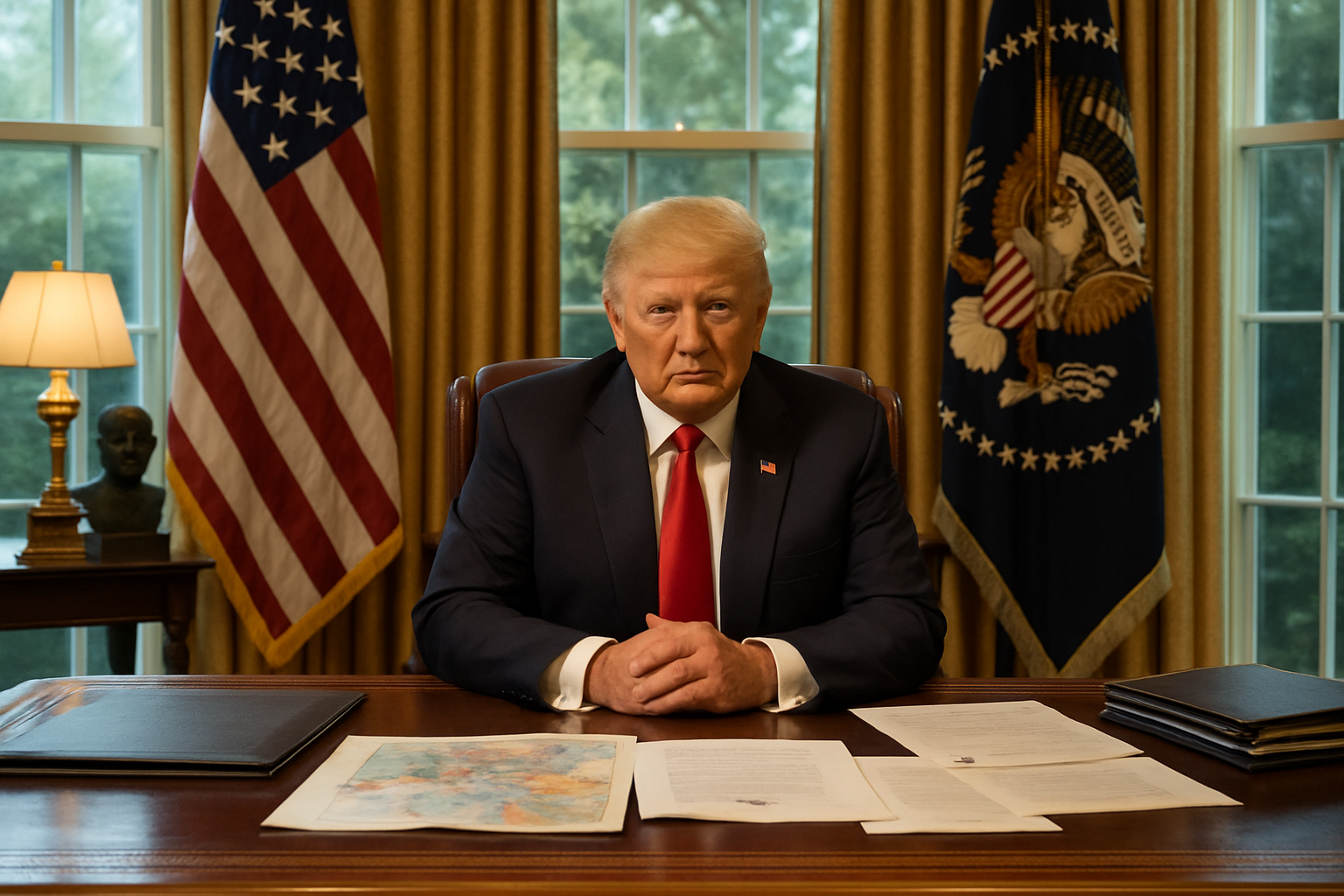
The Trump administration is orchestrating an unprecedented convergence of diplomatic initiatives, with the Board of Peace Council set to convene February 19 in Washington while pursuing breakthrough negotiations on Ukraine-Russia peace talks and Iran nuclear agreements, marking a pivotal moment for international conflict resolution.
Board of Peace Council Prepares Historic Gaza Summit
President Trump's Board of Peace initiative reaches a critical milestone this week as 27 member nations prepare to gather at the Donald Trump Institute of Peace in Washington D.C. The summit, scheduled for February 19, has secured over $5 billion in pledges for Gaza reconstruction and humanitarian aid, with thousands of International Stabilization Force personnel committed for deployment.
Hungarian Prime Minister Viktor Orbán has confirmed attendance, while Italy's PM Giorgia Meloni will participate as an observer following resolution of constitutional concerns. Cyprus President Nikos Christodoulides described the invitation as "particularly important," emphasizing Gaza reconstruction plans, while Romania's President Nicușor Dan will make his first U.S. visit since taking office to participate.
The initiative represents Trump's "business approach" to conflict resolution, departing from traditional UN frameworks with executive authority. However, significant obstacles remain, including over 1,600 documented ceasefire violations since October 2025 and Hamas leader Khaled Meshaal's categorical rejection of disarmament demands in Doha, maintaining that armed resistance is justified "while occupation exists."
Ukraine-Russia Peace Talks Gain European Support
The Trump administration's diplomatic momentum continues with the Geneva peace talks between Ukraine, Russia, and the United States, now in their third round. For the first time, European officials from the "Big 5" nations—Germany, France, Italy, UK, and Poland—are participating as observers, signaling growing international commitment to peaceful resolution.
Building on the Abu Dhabi breakthrough that achieved a 314-prisoner exchange and restored US-Russia military communications after a four-year suspension, the talks represent the most significant diplomatic opportunity since the conflict began. The Pentagon has established deconfliction protocols covering operations globally, providing the sole remaining major diplomatic channel between the nuclear superpowers.
Ukraine's President Zelensky has set conditions for any peace agreement, demanding 20-30 year security guarantees versus the U.S. proposal of 15 years. The fundamental sticking point remains unchanged: eastern Ukrainian territories under Russian control, with Russia capturing 481 square kilometers in January versus 260 square kilometers in December 2025.
"Americans are proposing parties end the war by beginning of summer, will pressure both sides according to timeline."
— President Zelensky, Munich Security Conference
Iran Nuclear Negotiations Reach Critical Phase
Concurrent with peace initiatives, the Trump administration is pursuing nuclear negotiations with Iran, with talks resuming in Geneva next week. Iranian Foreign Minister Abbas Araghchi has expressed openness to "reassuring deals" while maintaining that uranium enrichment at 60% purity remains an "inalienable right"—significantly above the 3.67% JCPOA limit and approaching the 90% weapons-grade threshold.
The administration has deployed a dual-carrier strike force, with USS Gerald R. Ford joining USS Abraham Lincoln, creating the largest U.S. naval presence in the Middle East in years. President Trump made his most explicit regime change comments yet, declaring that "change in power in Iran would be the best thing that could happen."
A remarkable regional coalition of Saudi Arabia, UAE, Qatar, and Egypt is backing the diplomatic process—an unprecedented Middle Eastern consensus for preventing military confrontation. However, fundamental disagreements persist over scope: Iran demands nuclear-only talks excluding ballistic missiles and regional proxies as "red lines," while Secretary Marco Rubio insists on comprehensive agreements addressing missiles, armed groups, and human rights.
Air Force One Redesign Reflects Trump's Vision
In a symbolic move reflecting the administration's broader transformation agenda, President Trump has ordered the redesign of Air Force One and other government aircraft. The planes will transition from their traditional white and blue livery to red, white, dark blue, and gold color schemes, marking a distinctive visual departure from previous administrations.
The redesign coincides with broader policy changes that have faced legal challenges. Federal Judge Ana Reyes recently invoked George Orwell's "1984" in ordering the Trump administration to reinstate a Philadelphia slavery exhibit, accusing the government of attempting to rewrite history after presidential decrees removed content deemed "conflictive."
Vatican Declines Peace Council Participation
The administration's peace initiatives have faced some diplomatic setbacks, with the Vatican announcing it will not participate in Trump's "Peace Council." Cardinal Pietro Parolin emphasized that "at the international level, above all, it is the UN that manages these crisis situations," highlighting tensions between Trump's alternative diplomatic frameworks and traditional international institutions.
Mexico's President Claudia Sheinbaum also declined participation, citing Palestine state recognition policy, while other nations have expressed concerns about undermining established multilateral frameworks.
Broader Policy Challenges and Media Relations
The administration continues to face resistance across multiple policy fronts. CBS late-night host Stephen Colbert, a Trump administration critic, reported that network lawyers barred him from airing an interview with a Democratic Senate candidate in Texas, citing concerns about violating federal fairness rules—illustrating the broader tensions between the administration and media outlets.
These developments unfold against the backdrop of the New START treaty expiration on February 5, 2026—marking the first time in over 50 years without US-Russia nuclear constraints. UN Secretary-General Guterres has warned that nuclear risks are at their "highest in decades," adding urgency to the administration's diplomatic initiatives.
Testing Innovative Diplomacy
The convergence of multiple peace initiatives represents the most comprehensive test of Trump's "business approach" to international relations. The administration is simultaneously pursuing leader-driven formats for Gaza reconstruction, territorial dispute resolution for Ukraine-Russia, and nuclear crisis management with Iran—all while maintaining military pressure and economic leverage.
Success in any of these initiatives could provide templates for 21st-century conflict resolution, potentially reshaping international diplomacy beyond traditional multilateral frameworks. However, failure could undermine alternative diplomatic approaches and accelerate military solutions to complex global challenges.
The February 19 Board of Peace summit will serve as a crucial test case, determining whether innovative leader-driven peace initiatives can overcome deep-rooted political and security challenges through economic incentives and direct engagement, or whether traditional institutional frameworks remain indispensable for sustainable conflict resolution.
As these multiple diplomatic tracks converge, the international community watches to see whether Trump's transactional approach to foreign policy can deliver breakthrough agreements that have eluded traditional diplomacy, or whether the fundamental obstacles that have prevented previous settlements remain insurmountable despite new formats and unprecedented financial commitments.