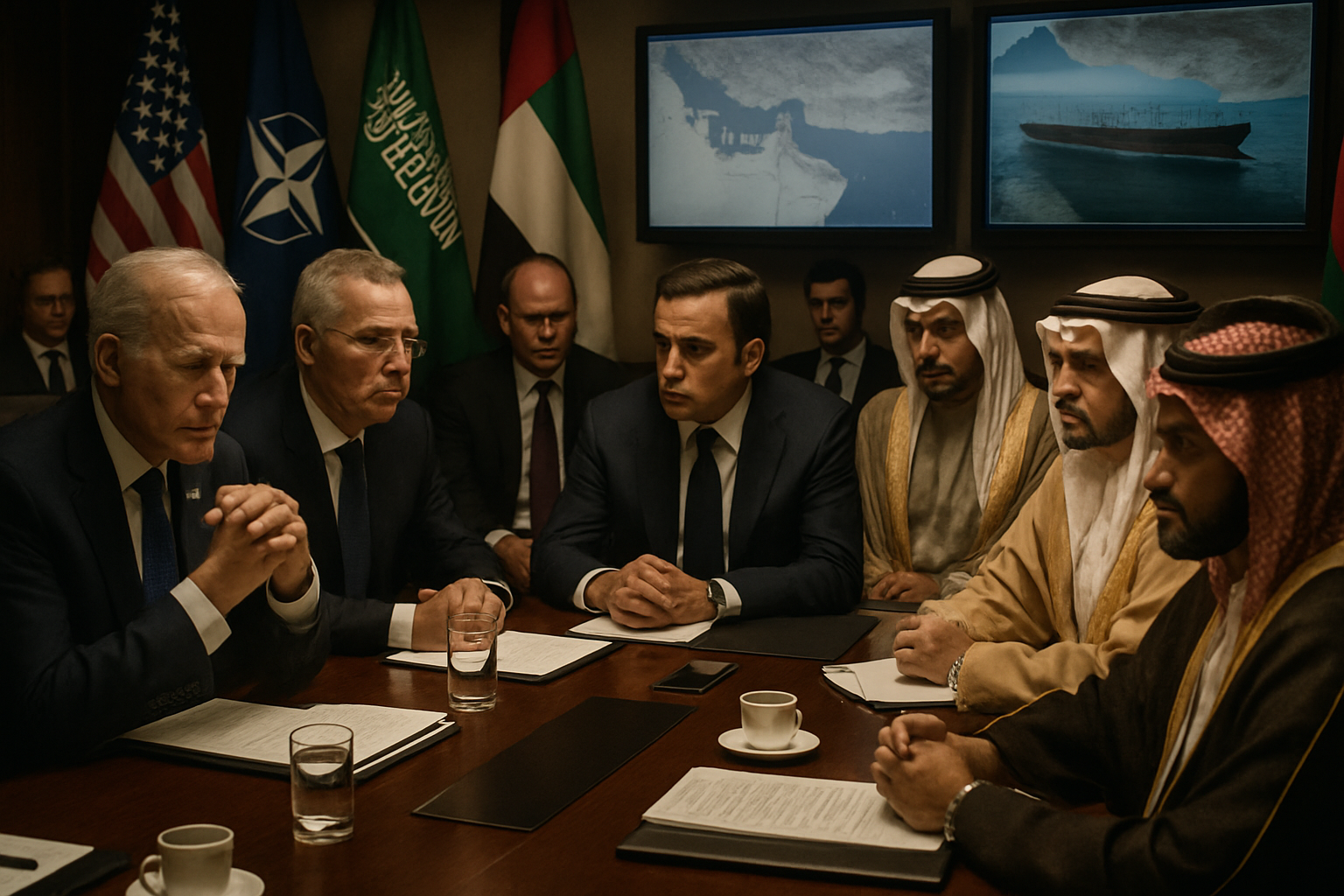
President Donald Trump delivered an unprecedented attack on NATO allies, telling European partners to "go get your own oil" and secure the Strait of Hormuz independently after they delivered a crushing rejection of his demands for military support in the Iran conflict.
The crisis represents the deepest alliance fracture since NATO's formation in 1949, with German Defense Minister Boris Pistorius leading European resistance by asking "What does Donald Trump expect handful European frigates to do that powerful US Navy cannot?" France, Japan, and Australia have explicitly declined deploying naval vessels to the Persian Gulf despite Trump's direct requests.
European Strategic Autonomy on Display
In a remarkable demonstration of strategic autonomy, European allies have distinguished between defending their own territory and participating in American military adventures abroad. While rejecting Trump's Gulf coalition demands, Europeans showed unprecedented unity when Iranian drones struck RAF Akrotiri in Cyprus - the first attack on European soil since World War II.
The Cyprus attack prompted an immediate naval coalition response featuring HMS Dragon, Spanish frigates, and Italian, French, Dutch, and Greek vessels. The European Union activated its ESTIA crisis mechanism for the first time in bloc history, coordinating evacuations across the Eastern Mediterranean.
"No war in Iran, but solidarity with Cyprus as an EU country victim of aggression"
— Spanish Prime Minister Pedro Sánchez
Energy Security at Breaking Point
The alliance crisis comes as global energy markets face unprecedented volatility. Iran's Revolutionary Guard has deployed an estimated 2,000-6,000 naval mines throughout the Strait of Hormuz, effectively closing the waterway that handles 40% of global seaborne oil transit.
Oil prices have surged past $100 per barrel for the first time since 2022, with Brent crude reaching peaks of $119.50 and West Texas Intermediate recording an 18.98% single-day jump. The International Energy Agency has authorized the largest strategic petroleum reserve release in its 50-year history - 400 million barrels from 32 countries.
The crisis has exposed dangerous over-reliance on strategic chokepoints, with Qatar's Energy Minister warning that force majeure declarations are possible "within weeks" if oil approaches $150-$200 per barrel, threatening to "bring down world economies."
Congressional Opposition Intensifies
On the domestic front, bipartisan lawmakers are demanding comprehensive answers about Trump's Iran strategy, costs, and potential ground troop deployment. Senator Richard Blumenthal expressed being "more concerned than ever" about boots on the ground, as Operation Epic Fury has already cost $11.3 billion in its first week - the most expensive recent military operation.
The conflict's unpopularity is "almost unprecedented" for early-stage operations, with only 25% American support. Pentagon operations are scheduled through September, far beyond Trump's initial 4-6 week timeline. The administration has confirmed 150 US troops wounded (8 critical) and 3 confirmed deaths, while USS Charlotte submarine sank Iranian frigate IRIS Dena - the first enemy vessel sunk by a US submarine since World War II.
Nuclear Diplomacy Collapse Context
The current military crisis emerged from the complete breakdown of US-Iran nuclear negotiations despite achieving "broad agreement on guiding principles" - the most progress since the JCPOA collapse in 2018. The talks foundered on fundamental scope disagreements: Iran demanding nuclear-only discussions while excluding ballistic missiles and regional proxies as "red lines," versus US insistence on comprehensive agreements addressing missiles, armed groups, and human rights.
Iran continues uranium enrichment at 60% purity with over 400kg of weapons-grade material - sufficient for multiple weapons if weaponized. The crisis occurs against the backdrop of the New START treaty's expiration in February 2026, marking the first time in 50+ years without US-Russia nuclear constraints.
Regional Coalition Under Severe Strain
The unprecedented Saudi-UAE-Qatar-Egypt consensus that initially supported diplomatic solutions is now severely threatened by Iranian retaliation targeting member territories directly. Egyptian President Abdel Fattah el-Sisi condemned attacks on "sisterly Arab countries," warning of "comprehensive chaos spreading across the region."
Iranian "Operation True Promise 4" has systematically targeted Gulf allies: one civilian killed in UAE's Abu Dhabi, 32 injured in Kuwait airport strikes, and 8 wounded in Qatar despite Patriot systems intercepting 65 missiles and 12 drones. Kuwait has relocated airline operations to Saudi Arabia following repeated attacks.
Trump's Regime Change Policy Evolution
Trump has explicitly evolved from nuclear-focused diplomacy to comprehensive regime change advocacy, demanding Iran's "unconditional surrender" and claiming the right to personally choose the next Iranian Supreme Leader. He has rejected the succession of Mojtaba Khamenei (son of the deceased Ali Khamenei) as a "lightweight," representing the most direct assertion of American control over Iranian affairs since 1979.
This policy shift has eliminated diplomatic solutions, with Trump declaring that Iranian government overthrow would be "the best thing that could happen." The approach has further isolated traditional allies who view it as American military adventurism rather than collective security necessity.
Global Aviation and Supply Chain Disruption
The crisis has created the most severe aviation disruption since COVID-19, with over 18,000 flights cancelled worldwide. Eight Middle Eastern countries maintain simultaneous airspace closures, severing critical Asia-Europe corridors. Dubai International Airport - the world's busiest with 86 million passengers annually - remains completely shut down due to missile damage.
Supply chain disruptions extend far beyond energy, affecting manufacturing in automotive, electronics, and textiles sectors dependent on Gulf logistics networks. The Persian Gulf's role as a critical Asia-Europe trade hub has been completely compromised, exposing fundamental vulnerabilities in global systems to geopolitical shock.
King Charles State Visit Amid Crisis
Adding complexity to the diplomatic landscape, King Charles III will proceed with a planned state visit to the United States in late April despite calls for cancellation due to the Iran war. The visit, marking the 250th anniversary of American independence from British rule, reflects the UK government's attempt to repair relations with Trump despite the administration's criticism of Britain as "not Winston Churchill's Britain."
The monarch's first state visit to the US since his mother Queen Elizabeth's 2007 trip comes at a particularly rocky time for the "special relationship," with Trump repeatedly criticizing Prime Minister Keir Starmer's reluctance to fully support the Iran conflict.
Template-Setting Crisis for the 21st Century
UN Secretary-General António Guterres has described the current situation as the "greatest test of multilateral cooperation and crisis management in the modern era." The rapid transition from diplomatic engagement to military confrontation demonstrates the fragility of crisis management in the multipolar era.
The European rejection of American military requests while defending their own territory suggests a new paradigm of selective cooperation, challenging traditional NATO frameworks. This template-setting moment will influence how alliance obligations are balanced against sovereignty for decades to come.
Stakes and Implications
The stakes extend far beyond the immediate conflict to fundamental questions about international cooperation in the 21st century. Success in containing the crisis could provide frameworks for future nuclear dispute resolution and strengthen diplomatic credibility. Failure may accelerate military solutions to international problems, reshape Middle Eastern geopolitics for decades, encourage nuclear proliferation elsewhere, and undermine diplomatic credibility for territorial and security disputes worldwide.
March 2026 represents a potential watershed moment in international relations, determining whether diplomatic solutions or military confrontation becomes the precedent for 21st-century conflict resolution. The crisis affects not only Middle East stability but global energy security, nuclear governance credibility, and the post-World War II international order's sustainability.
As financial markets continue their role as the "ultimate constraint" on escalation - with Pakistan's stock exchange recording its largest decline in history at -8.97% - the world watches to see whether renewed Western unity through institutional adaptation or continued fragmentation will determine the trajectory of international relations for the remainder of the century.