President Donald Trump's second-term agenda faces its most significant legal and constitutional challenges yet, as federal courts deliver a series of rulings blocking key administration policies while the president moves ahead with controversial voting restrictions and institutional changes that critics say threaten democratic norms.
The convergence of legal setbacks, policy overhauls, and constitutional confrontations represents what legal scholars describe as the most serious test of American democratic institutions since Watergate, with implications extending far beyond Trump's presidency.
Federal Courts Mount Systematic Resistance
In a dramatic legal victory for immigration advocates, U.S. District Judge Allison Burroughs ordered the Trump administration to restore legal protections for migrants who entered the United States through the Biden-era CBP One border system. The Massachusetts federal court ruled that the Department of Homeland Security acted unlawfully when it attempted to strip legal status from thousands of migrants who had entered the country through the official border processing system.
The ruling represents the latest in a pattern of federal judicial pushback against Trump administration policies. Judge Ana Reyes has blocked the termination of Temporary Protected Status for 350,000 Haitians, citing discriminatory intent. An Oregon judge now requires ICE to obtain warrants before arrests unless there is a demonstrable flight risk. In Philadelphia, a federal judge ordered the restoration of a slavery exhibit, invoking George Orwell's "1984" in condemning what he characterized as government attempts to rewrite history.
"The government claims it alone has the power to erase, alter, remove and hide historical accounts."
— Federal Judge, Philadelphia ruling
This systematic judicial resistance has created a complex legal patchwork that enforcement agencies must navigate while implementing the administration's broader policy agenda.
Voting Restrictions Executive Order Triggers Legal Threats
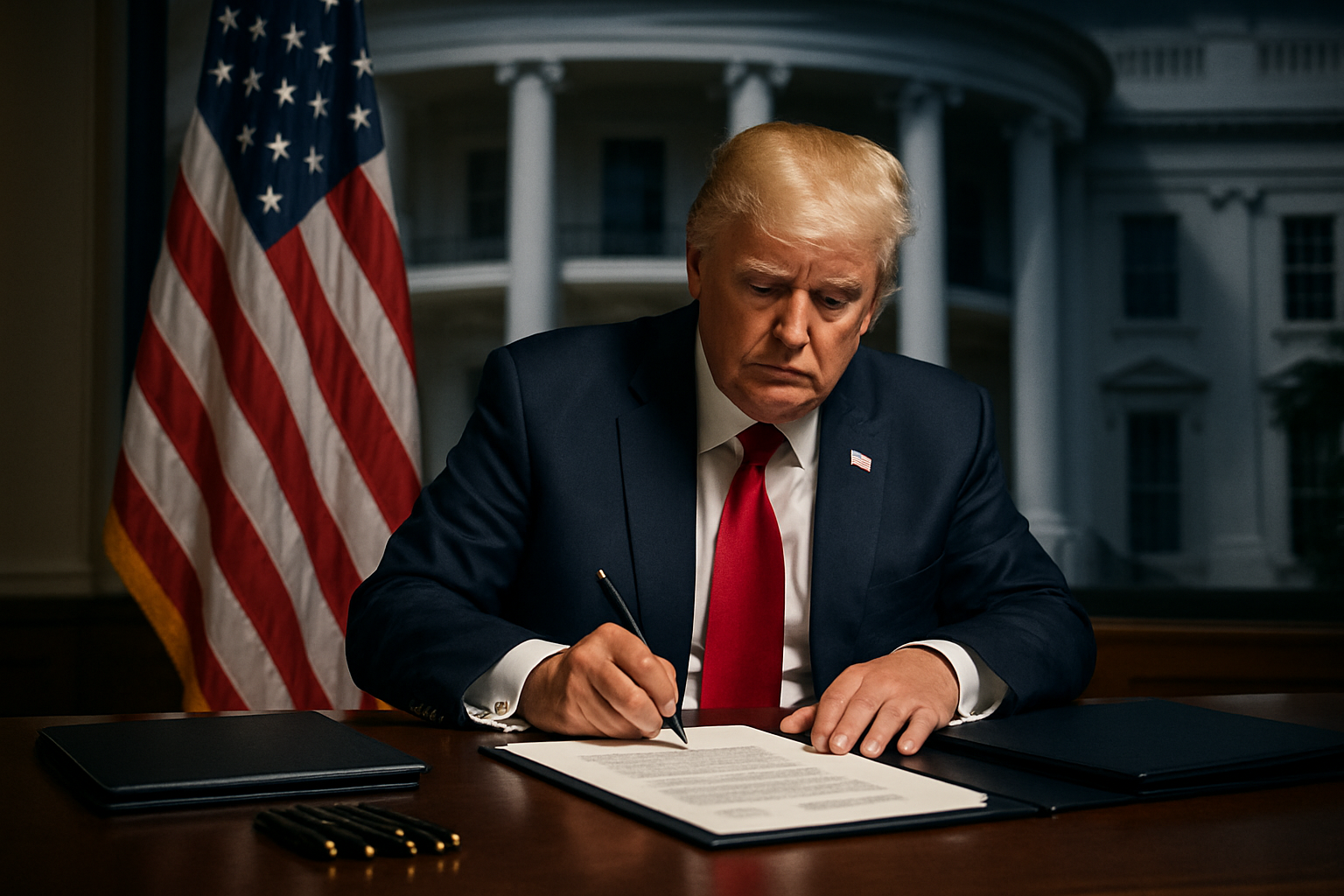
Despite facing legal challenges on multiple fronts, Trump signed a controversial executive order on Tuesday tightening rules on mail-in voting nationwide, including directing his administration to compile a list of confirmed U.S. citizens eligible to vote. The order comes ahead of the November midterm elections and repeats Trump's longstanding but unsubstantiated claims that mail-in voting enables fraud.
The executive order immediately drew swift condemnation from voting rights groups and Democratic officials, who announced plans for immediate legal challenges. Constitutional law experts argue the federal government has limited authority over state election administration, setting up what could be a defining Supreme Court case on federal versus state election powers.
The timing of the voting order appears particularly significant given Trump's upcoming attendance at Wednesday's Supreme Court hearing on birthright citizenship—making him the first sitting president to attend oral arguments at the nation's highest court. This unprecedented move signals the administration's recognition of the high stakes surrounding constitutional interpretation during this period.
Supreme Court Constitutional Crisis Aftermath
The voting restrictions come as the Trump administration continues to grapple with the fallout from February's devastating 6-3 Supreme Court ruling that struck down his global tariff program under the International Emergency Economic Powers Act (IEEPA). Chief Justice John Roberts authored the majority opinion applying the "major questions doctrine," which requires clear congressional authorization for presidential actions of "vast economic and political significance."
Trump's immediate response—calling justices a "disgrace to our nation" and "disloyal to the Constitution" while escalating to 15% global tariffs using alternative legal authorities—created what constitutional scholars describe as the most serious executive-judicial confrontation since Watergate.
The Supreme Court ruling vindicated House Republicans who had passed legislation ending Canada tariffs by a 219-211 vote, with six GOP defections representing the first significant bipartisan rebuke of Trump's trade authority in his second term. Speaker Mike Johnson's inability to prevent the vote highlighted growing institutional opposition to expanded presidential powers.
Immigration Enforcement Under Intense Scrutiny
The administration's immigration policies face particular scrutiny following a series of federal court defeats and public opinion shifts. A University of California study reveals that deportations have quadrupled during the first nine months of Trump's second term compared to previous levels, while ICE detentions have similarly multiplied.
Two-thirds of Americans now believe ICE has "gone too far," according to NPR/PBS/Marist polling, marking a significant shift in public opinion. This change follows the fatal shootings of Alex Pretti and Renee Nicole Good by ICE agents in Minneapolis, which led to the scaling back of Operation Metro Surge and the implementation of mandatory body cameras for federal agents.
Congressional Democrats have threatened to block DHS funding unless "drastic changes" are implemented, while House Speaker Mike Johnson has scheduled two weeks of ICE reform debates. The economic disruption has been substantial, with major corporations like Target facing employee pressure over workplace raid protocols and workforce shortages affecting agriculture, hospitality, and healthcare sectors.
"The Department of Homeland Security acted unlawfully when it tried to strip legal status from many migrants who had entered the country legally."
— U.S. District Judge Allison Burroughs
International Implications and Diplomatic Pressure
The policy challenges have international dimensions, particularly regarding airport naming decisions and diplomatic protocols. Florida Governor Ron DeSantis signed legislation renaming Palm Beach International Airport after President Trump, adding another layer of institutional change that critics view as part of a broader personalization of government institutions.
European officials have expressed concerns about American policy predictability, with the EU Parliament preparing to suspend the EU-US trade agreement for the first time due to institutional concerns. International observers are monitoring American institutional resilience as crucial for global cooperation frameworks.
Institutional Resilience Under Test
The convergence of legal challenges, policy overhauls, and constitutional confrontations represents what many scholars view as a fundamental test of democratic institutional resilience. Federal courts are demonstrating their capacity to serve as constitutional guardians, while Congress shows both resistance and accommodation to expanded executive authority.
The Trump administration's response to these challenges will likely establish precedents affecting presidential power for generations. The success or failure of institutional checks and balances during this period could reshape the fundamental governmental power balance in 21st-century American democracy.
Legal experts note that the major questions doctrine established by the Supreme Court creates a higher bar for executive economic policy without explicit congressional authorization. This strengthens institutional checks during an era of expanded presidential power, but Trump's defiance through alternative legal authorities tests the fundamental separation of powers.
Looking Ahead: Critical Decisions Pending
Several critical developments will shape the trajectory of these constitutional conflicts in the coming months. The Supreme Court hearing on birthright citizenship, with Trump in attendance, could establish landmark precedents for immigration law. Federal court challenges to the voting restrictions executive order will test the boundaries of federal election authority.
Meanwhile, the ongoing legal battles over immigration policies, historical preservation, and civil rights protections will determine whether federal courts can effectively check executive power through judicial review. The resolution of these conflicts will influence not only the remainder of Trump's term but also the broader evolution of American democratic governance.
The stakes extend beyond immediate policy outcomes to fundamental questions about institutional independence, constitutional limits on presidential power, and the capacity of democratic systems to maintain checks and balances during periods of political polarization. International observers view these developments as template-setting for democratic responses to executive power challenges worldwide.