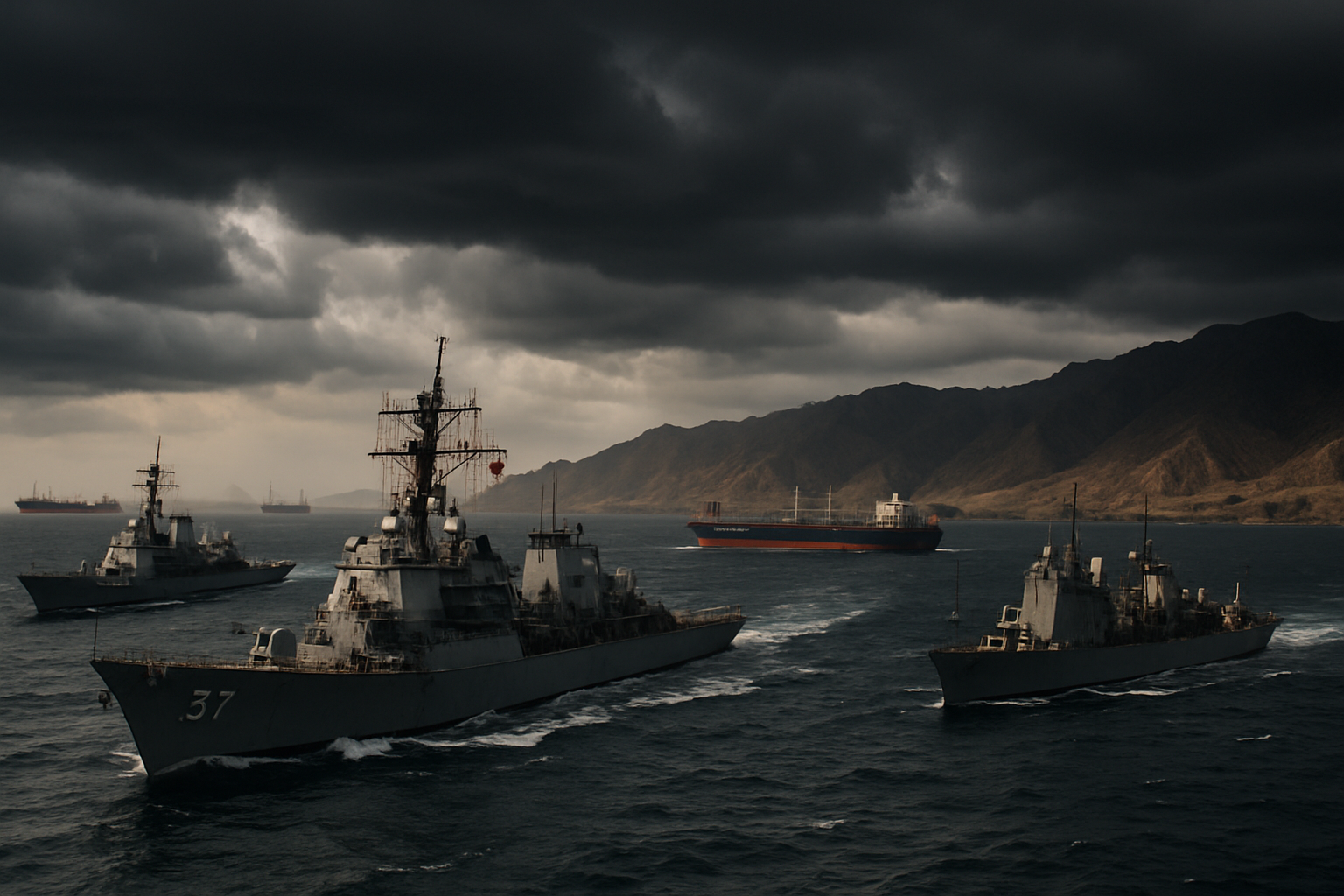
US allies have delivered a resounding rejection to President Donald Trump's urgent demands for an international naval coalition to reopen the Strait of Hormuz, as the Iran war enters its most critical phase with oil prices breaching $100 per barrel and global supply chains facing unprecedented disruption.
German Defense Minister Boris Pistorius led the resistance, asking pointedly: "What does Donald Trump expect a handful or two handfuls of European frigates to do in the Strait of Hormuz that the powerful US Navy cannot do?" His blunt assessment reflects growing European frustration with American military demands during what has become the most dangerous international crisis since the Cold War.
Coalition of the Unwilling
Trump's appeal to seven countries—including China, France, Japan, South Korea, and the UK—to send warships has met widespread rejection. Japan explicitly declined to dispatch naval vessels, with Prime Minister Sanae Takaic stating his country would not participate in escort operations. Australia similarly confirmed no plans to send ships, despite their critical trade routes through the waterway.
The pushback came despite NATO countries' typical reluctance to anger the White House, with many having faced sharp criticism from Trump in recent months. However, the scope of the Iran crisis has fundamentally altered alliance dynamics, with European leaders viewing this as America's war rather than a collective security issue.
"This is not our war, we did not start it."
— Boris Pistorius, German Defense Minister
Even traditional Trump allies have distanced themselves from military involvement. Italian Prime Minister Giorgia Meloni, despite her generally warm relationship with the US president, has reportedly rejected participation in any Hormuz operation.
Energy Crisis Reaches Breaking Point
The Iranian Revolutionary Guard's mining of the Strait of Hormuz has created the most severe global energy crisis since the 1970s oil shocks. With 40% of global seaborne oil transit blocked, prices have surged past $100 per barrel for the first time since 2022, with Brent crude peaking at $119.50 and West Texas Intermediate hitting a record single-day jump of 18.98%.
The International Energy Agency has announced its largest strategic petroleum reserve release in 50 years—400 million barrels from 32 member countries, more than double the 2022 Ukraine crisis response. Japan is releasing 80 million barrels, its first deployment since the 2011 Fukushima disaster, highlighting the severity of supply concerns.
Qatar Energy Minister Saad Al Kaabi has issued dire warnings that Gulf states may be forced to declare force majeure "within weeks" if the crisis continues, potentially driving oil prices toward $150 per barrel and threatening to "bring down the economies of the world."
NATO's Reluctant Response
Despite European rejection of direct military participation, the alliance has been forced to respond to Iran's unprecedented expansion of attacks. The first Iranian strikes on European territory since World War II—targeting RAF Akrotiri in Cyprus—prompted an emergency naval coalition including HMS Dragon, Spanish frigates, and vessels from Italy, France, Netherlands, and Greece.
EU foreign policy chief Kaja Kallas has suggested expanding the existing Red Sea naval operation Aspides into the Persian Gulf, though Spain and Germany have opposed changing the mission's mandate. The European response reflects a careful balance between supporting regional stability and avoiding direct involvement in Trump's war.
German Chancellor Friedrich Merz's spokesman emphasized that the Iran war has "nothing to do with NATO," highlighting the alliance's struggle to define its role in a conflict many members view as optional rather than defensive.
Global Aviation Paralysis
The crisis has triggered the most extensive aviation disruption since COVID-19, with over 18,000 flights cancelled worldwide. Eight Middle Eastern countries have simultaneously closed their airspace, severing critical Europe-Asia air corridors and stranding hundreds of thousands of passengers.
Dubai International Airport, the world's busiest, remains completely shut down after sustaining missile damage. Major carriers including Emirates, Air France-KLM, Wizz Air, and Bulgaria Air have suspended operations indefinitely, forcing complex rerouting through alternative hubs at dramatically increased costs.
The aviation crisis demonstrates the global reach of what began as a regional conflict, with knock-on effects rippling through supply chains dependent on air cargo and time-sensitive deliveries.
Diplomatic Breakdown and Military Escalation
The current crisis stems from the complete collapse of US-Iran nuclear negotiations, despite achieving what negotiators called "broad agreement on guiding principles" in Geneva—the most progress since the 2018 JCPOA breakdown. The fundamental disagreement over scope proved insurmountable: Iran demanded nuclear-only talks excluding ballistic missiles and regional proxies as "red lines," while the US insisted on comprehensive agreements addressing missiles, armed groups, and human rights.
This diplomatic failure triggered "Operation Epic Fury," the largest US-Israeli coordinated military operation since 2003, which resulted in the death of Supreme Leader Ali Khamenei and sparked Iran's massive "Operation True Promise 4" retaliation across the region.
Iran's Revolutionary Guard has declared "no red lines remain," systematically targeting US and allied assets. The conflict has produced casualties across multiple countries: one civilian killed in the UAE, 32 injured in Kuwait airport strikes, and eight wounded in Qatar despite Patriot missile interceptions of 65 missiles and 12 drones.
Economic and Strategic Implications
Financial markets have crashed globally, with Pakistan's KSE-100 suffering its largest single-day decline in history (-8.97%) and South Korea's KOSPI triggering circuit breakers with a 12% fall. The Korean won has hit 17-year lows as foreign capital flees regional exposure.
The 21-mile Strait of Hormuz has been exposed as a critical single-point failure in modern global logistics. With Maersk and MSC suspending all Persian Gulf operations, over 150 oil and LNG tankers worth billions remain stranded. Alternative Arabian Peninsula routes lack adequate capacity and involve significant time and cost penalties.
The crisis has demonstrated dangerous over-dependence on strategic chokepoints, requiring fundamental energy architecture restructuring to reduce geopolitical volatility. Strategic petroleum reserves provide only temporary buffers for sustained disruptions, highlighting the need for supply diversification and accelerated renewable energy transitions.
Regional Coalition Under Strain
Perhaps most significantly, the unprecedented Saudi-UAE-Qatar-Egypt diplomatic consensus supporting diplomatic solutions has come under severe strain as Iranian retaliation has directly targeted member territories. Egyptian President Abdel Fattah el-Sisi condemned attacks on "sisterly Arab countries," warning of "comprehensive chaos" if the conflict continues to expand.
This breakdown of regional coalition support represents a strategic blow to Middle Eastern stability, as the Gulf states face an impossible choice between maintaining US alliance relationships and avoiding Iranian retaliation on their territory.
Nuclear Governance Crisis
The Iran crisis occurs amid a broader nuclear governance breakdown, with New START having expired in February 2026—the first time in over 50 years without US-Russia nuclear constraints. Combined with China's nuclear expansion and Iran's continued 60% uranium enrichment (with over 400kg of weapons-grade material), UN Secretary-General António Guterres has warned that nuclear risks are at their "highest in decades."
This template-setting moment will determine whether 21st-century international disputes are resolved through diplomacy or military confrontation, with implications extending far beyond the current crisis.
Congressional and Domestic Pressure
Bipartisan lawmakers in Congress are demanding answers on strategy, costs, and the potential deployment of ground troops. Senator Richard Blumenthal has expressed being "more concerned than ever" about boots on the ground, while the conflict's unpopularity—with only 25% American support—creates political constraints on escalation.
Operation Epic Fury has already cost $11.3 billion in its first week, with Pentagon operations prepared through September—far beyond the White House's initial 4-6 week timeline. Financial markets are emerging as the "ultimate constraint" on prolonged military action, as sustained economic disruption threatens global stability.
Looking Forward: Template-Setting Implications
The refusal of major allies to join Trump's naval coalition represents more than a diplomatic setback—it reflects a fundamental shift in how America's partners view military intervention in the multipolar era. The rapid transition from diplomatic breakthrough to military escalation demonstrates the fragility of modern crisis management mechanisms when great power tensions intersect with regional conflicts.
Success in containing this crisis could provide a framework for future nuclear dispute resolution and strengthen diplomatic precedents. Failure may accelerate military solutions to international problems, reshape Middle Eastern geopolitics for decades, encourage nuclear proliferation globally, and undermine diplomatic credibility worldwide.
As energy prices continue their historic surge and global supply chains face unprecedented strain, the world watches whether multilateral cooperation can manage what UN officials have called "the greatest test of crisis management in the modern era." The coming days will determine whether this remains a contained regional confrontation or expands into a broader Middle Eastern war with implications extending far beyond current events.
March 16, 2026, may be remembered as the day when America's post-Cold War alliance system faced its greatest test—and found its partners choosing restraint over military adventure, even at the cost of transatlantic unity.