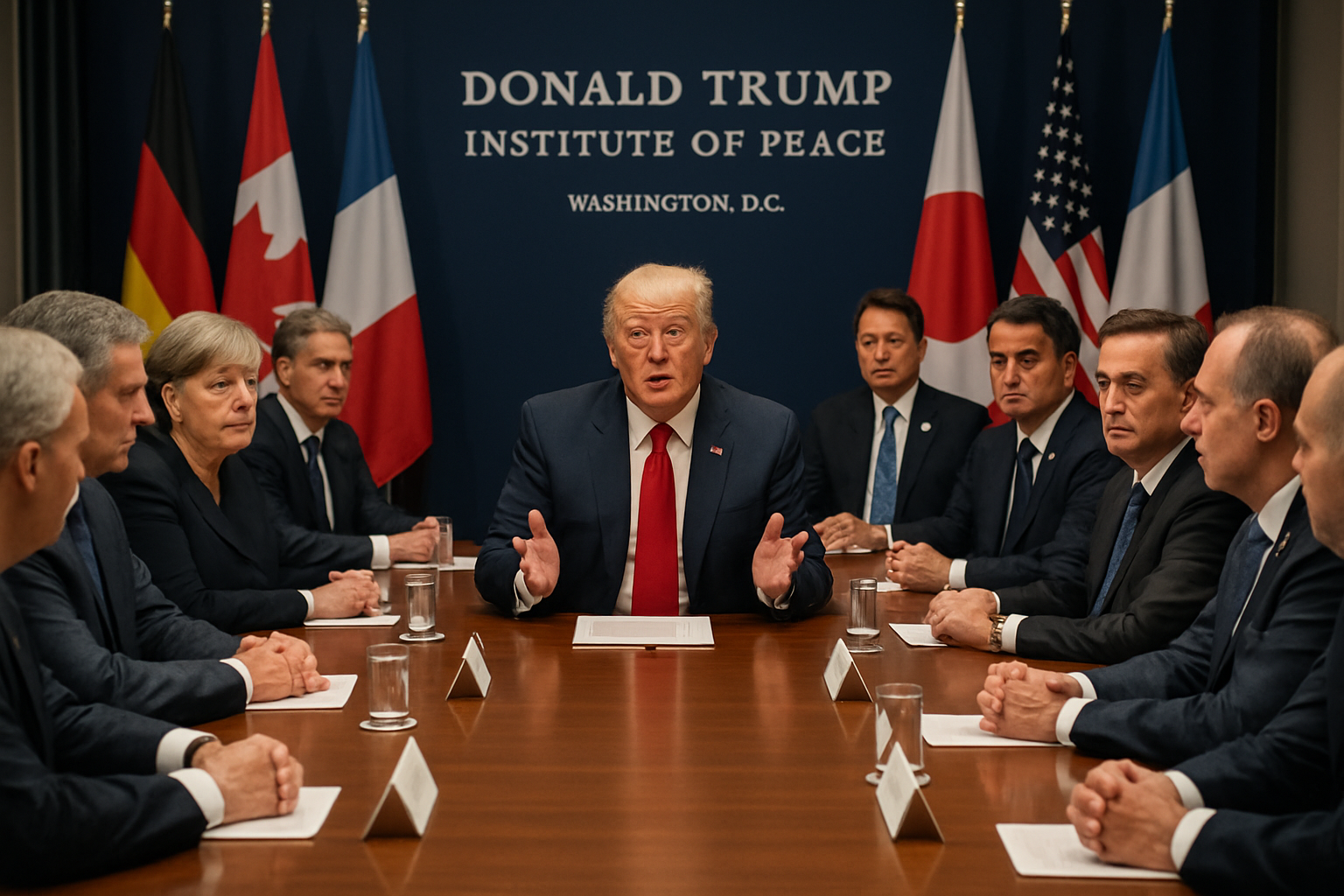
President Donald Trump announced Thursday that member nations of his newly established Board of Peace have raised $7 billion for Gaza reconstruction, marking a historic milestone in international diplomatic efforts to address one of the world's most persistent humanitarian crises.
Speaking at the inaugural Board of Peace meeting at the Donald Trump Institute of Peace in Washington D.C., Trump addressed representatives from 47 countries, revealing the substantial financial commitment secured through his administration's "business approach" to conflict resolution. The announcement represents the culmination of weeks of intensive diplomatic engagement that began with conceptual discussions at the World Economic Forum in Davos.
International Participation and Notable Absences
The summit brought together a diverse coalition of international leaders, with Hungarian Prime Minister Viktor Orbán, Pakistani Prime Minister Shehbaz Sharif, and Kazakhstan President Kassym-Jomart Tokayev among the key attendees. Several European nations participated as observers, including Italy's Prime Minister Giorgia Meloni, Cyprus President Nikos Christodoulides, and Romanian President Nicușor Dan, who made his first official visit to the United States to attend the historic gathering.
However, the absence of several major powers highlighted the complex geopolitical dynamics surrounding Trump's initiative. The Vatican declined participation through Cardinal Pietro Parolin, who emphasized that "the UN should manage crisis situations," while Mexico's President Claudia Sheinbaum refused to attend due to her administration's Palestine recognition policy. Germany, France, and the United Kingdom were notably absent, creating what European officials described as a significant diplomatic rift within the EU.
"This represents a business approach to conflict resolution, departing from traditional UN frameworks while maintaining executive authority to deliver results."
— Senior White House Official
Azerbaijan's Position Amid Regional Tensions
In a significant development, Azerbaijan's presidential aide Hikmet Hajiyev announced that while his country supports the Board of Peace goals, Azerbaijan would not participate in the $7 billion Gaza fund. This decision reflects the complex regional dynamics at play, as nations navigate between supporting broader peace initiatives while maintaining their specific foreign policy priorities.
The Azerbaijani position underscores the challenges facing Trump's diplomatic initiative, as it seeks to build consensus among diverse international partners with varying regional interests and historical relationships with the parties involved in the Gaza conflict.
Implementation Challenges and Regional Context
Despite the substantial financial commitment, the Gaza Reconstruction Fund faces significant implementation obstacles. Intelligence sources indicate that over 1,600 systematic ceasefire violations have been documented since the October 2025 truce, resulting in more than 573 Palestinian deaths during what was supposed to be a peace period. The Rafah crossing remains severely limited, with only 27 Palestinians crossing daily versus the planned quota of 200.
Hamas leadership has categorically rejected disarmament demands, with political bureau leader Khaled Meshaal declaring in Doha that armed resistance remains justified "while occupation exists." This stance complicates traditional post-conflict reconstruction models that typically require demilitarization as a prerequisite for international aid.
Diplomatic Innovation vs. Traditional Frameworks
The Board of Peace initiative represents a fundamental departure from established international diplomatic mechanisms. Unlike traditional UN-led processes, Trump's approach grants executive authority to the chairman while emphasizing business-style negotiations and direct engagement between leaders.
European officials have privately expressed concerns about this parallel diplomatic track potentially undermining established international institutions. Lithuania raised "fundamental questions" about the approach, while Albania defended participation citing its "special relationship with the United States."

West Bank Crisis Complicates Peace Efforts
The Gaza reconstruction announcement came as Israel implemented what experts describe as the most comprehensive West Bank land registration since 1967. Israeli Finance Minister Bezalel Smotrich's policies, designed to "kill the idea of a Palestinian state," have drawn unprecedented international condemnation from 85 UN member states.
Eight Arab nations—Saudi Arabia, Jordan, Egypt, UAE, Qatar, Indonesia, Pakistan, and Turkey—issued a joint condemnation calling Israeli measures violations of international law "aimed at imposing unlawful sovereignty." This parallel crisis threatens to complicate reconstruction efforts in Gaza while raising fundamental questions about Palestinian statehood.
Humanitarian Crisis Deepens
The humanitarian situation in Gaza continues to deteriorate despite ceasefire agreements. Gaza Civil Defense operations have shut down due to fuel shortages, hampering emergency response capabilities. Over 20,000 Palestinians await medical evacuation, while the total Gaza death toll has reached 71,800 according to local health authorities.
A landmark study published in The Lancet Global Health revealed that Gaza's death toll has been systematically undercounted by approximately 35%, suggesting actual casualties exceed 75,000 people—representing 3-4% of Gaza's total population.
International Stabilization Force Plans
Beyond financial commitments, the Board of Peace secured pledges for an International Stabilization Force from five countries: Indonesia, Morocco, Kazakhstan, Kosovo, and Albania. Egypt and Jordan committed to providing police training, while US Major General Jasper Jeffers will lead operations at the Rafah crossing.
Argentina offered to deploy its Cascos Blancos peacekeepers, adding a Latin American component to the international effort. However, the deployment of these forces remains contingent on achieving sustainable ceasefire conditions—a prerequisite that current violation patterns suggest may be difficult to establish.
Business Diplomacy Faces Reality Test
Trump's "business diplomacy" approach faces its most significant test in addressing the deep-rooted political and security challenges that have perpetuated the Israeli-Palestinian conflict for decades. The initiative's success depends not only on mobilizing financial resources but also on addressing fundamental issues of sovereignty, security, and territorial control.
"We can count on Romania's commitment to get involved in the Gaza Strip reconstruction."
— President Nicușor Dan, Romania
The $7 billion commitment, while substantial, must navigate a complex implementation environment where traditional reconstruction models requiring stable security conditions do not currently exist. The systematic nature of ceasefire violations suggests that enforcement mechanisms remain insufficient to create the stability necessary for large-scale reconstruction efforts.
Global Governance Implications
The Board of Peace initiative occurs against the backdrop of broader changes in global governance. The New START Treaty between the United States and Russia expired on February 5, 2026—the first time in over 50 years that the superpowers operate without nuclear constraints. This context adds urgency to diplomatic innovations while raising questions about the sustainability of parallel mechanisms.
European officials view the initiative as a test case for 21st-century international cooperation, where leader-driven approaches compete with traditional multilateral frameworks. The success or failure of Trump's approach could influence how the international community addresses complex conflicts in an increasingly multipolar world.
Regional Diplomatic Coordination
The unprecedented coordination among Arab and Muslim nations in condemning ongoing violations represents a significant diplomatic development. Countries that have normalized relations with Israel, including the UAE and Saudi Arabia, joined traditional critics like Turkey and Pakistan in expressing concern about implementation failures.
Over 400 EU diplomats have called for increased pressure on Israeli authorities, while a European Left Coalition petition against EU-Israel partnerships has exceeded 400,000 signatures. This grassroots and institutional pressure adds another layer of complexity to reconstruction efforts.
Looking Ahead: Critical Weeks for Peace Initiative
The coming weeks will be decisive for the Board of Peace initiative as it transitions from financial commitments to concrete implementation. The February 19 summit established working groups to address specific challenges, including security arrangements, humanitarian access, and reconstruction logistics.
The initiative's broader implications extend beyond Gaza to fundamental questions about international cooperation, conflict resolution mechanisms, and the role of economic incentives in addressing political disputes. Success could provide a template for addressing other global conflicts, while failure might accelerate military solutions to complex diplomatic challenges.
As the international community watches this unprecedented experiment in "business diplomacy," the $7 billion Gaza Reconstruction Fund represents both the potential and limitations of innovative approaches to one of the world's most intractable conflicts. The ultimate measure of success will be whether these substantial financial commitments can translate into sustainable peace and improved conditions for Gaza's 2.3 million residents.