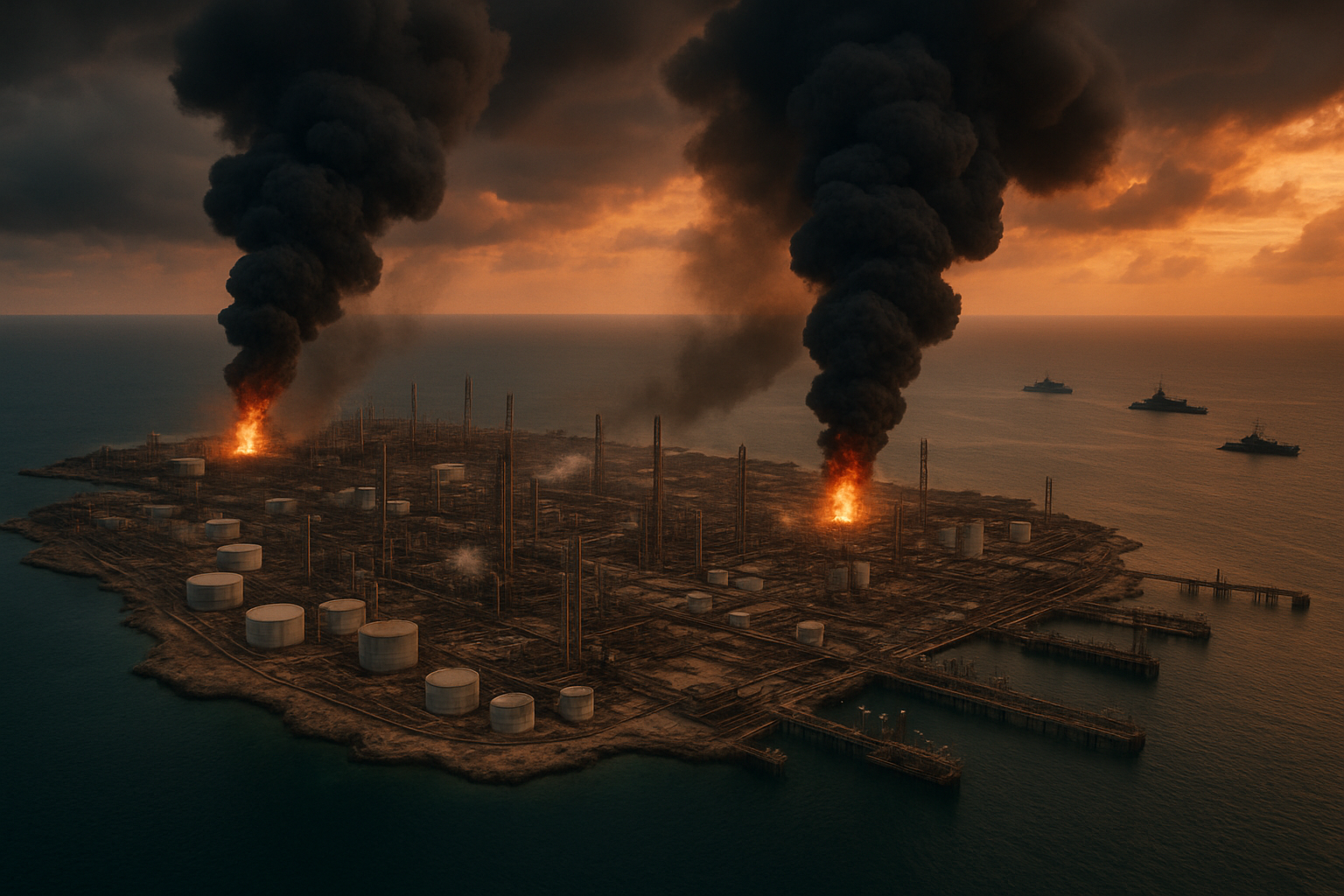
President Donald Trump announced the execution of what he called "one of the most powerful bombing raids in the history of the Middle East" against Iran's Kharg Island, while the Pentagon confirmed deployment of an additional 5,000 Marines to the region as the US-Iran war enters its most dangerous phase.
The strikes on Kharg Island represent a major escalation in the two-week conflict, targeting Iran's most critical oil export infrastructure that handles approximately 90% of the country's crude oil exports. Trump declared on Truth Social that he had "destroyed every military target" on what he described as "Iran's crown jewel."
Kharg Island: Iran's Economic Lifeline Under Attack
The targeting of Kharg Island marks the first time US forces have struck this strategically vital facility, which serves as Iran's primary oil export terminal in the Persian Gulf. The island's infrastructure processes the vast majority of Iran's oil exports, making it arguably the country's most economically significant military target.
"For reasons of decency, I have chosen NOT to wipe out the Oil Infrastructure on the Island," Trump stated, indicating the strikes focused on military installations rather than oil facilities themselves. However, he warned that Iran faced immediate reconsideration of this decision if they continued to interfere with shipping through the Strait of Hormuz.
"Should Iran, or anyone else, do anything to interfere with the Free and Safe Passage of Ships through the Strait of Hormuz, I will immediately reconsider this decision."
— President Donald Trump, Truth Social
Massive Military Reinforcement
Concurrent with the Kharg Island strikes, The Wall Street Journal reports that the Pentagon has approved moving an additional 5,000 Marines and sailors into the Middle East region. The request for reinforcements came from US Central Command and received approval from Defense Secretary Pete Hegseth.
This deployment would bring total US military presence in the region to unprecedented levels since the 2003 Iraq invasion, with dual aircraft carrier groups already positioned in the Persian Gulf alongside the newly arrived Marines and supporting naval vessels.
The US military buildup includes stealth B-2A Spirit bombers, which US Central Command (CENTCOM) showed launching from air bases as part of what Iranian sources called the most intensive bombardment of Iranian territory in the conflict's duration.
Global Crisis Deepens
The conflict has triggered the most severe global aviation crisis since COVID-19, with over 18,000 flights cancelled worldwide as eight Middle Eastern countries maintain simultaneous airspace closures. Dubai International Airport, the world's busiest with 86 million annual passengers, remains completely shut down from missile damage.
Energy markets continue their dramatic surge, with oil prices jumping 10% past $80 per barrel as Iran has effectively closed the Strait of Hormuz, which carries 40% of global seaborne oil transit. More than 150 oil tankers remain stranded in the Persian Gulf, representing billions of dollars in cargo value.
Natural gas prices have exploded by 24% in Europe and 78% in the United States, while Qatar has been forced to halt LNG production at facilities representing approximately 20% of global exports following Iranian infrastructure attacks.
Nuclear Diplomacy Collapsed
The current military escalation emerged from the complete breakdown of nuclear negotiations that had achieved what diplomats called "broad agreement on guiding principles" - the most progress since the 2018 JCPOA collapse. However, fundamental disagreements over scope proved insurmountable.
Iran had excluded ballistic missiles and regional proxies as "red lines," demanding nuclear-only talks, while the US insisted on comprehensive agreements addressing missiles, armed groups, and human rights concerns. Iran continues uranium enrichment at 60% purity with over 400 kilograms of weapons-grade material - sufficient for multiple nuclear weapons if weaponized.
Regional Consequences
The conflict has severely strained the unprecedented regional coalition of Saudi Arabia, UAE, Qatar, and Egypt that had been supporting diplomatic efforts. Iranian retaliation under "Operation True Promise 4" has directly targeted these allies' territories, with casualties reported in the UAE, Kuwait, Qatar, and Cyprus.
Most significantly, Iranian drone strikes on RAF Akrotiri in Cyprus marked the first attack on European territory since World War II, prompting an unprecedented naval coalition response from European nations including the UK, Spain, Italy, France, Netherlands, and Greece.
The largest international evacuation since the 2011 Arab Spring is underway, with Australia reporting 115,000 nationals trapped in the region and Germany struggling to assist 30,000 stranded tourists. The EU has activated its ESTIA emergency evacuation plan for Cyprus for the first time in the bloc's history.
Congressional Scrutiny Intensifies
The conflict faces mounting bipartisan criticism in Congress, with lawmakers demanding comprehensive briefings on strategy, costs, and potential ground troop deployment. Senator Richard Blumenthal expressed being "more concerned than ever" about the possibility of boots on the ground.
Operation Epic Fury has cost $3.7 billion in its first week alone, with daily expenses reaching $891.4 million. The Pentagon is reportedly preparing operations extending through September, far beyond the initial 4-6 week timeline suggested by the White House.
"The conflict's unpopularity is almost unprecedented for early-stage military operations, with only 25% of Americans supporting the strikes according to recent polling."
— Congressional source familiar with classified briefings
Historical Significance
Military historians note that the USS Charlotte's sinking of the Iranian frigate IRIS Dena off Sri Lanka represents the first enemy vessel destroyed by a US submarine since World War II, expanding the conflict's scope into the Indian Ocean with global implications.
The current crisis has been characterized by UN Secretary-General António Guterres as "the greatest test of multilateral cooperation in crisis management of the modern era." The rapid transition from diplomatic breakthrough to military confrontation demonstrates what analysts call the fragility of crisis management in the multipolar era.
The ongoing New START treaty expiration, which left the world without US-Russia nuclear constraints for the first time in over 50 years, compounds the nuclear governance crisis as China expands its atomic arsenal and Iran approaches weapons-grade uranium enrichment.
Looking Ahead
The template-setting nature of this crisis extends far beyond the Middle East, potentially establishing precedents for 21st-century international conflict resolution that will reverberate for decades. The stakes include regional war prevention, global energy security, nuclear governance credibility, and international law enforcement of post-World War II order principles.
As Trump's demand for Iran's "unconditional surrender" eliminates remaining diplomatic options and Iran's new hardline military leadership consolidates control, the trajectory appears set for prolonged conflict with implications extending far beyond the immediate region.
The coming phase will prove critical in determining whether this escalation can be contained as a regional confrontation or will expand into a broader Middle Eastern war with worldwide implications for international relations, energy security, and the fundamental mechanisms of global stability.