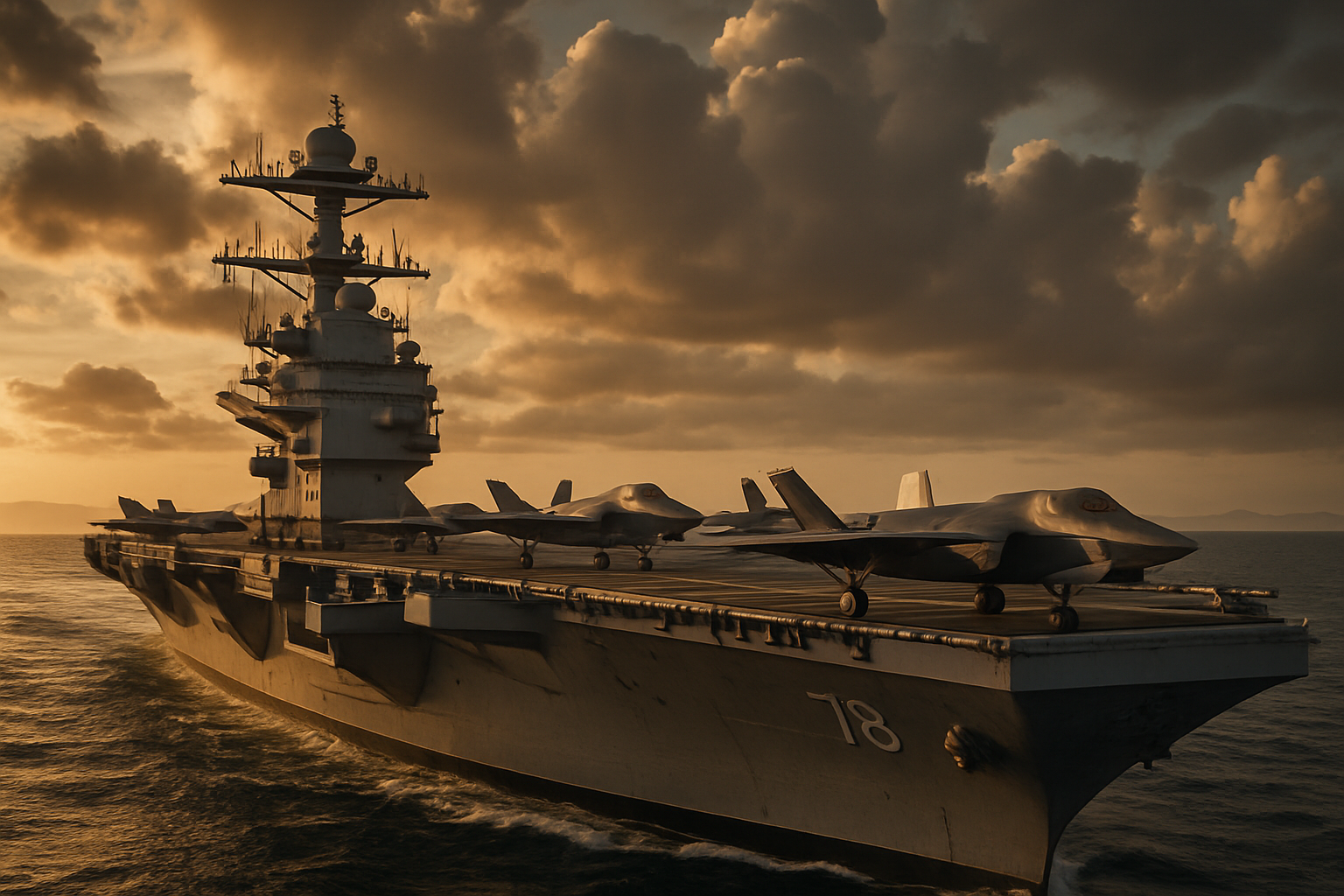
President Donald Trump announced Friday the deployment of a second aircraft carrier to the Middle East while making his most explicit comments yet about regime change in Iran, declaring that a "change in power" would be "the best thing that could happen" as nuclear negotiations remain deadlocked despite a framework agreement established in Oman last week.
The USS Gerald R. Ford, the world's largest and most advanced aircraft carrier, will join the USS Abraham Lincoln already positioned in the Arabian Sea, creating an unprecedented dual-carrier strike force approximately 800 kilometers from Iran's coast. The deployment represents the largest U.S. naval buildup in the Middle East in years and comes amid rising tensions despite ongoing diplomatic engagement.
Trump's Most Direct Regime Change Comments
Speaking aboard Air Force One, Trump made his most overt call yet for the toppling of Iran's clerical establishment. "A change in power in Iran would be the best thing that could happen," the president declared, adding that the U.S. stands for "zero uranium enrichment" in any future agreement.
The comments represent a significant escalation in rhetoric from the Trump administration, which has maintained that negotiations with Iran could be "successful" while simultaneously increasing military pressure. Trump's regime change suggestion comes as Iranian Foreign Minister Abbas Araghchi has declared that Iran will "never abandon uranium enrichment even if war is imposed."
Unprecedented Naval Force Projection
The decision to deploy the Gerald R. Ford alongside the Abraham Lincoln creates an extraordinary concentration of American naval power in the region. Asked why a second aircraft carrier was needed, Trump responded bluntly: "In case we don't make a deal, we'll need it... if we need it, we'll have it ready."
Pentagon officials, speaking on condition of anonymity, confirmed the carrier would take at least a week to reach the Middle East from its current position in the Caribbean, where it had been participating in operations related to Venezuela. The deployment will position two complete carrier strike groups—including guided-missile destroyers, fighter jets, and surveillance aircraft—within striking distance of Iranian territory.
"The deployment of two carrier strike groups represents our commitment to regional stability while maintaining all options on the table."
— Senior Pentagon Official
Nuclear Talks Progress Amid Military Buildup
The military escalation comes despite what both sides have described as progress in nuclear negotiations mediated by Oman. Following talks in Muscat on February 7, Iranian Foreign Minister Araghchi described a "positive atmosphere," while Trump declared the discussions "very good" with Iran "very eager to make a deal."
However, fundamental disagreements persist over the scope of any potential agreement. Iran maintains that ballistic missiles and regional proxy activities are "red lines" that cannot be included in nuclear-only talks, while U.S. Secretary of State Marco Rubio insists any comprehensive agreement must address Iran's missile program, support for armed groups, and human rights record.
Iran currently enriches uranium at 60% purity—significantly above the 3.67% limit specified in the 2015 Joint Comprehensive Plan of Action (JCPOA)—and is approaching the 90% threshold needed for weapons-grade material. Intelligence sources suggest Iran may consider a three-year enrichment halt and transfer of existing stockpiles to Russia as potential concessions, though recent hardline statements cast doubt on such compromises.
Regional Coalition Backs Diplomacy
Despite the military buildup, an unprecedented coalition of Middle Eastern powers continues to support the diplomatic process. Saudi Arabia, the United Arab Emirates, Qatar, and Egypt have all backed continued negotiations—a remarkable consensus among typically opposing regional powers.
Oman's neutral mediation, leveraging its historical role in the 2015 JCPOA negotiations, has proven essential for maintaining dialogue despite the trust deficit between Washington and Tehran. The Persian Gulf handles approximately 40% of global oil transit, making regional stability crucial for international energy markets.
Military Incidents Continue During Diplomacy
The diplomatic efforts proceed against a backdrop of continuing military incidents. Recent confrontations include an F-35C fighter jet from the Abraham Lincoln shooting down an Iranian Shahed-139 drone that aggressively approached the carrier, and Iranian Revolutionary Guard Corps (IRGC) vessels harassing U.S.-flagged tankers in the Strait of Hormuz.
Oil prices have risen more than $1 per barrel following the latest incidents, reflecting market concerns about potential supply disruption in one of the world's most critical energy chokepoints. The dual-track approach of military deterrence alongside diplomatic engagement appears to be Trump's preferred strategy for addressing the Iran challenge.
Domestic Pressures on Both Sides
Both governments face significant domestic pressures that complicate negotiations. Iran confronts severe economic sanctions and has arrested more than 42,000 protesters since widespread demonstrations began in 2022, creating pressure for sanctions relief. However, Iranian leadership appears to prioritize maintaining nuclear capabilities over immediate economic relief.
The Trump administration must balance Republican hawk pressure, which views engagement as appeasement, against the need for a foreign policy victory. Israeli Prime Minister Benjamin Netanyahu, who met with Trump this week, has emphasized that any agreement must include comprehensive provisions limiting Iranian ballistic missiles and ending support for regional proxy groups.
International Nuclear Governance Crisis
The Iran crisis unfolds amid broader challenges to international nuclear governance. The New START treaty between the United States and Russia expired on February 5, marking the first time in more than 50 years without nuclear arms control agreements between the superpowers. China's expanding nuclear arsenal—grown from approximately 350 warheads in 2020 to over 500 currently—further complicates multilateral arms control frameworks.
UN Secretary-General António Guterres has warned that nuclear weapon use risks are "higher than at any time in decades," adding urgency to efforts to prevent Iranian weapons development while maintaining broader non-proliferation regimes.
Verification Challenges Unprecedented
Any future agreement would require verification mechanisms far exceeding the complexity of the original JCPOA. Iran's advanced centrifuge technology, 60% enrichment capability, and sophisticated nuclear infrastructure represent technical challenges not present during the 2015 negotiations.
Arms control experts note that Iran currently possesses sufficient enriched uranium for multiple weapons if weaponized, making robust oversight and verification essential for any credible agreement. The advanced state of Iran's nuclear program means that even temporary halts would require unprecedented monitoring mechanisms.
Coming Weeks Decisive
The next phase of negotiations will test whether innovative diplomatic solutions can bridge decade-old challenges or whether the current framework represents another false start. Both sides have agreed to continue talks, but the fundamental scope disagreement—Iran's nuclear-only approach versus the U.S. integrated threat assessment—remains unresolved.
Success could prevent a regional war that would destabilize the Persian Gulf with global energy security implications. Failure may accelerate toward military solutions that could reshape Middle Eastern geopolitics for decades while undermining diplomatic credibility for addressing territorial disputes and nuclear proliferation challenges worldwide.
The deployment of a second aircraft carrier signals both deterrence commitment and strike readiness should diplomacy fail. As Trump's regime change comments demonstrate, the administration appears prepared to pursue all options while maintaining that Iran's current government represents an obstacle to regional stability and nuclear non-proliferation goals.