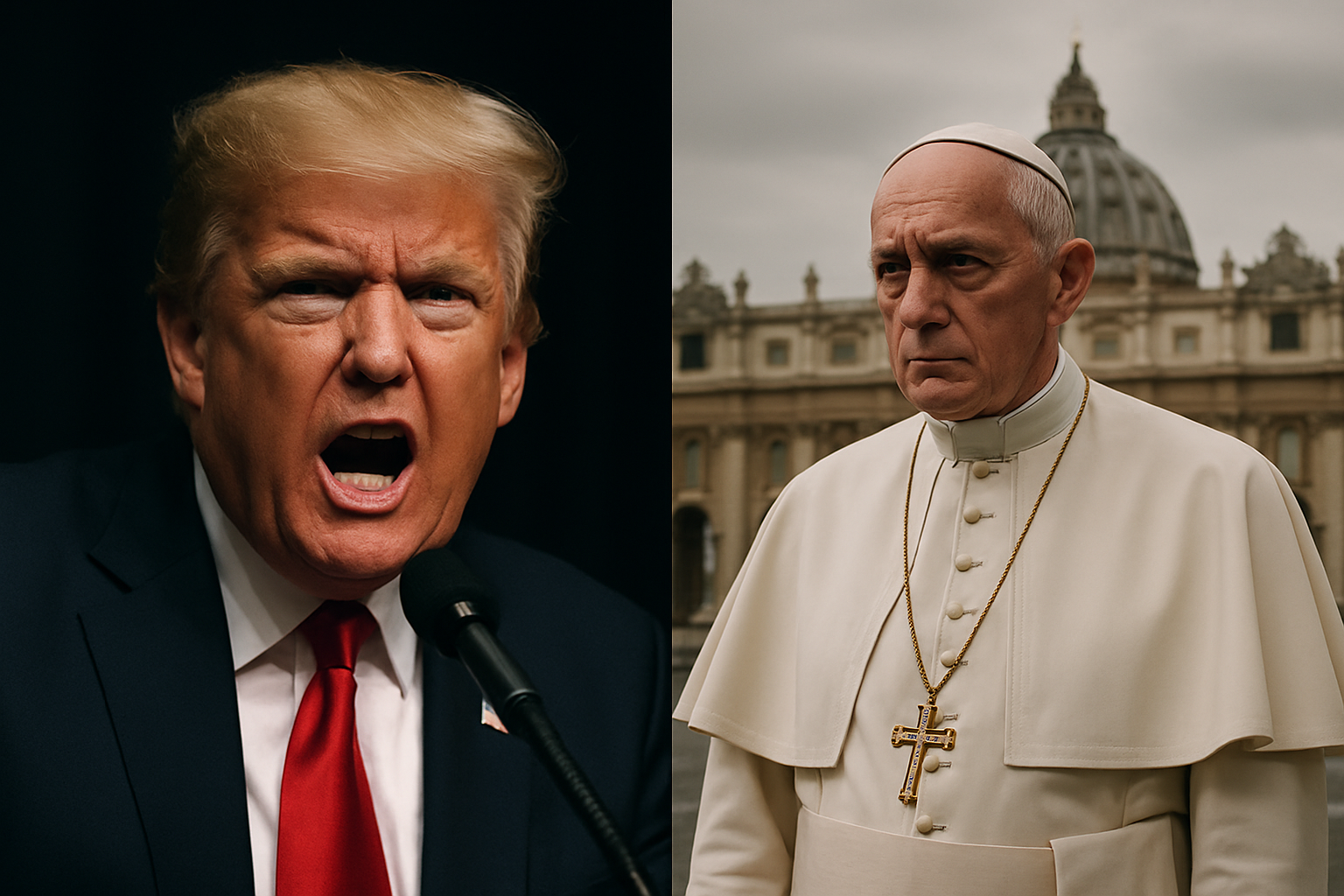
President Donald Trump launched an extraordinary attack on Pope Leo XIV via social media Sunday evening, calling the Chicago-born pontiff "weak on crime" and "terrible for foreign policy" after the Pope condemned Trump's apocalyptic threats against Iran as "truly unacceptable."
The unprecedented assault on the leader of the Catholic Church represents the starkest turnaround in Trump's relationship with Pope Leo XIV, whom he once praised as "the first American pope" when Leo was elected in May 2025. The clash has escalated into the most serious confrontation between an American president and the Vatican in modern history.
Trump's Social Media Barrage
Writing on his Truth Social platform, Trump declared: "Pope Leo is WEAK on Crime, and terrible for Foreign Policy. I don't want a Pope who thinks it's OK for Iran to have a Nuclear Weapon." He further demanded that the Pope "stop catering to the Radical Left" and criticized him as "very liberal."
The attack came just hours after Pope Leo XIV delivered his strongest condemnation yet of the ongoing Iran crisis, calling Trump's threat that "a whole civilisation will die tonight" a violation of international law. The Pope's intervention marked a dramatic escalation in his criticism of the administration's Middle East policy.
"This is our God: Jesus, King of Peace, who rejects war, whom no one can use to justify war. [Jesus] does not listen to the prayers of those who wage war, but rejects them, saying: 'Even though you make many prayers, I will not listen: your hands are full of blood.'"
— Pope Leo XIV, Palm Sunday Mass
From Praise to Unprecedented Criticism
The relationship between Trump and Pope Leo XIV began with great fanfare. When Cardinal William Levada of Chicago was elected as Pope Leo XIV in May 2025, Trump enthusiastically hailed him as a historic figure, emphasizing the significance of having the first American-born pontiff in Catholic history.
However, tensions began mounting as Pope Leo XIV increasingly criticized the administration's Iran policy. The Pope's Easter peace vigil in April 2026 marked a turning point, where he condemned the "delusion of omnipotence" fueling the US-Israeli war in Iran. His subsequent Palm Sunday message, declaring that God rejects the prayers of leaders with "hands full of blood," represented his most direct challenge to Trump's military approach.
The Iran Crisis Context
The papal criticism comes amid the most dangerous international crisis since the Cold War. Trump's Iran policy has evolved from nuclear negotiations to explicit regime change advocacy, with the president demanding Iran's "unconditional surrender" and claiming the right to "personally choose" the next Iranian Supreme Leader.
The crisis has seen unprecedented military escalation, with dual-carrier deployments representing the largest US Middle East naval presence since 2003. Operation Epic Fury has cost $11.3 billion in its first week alone, with 150 US troops wounded and 3 killed. The conflict has disrupted global energy markets, with oil prices surging past $100 per barrel as Iran closed the Strait of Hormuz, affecting 40% of global oil transit.
Pope Leo XIV's peace advocacy has consistently challenged this military approach. His Easter intervention established what Vatican experts call a "template-setting papal engagement" that prioritizes moral authority over diplomatic comfort in addressing global crises.
International Religious Freedom Implications
The Pope's criticism extends beyond the Iran conflict to broader concerns about religious freedom during wartime. The Vatican strongly condemned Israeli restrictions on Christian access to the Church of the Holy Sepulchre during Palm Sunday - the first such restrictions in centuries - which affected 2.4 billion Christians during Holy Week and 2 billion Muslims during Ramadan simultaneously.
Vatican sources indicate that Pope Leo XIV's approach represents a fundamental shift toward direct moral challenges of world leaders who claim divine justification for warfare, marking an evolution from traditional diplomatic protocols.
Global Catholic Response
The confrontation has sent shockwaves through the global Catholic community. Multiple European leaders, including French President Macron and Italian PM Meloni, have defended the Pope's right to speak on matters of war and peace. Eight Arab nations issued a joint statement supporting the Vatican's position on religious freedom protections.
Trump's attack on Pope Leo XIV is particularly significant given that the pontiff leads 1.4 billion Catholics worldwide. The President's criticism of the first American pope creates complex dynamics for Catholic voters in the United States, many of whom supported Trump in previous elections.
Unprecedented Diplomatic Crisis
Vatican experts describe Trump's public attack on the Pope as unprecedented in modern diplomatic history. The assault goes beyond traditional disagreements between secular and religious leaders, representing what one Vatican official called "a fundamental challenge to the Church's moral authority in international affairs."
The timing is particularly sensitive, as Pope Leo XIV is scheduled for a historic Africa tour from April 13-23, including the first papal visit to Algeria in Catholic history. The tour is designed to promote Catholic-Muslim dialogue during a period when religious communities worldwide are calling for peace in the Middle East.
Congressional and International Reactions
The Pope's position has found support among some members of Congress, with Democratic leaders issuing a joint statement calling for "patriotic duty over party loyalty" to end the Iran crisis. Senator Chuck Schumer described Trump as "extremely sick" for his apocalyptic threats against Iranian civilization.
Internationally, the Pope's stance aligns with widespread global condemnation of the Iran crisis. UN Secretary-General António Guterres called it "the greatest test of multilateral cooperation in the modern era," while China and Russia have condemned what they term "reckless actions" by Washington.
The Nuclear Dimension
Pope Leo XIV's criticism gains particular urgency given the nuclear dimensions of the Iran crisis. Iran continues enriching uranium to 60% purity, approaching weapons-grade levels, while the crisis unfolds amid the expiration of the New START treaty - leaving the world without US-Russia nuclear constraints for the first time in over 50 years.
The Vatican has consistently advocated for nuclear disarmament, and Pope Leo XIV's intervention represents what experts call a critical test of whether ancient spiritual traditions can provide contemporary guidance for a world facing nuclear threats.
Looking Ahead
The clash between Trump and Pope Leo XIV occurs at a pivotal moment in international relations. With Pakistan attempting to mediate between the US and Iran, and global energy markets in turmoil, the Pope's moral authority could prove influential in ongoing diplomatic efforts.
Vatican sources indicate that Pope Leo XIV intends to continue his peace advocacy despite Trump's criticism, viewing his role as transcending political considerations. The Pope's upcoming Africa tour will provide additional opportunities to emphasize themes of peace and reconciliation.
As the Iran crisis continues to escalate, with potential ground invasion preparations and threats to expand the conflict, Pope Leo XIV's voice represents one of the few global moral authorities challenging the drift toward broader regional war. His willingness to directly confront American power marks a defining moment for Vatican diplomacy in the 21st century.
The unprecedented nature of Trump's attack on the first American pope raises fundamental questions about the relationship between political authority and moral leadership in an interconnected world facing existential challenges. Whether this confrontation leads to lasting damage in US-Vatican relations or ultimately strengthens the Church's prophetic voice remains to be seen.