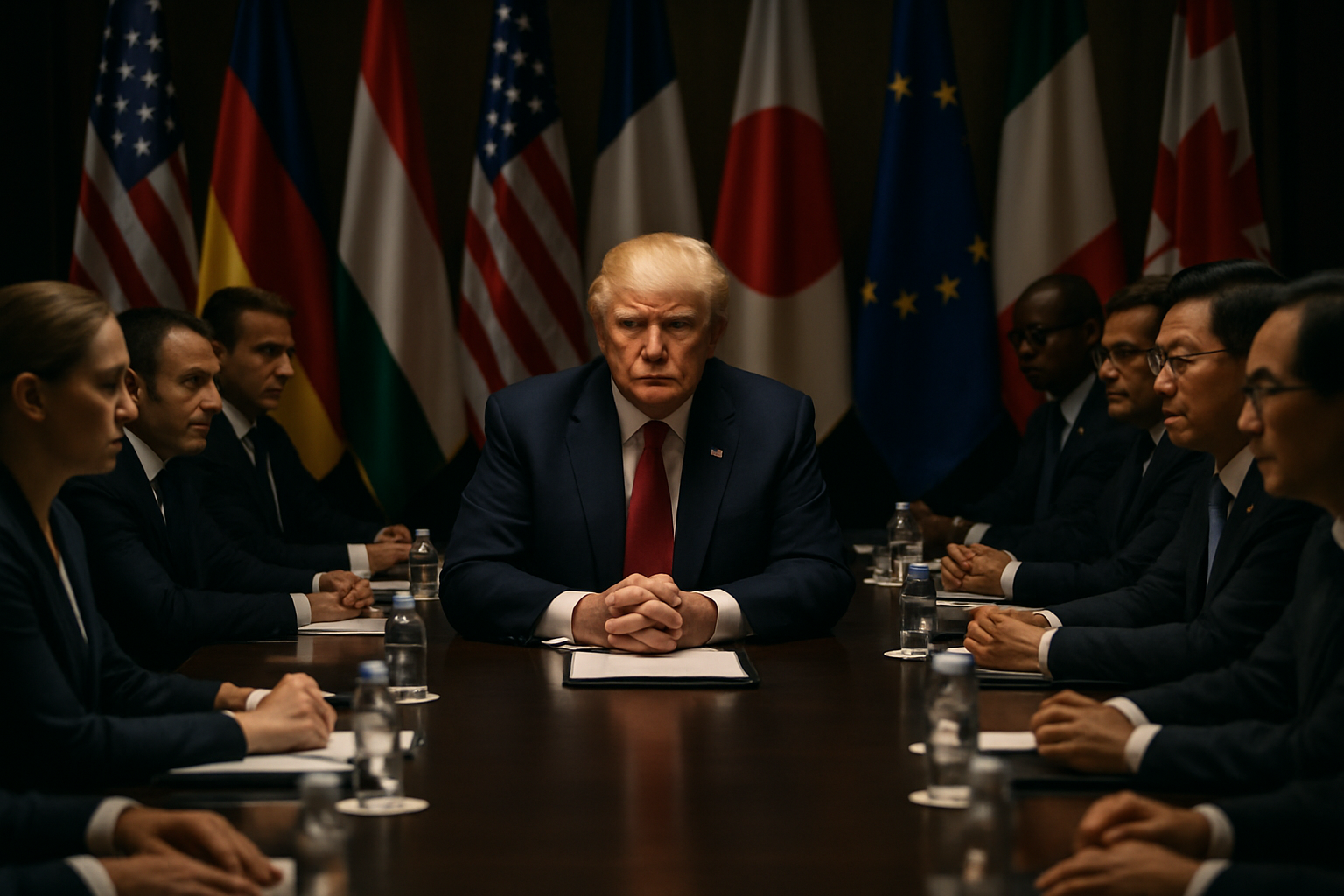
President Donald Trump announced a historic $17 billion international reconstruction package for Gaza at the inaugural meeting of his Board of Peace initiative, marking the largest financial commitment to the war-torn territory in history while simultaneously facing severe implementation challenges from ongoing violence and political deadlock.
The February 19, 2026 summit at the newly renamed Donald Trump Institute of Peace in Washington brought together 27 member nations in an unprecedented diplomatic gathering that Trump described as representing a "business approach" to conflict resolution, departing from traditional United Nations frameworks.
Record Financial Commitments Secured
Trump announced the United States would contribute $10 billion to Gaza reconstruction efforts, with an additional $7 billion pledged by member nations including Kazakhstan, Azerbaijan, the United Arab Emirates, Morocco, Bahrain, Qatar, Saudi Arabia, Uzbekistan, and Kuwait. The $17 billion total represents the largest international financial pledge to Gaza in history, dwarfing previous reconstruction efforts.
"Kazakhstan, Azerbaijan, the United Arab Emirates, Morocco, Bahrain, Qatar, Saudi Arabia, Uzbekistan, and Kuwait had jointly contributed more than $7 billion to the relief initiative," Trump said, describing the support as "fantastic."
— President Donald Trump, Board of Peace Meeting
Saudi Arabia's commitment emerged as particularly significant, with Minister of State for Foreign Affairs Adel Al-Jubeir announcing a $1 billion pledge while reaffirming the Kingdom's "long-standing commitment to achieving a just and lasting peace in the Middle East."
International Participation and Notable Absences
Key attendees at the summit included Hungarian Prime Minister Viktor Orbán, Pakistani Prime Minister Shehbaz Sharif, and observers from Italy (Prime Minister Giorgia Meloni), Cyprus (President Nikos Christodoulides), and Romania (President Nicușor Dan making his first U.S. visit).
However, several major powers declined participation, creating diplomatic rifts. Cardinal Pietro Parolin announced the Vatican would not participate, stating that "the UN should manage crisis situations." Mexico's President Claudia Sheinbaum declined citing Palestine recognition policy differences.
Most notably absent were major European powers Germany, France, and the United Kingdom, whose non-participation sparked what European officials described as being "up in arms" during ambassadorial meetings about the initiative's departure from established multilateral frameworks.
Systematic Ceasefire Violations Threaten Implementation
The ambitious reconstruction plans face immediate obstacles from deteriorating conditions on the ground. Gaza Government Media Office has documented over 1,600 systematic ceasefire violations since the October 2025 truce agreement, resulting in 573+ Palestinian deaths during what was supposed to be a peace period.
The total Gaza death toll has reached 71,800, with a recent Lancet Global Health study revealing casualties may be systematically undercounted by approximately 35%, suggesting actual deaths exceed 75,000 people.
"Where is the ceasefire?" questioned Dr. Mohamed Abu Selmiya, Director of Al-Shifa Hospital, highlighting the gap between diplomatic agreements and ground realities.
— Dr. Mohamed Abu Selmiya, Al-Shifa Hospital Director
The Rafah crossing, critical for humanitarian access, operates under severe restrictions with only 27 Palestinians crossing versus the agreed 200 daily quota. Hamas condemns what it terms "systematic harassment" by Israeli security, while 20,000 Palestinians await medical evacuation.
Hamas Rejects Disarmament Demands
Traditional reconstruction models requiring demilitarization face a fundamental challenge from Hamas leadership. Khaled Meshaal, in a February 8 statement from Doha, categorically rejected disarmament demands, declaring that "criminalizing resistance, weapons and those who carried it out" is unacceptable.
Meshaal maintained that armed resistance remains justified "while there is occupation," describing it as a fundamental right under international law. Israeli sources estimate Hamas retains approximately 20,000 fighters despite the ceasefire agreement.
This rejection of disarmament creates a critical implementation challenge, as international reconstruction efforts typically require stable security environments and demilitarized territories before major financial commitments can be deployed effectively.
Simultaneous West Bank Crisis Complicates Peace Efforts
The Board of Peace initiative faces additional complications from simultaneous developments in the West Bank, where the Israeli government approved the most comprehensive land registration since 1967. Finance Minister Bezalel Smotrich's proposal targets hundreds of thousands of dunams, particularly focusing on the strategically vital Jordan Valley.
Energy Minister Eli Cohen acknowledged the measures constitute "factual sovereignty" implementation, stating the steps will "establish reality on the ground that there will be no Palestinian state." This has prompted unprecedented international condemnation from 85 UN member states and eight Arab nations.
FIFA and Sports Diplomacy Component
In an innovative element, Trump announced that FIFA would contribute $75 million for Gaza reconstruction projects related to football infrastructure. FIFA President Gianni Infantino participated in the summit via video, detailing plans to construct 50 mini-football fields at approximately $50,000 per unit.
Trump addressed Infantino directly during the meeting: "You're doing fields and you're getting the best stars in the world to go there, people who are bigger than you and me."
The FIFA commitment represents $2.5 million in direct construction costs plus five larger facilities, demonstrating how sports diplomacy could play a role in reconstruction efforts while providing positive activities for Gaza's population, particularly youth affected by the prolonged conflict.
Military and Security Arrangements
The Board of Peace announced commitments for an International Stabilization Force, with five countries agreeing to deploy troops: Indonesia, Morocco, Kazakhstan, Kosovo, and Albania. Egypt and Jordan committed to training police forces as part of broader security arrangements.
US Major General Jasper Jeffers was appointed to lead initial International Stabilization Force deployment in Rafah, while Argentina offered to contribute its Cascos Blancos (White Helmets) peacekeeping forces to the mission.
These military commitments represent thousands of personnel dedicated to Gaza stabilization, though their effectiveness depends on achieving the security conditions that current ceasefire violations make problematic.
European Institutional Concerns
The Board of Peace initiative has sparked significant concern among European officials who worry about undermining established UN frameworks. EU Commissioner Dubravka Šuica's attendance without prior consultation with member state capitals created internal controversy.
Albania defended participation citing its "special relationship with the United States," while Lithuania called for EU consensus while raising "fundamental questions" about the initiative's approach to international law and institutional cooperation.
Over 400 EU diplomats have demanded increased pressure on Israeli authorities regarding ceasefire violations, while a European Left Coalition petition against EU-Israel partnerships has exceeded 400,000 signatures.
Iranian Nuclear Context
The Board of Peace meeting occurred against the backdrop of escalating tensions with Iran, as Trump simultaneously delivered a 10-day ultimatum regarding nuclear negotiations. The U.S. has deployed dual aircraft carriers (USS Gerald R. Ford and Abraham Lincoln) in the largest Middle East naval presence in years.
Iran continues uranium enrichment at 60% purity, approaching the 90% weapons-grade threshold, while maintaining that ballistic missiles and regional proxy activities remain "red lines" excluded from nuclear-only talks.
Business Diplomacy vs. Traditional Frameworks
Trump's "business approach" to conflict resolution represents a significant departure from traditional multilateral diplomacy. The initiative operates with Trump maintaining executive authority as chairman, designed to mobilize resources more quickly than UN frameworks while maintaining political unity among diverse member nations.
The approach builds on private sector models for project management and financing, emphasizing concrete deliverables and measurable outcomes rather than process-oriented diplomatic negotiations.
However, critics argue this undermines established international law mechanisms and could create problematic precedents for bypassing multilateral institutions in future conflict resolution efforts.
Implementation Challenges and Timeline
Despite the historic financial commitments, implementation faces severe challenges. Gaza's Civil Defense has completely shut down due to fuel shortages, hampering emergency response capabilities essential for large-scale reconstruction efforts.
The ongoing "systematic harassment" at border crossings, systematic ceasefire violations, and Hamas's rejection of disarmament create fundamental obstacles to deploying reconstruction resources safely and effectively.
International observers describe the situation as "systematic implementation failures" rather than isolated incidents, suggesting deeper structural problems that financial commitments alone cannot address without corresponding political and security arrangements.
Historical Context and Stakes
The Board of Peace initiative represents Trump's most ambitious foreign policy legacy project, occurring amid multiple global conflicts testing traditional diplomacy, including Ukraine-Russia negotiations and the expiration of the New START nuclear treaty.
Success could provide a template for 21st-century conflict resolution, demonstrating how leader-driven diplomacy and economic incentives can overcome deep-rooted political and security challenges.
However, failure could undermine confidence in alternative diplomatic approaches and potentially accelerate military solutions to complex global challenges, affecting international cooperation and global governance evolution in a multipolar world.
Regional and Global Implications
The unprecedented $17 billion commitment demonstrates substantial international confidence in Trump's initiative, but success depends on addressing fundamental obstacles that have perpetuated the Israeli-Palestinian conflict for decades.
The initiative's outcome will influence not only Middle Eastern stability but also serve as a test case for whether economic incentives and direct engagement can succeed where traditional institutional processes have struggled.
Eight Arab nations—Saudi Arabia, Jordan, Egypt, UAE, Qatar, Indonesia, Pakistan, and Turkey—have issued joint condemnations of ongoing violations, representing unusual diplomatic consensus that could either support or undermine the Board of Peace depending on implementation success.
As the international community watches this unprecedented experiment in "business diplomacy," the stakes extend far beyond Gaza reconstruction to fundamental questions about international cooperation, conflict resolution mechanisms, and the effectiveness of leader-driven versus multilateral approaches in addressing 21st-century global challenges.