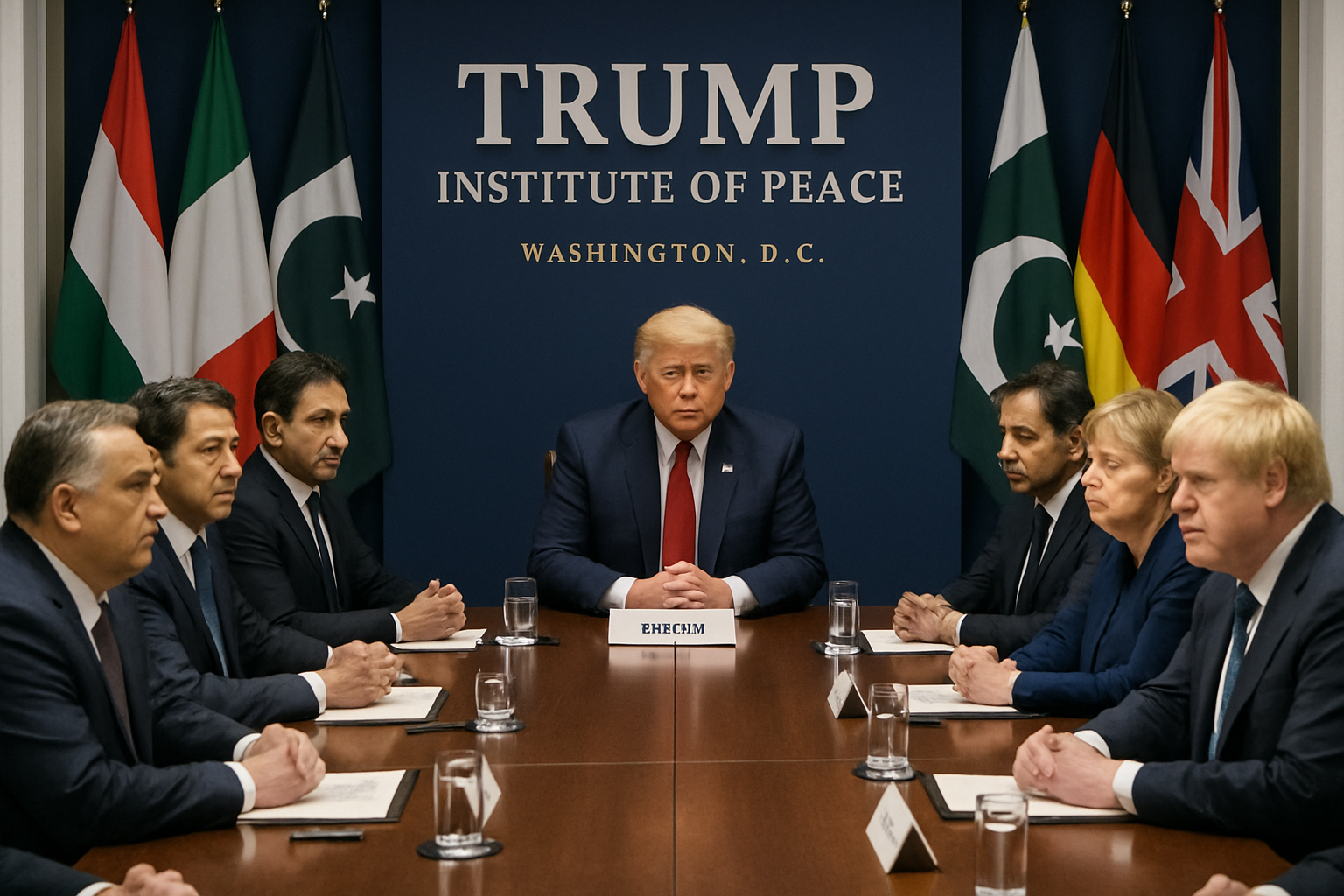
President Donald Trump convened the inaugural meeting of his Board of Peace on February 19, 2026, at the newly renamed Donald Trump Institute of Peace in Washington, bringing together 27 member nations who pledged over $5 billion for Gaza reconstruction despite mounting challenges from systematic ceasefire violations and Hamas's categorical rejection of disarmament.
The historic summit, attended by Hungarian Prime Minister Viktor Orbán, Pakistani Prime Minister Shehbaz Sharif, and observers from Italy, Cyprus, and Romania, represents Trump's ambitious "business approach" to conflict resolution that departs from traditional UN frameworks while maintaining presidential executive authority.
Unprecedented International Participation
The Board of Peace secured participation from 27 member nations, with thousands of personnel committed to an International Stabilization Force for Gaza deployment. Key attendees included Orbán, who confirmed his participation after direct invitation from Trump, and observers such as Italian Prime Minister Giorgia Meloni, Cyprus President Nikos Christodoulides, and Romanian President Nicușor Dan, who made his first U.S. visit to participate.
However, notable absences highlighted diplomatic divisions. The Vatican declined participation through Cardinal Pietro Parolin, who cited "critical issues" and emphasized that "the UN should manage crisis situations." Mexico's President Claudia Sheinbaum also declined, citing her country's Palestine recognition policy. Germany sent only an observer rather than Foreign Minister level representation.
Pakistan's participation proved particularly significant, with Prime Minister Shehbaz Sharif leading a high-level delegation including Deputy Prime Minister and Foreign Minister Ishaq Dar, Finance Minister Muhammad Aurangzeb, and other senior officials. However, Pakistani Defence Minister Asif emphasized that Israel recognition was "not on cards."
The Gaza Reconstruction Challenge
The Board's primary mission faces severe obstacles on the ground. Gaza Government Media Office has documented over 1,600 systematic ceasefire violations since the October 10, 2025 truce, resulting in 573+ Palestinian deaths during the supposed peace period. The total Gaza death toll has reached 71,800.
Hamas spokesman Hazem Qassem issued a stark warning during the summit, stating that "the war of genocide against the Strip is still ongoing – through killing, displacement, siege, and starvation – which has not stopped until this very moment." More than 600 Palestinians have been killed by Israeli forces in Gaza since the ceasefire deal began, according to the Hamas-run health ministry.
"We call for lifting the siege on Gaza and opening the crossings, and not being content with the partial and minimal opening."
— Hazem Qassem, Hamas Spokesman
The Rafah crossing remains severely restricted, with only 27 Palestinians crossing versus the promised 200 daily quota. Hamas has condemned what it terms "systematic harassment" by Israeli security forces, who have denied passage to 38 of 50 planned returnees. An estimated 20,000 Palestinians still await medical evacuation.
Hamas Rejects Disarmament Demands
A fundamental obstacle to traditional post-conflict reconstruction emerged from Hamas leader Khaled Meshaal's categorical rejection of disarmament demands during a February 8 statement in Doha. Meshaal declared that "criminalizing resistance, weapons and those who carried it out" is unacceptable, arguing that armed resistance remains justified "while there is occupation."
Israeli sources estimate Hamas maintains approximately 20,000 fighters despite the ceasefire, creating a significant challenge to international reconstruction models that typically require demilitarization. This positions Hamas's stance as fundamentally at odds with donor nations' expectations for traditional peace-building frameworks.
West Bank Crisis Complicates Peace Efforts
The Board of Peace initiative faces additional complications from Israel's most comprehensive West Bank land registration since 1967. Finance Minister Bezalel Smotrich has declared that policies will "continue to kill the idea of a Palestinian state," while Energy Minister Eli Cohen acknowledged the measures constitute "factual sovereignty" implementation designed to "establish reality on the ground that there will be no Palestinian state."
This territorial expansion has drawn unprecedented international condemnation from 85 UN member states, including eight Arab nations (Saudi Arabia, Jordan, Egypt, UAE, Qatar, Indonesia, Pakistan, Turkey) who issued a joint statement calling the measures violations of international law "aimed at imposing unlawful Israeli sovereignty."
Business Diplomacy Versus Traditional Frameworks
Trump's Board of Peace represents a deliberate departure from multilateral UN frameworks, with the president maintaining executive authority as chairman. This "business approach" to conflict resolution aims to mobilize resources more effectively than traditional institutions, but European officials have privately expressed concerns about undermining established international frameworks.
The initiative coincides with multiple global diplomatic challenges, including Iran-US nuclear talks, Ukraine-Russia negotiations with a June 2026 deadline, and the expiration of the New START treaty – the first time in over 50 years that the U.S. and Russia lack nuclear arms control constraints.
Regional and International Responses
The Board faces mixed international reception. Albania has defended its participation citing a "special relationship with the U.S.," while Lithuania has raised "fundamental questions" about the initiative. The EU lacks a unified position, reflecting broader divisions over whether to embrace diplomatic innovation or maintain traditional multilateral approaches.
Eight Arab nations have previously condemned Israeli ceasefire violations, with over 400 EU diplomats calling for increased pressure on Israeli authorities. A European Left Coalition petition against EU-Israel partnerships has exceeded 400,000 signatures, demonstrating significant public opposition to current policies.
Critical Implementation Challenges
The Board's success depends on addressing fundamental obstacles that have perpetuated the conflict for decades. Traditional reconstruction requires stable security environments and demilitarization – conditions currently absent given ongoing violations and Hamas's armed resistance philosophy.
Gaza Civil Defense has completely shut down due to fuel shortages, hampering emergency response capabilities. The humanitarian crisis continues to deepen, with systematic implementation failures rather than isolated incidents characterizing ceasefire compliance.
Strategic Implications for 21st Century Diplomacy
The February 19 summit represents a critical test of whether leader-driven formats can mobilize resources more effectively than traditional institutions. Success could provide a template for 21st-century conflict resolution, while failure may undermine confidence in alternative diplomatic approaches.
The stakes extend far beyond Gaza to fundamental questions about international cooperation and global governance evolution. The initiative tests whether economic incentives and direct engagement can overcome deep-rooted political and security challenges that have defied resolution through institutional processes.
"This is a historic moment that will determine whether innovative diplomacy can succeed where traditional frameworks have struggled."
— Senior Diplomatic Observer
Looking Forward
The Board of Peace initiative faces an immediate test of its effectiveness amid systematic ceasefire violations, territorial expansion, and resistance to demilitarization. The unprecedented $5 billion commitment demonstrates substantial international confidence, but success depends on addressing the underlying obstacles that have perpetuated conflict for decades.
World leaders are watching closely whether Trump's business-oriented approach to diplomacy can achieve breakthroughs where multilateral frameworks have struggled. The coming weeks will prove decisive in determining whether this diplomatic innovation can translate financial commitments into sustainable peace or whether fundamental political and security challenges will continue to defy resolution.
The summit's legacy will likely influence approaches to international cooperation well beyond the current administration, potentially reshaping how the global community addresses complex territorial disputes and conflict resolution in an increasingly multipolar world.